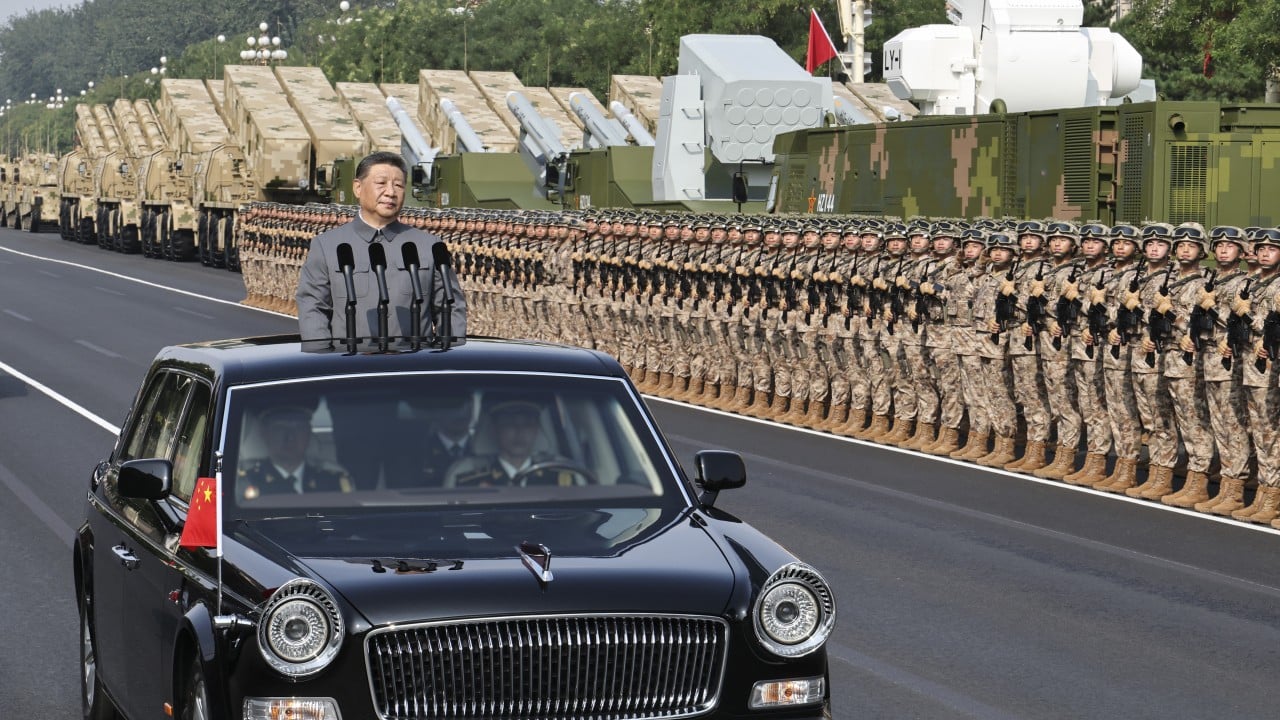
Western intelligence agencies and mainstream media are currently obsessing over a ghost. They look at the People’s Liberation Army (PLA) elite attending intensive ideological training camps in Beijing, listening to endless lectures on Xi Jinping Thought, and they see a military paralyzed by dogmatic communism. They see weakness. They see a return to Mao-era political purges that prioritize red over expert.
They are dead wrong.
The lazy consensus among defense analysts is that every hour a Chinese general spends reading political theory is an hour stolen from operational training. They view these ideological camps as an administrative tax, a loyalty test designed solely to prevent coups. This perspective assumes that ideological alignment and high-tech warfighting capability are mutually exclusive.
In reality, these sessions are not about dogmatic brainwashing. They are about building structural alignment for a highly decentralized, algorithmic style of warfare that the West is completely unprepared to face.
The False Dichotomy of Political Loyalty vs. Military Skill
For decades, the standard Pentagon playbook has separated military professionalism from political indoctrination. When Western commentators read reports about the PLA Top Brass studying Xi’s speeches at the National Defence University, they mock it. They assume it produces rigid commanders who are too terrified of political commissars to make split-second decisions on the battlefield.
I have spent fifteen years analyzing East Asian security architectures, tracking command-and-control changes, and interviewing former defense officials. The analysts who think these camps create tactical rigidity are projecting their own bureaucratic structures onto an entirely different entity.
The PLA has never been a national army in the Western sense; it is a party-army. That is an old truth, but the modern application is entirely new. Xi's ideological push is not a retreat into the 1960s. It is a prerequisite for executing Systems Destruction Warfare—the PLA's core doctrine of winning wars by crippling an enemy’s operational systems rather than just destroying their physical assets.
To execute this, you cannot have rogue commanders acting on independent impulses. You need absolute cognitive synchronization. The camps do not teach Marxist theory to replace military strategy; they use ideological uniformity as a protocol to ensure that thousands of disparate, autonomous units act as a single organism when the network goes dark.
The Algorithmic Army: Why Ideology is Infrastructure
To understand why the mainstream narrative is flawed, look at how modern command systems operate. The PLA is betting heavily on intelligentized warfare—using artificial intelligence, autonomous swarms, and cyber operations to overwhelm adversaries.
Imagine a scenario where a conflict breaks out in the Taiwan Strait. Communications are jammed within the first three minutes. Satellite links are severed. Cyber attacks render centralized command tables useless. In Western doctrine, this is where mission command kicks in: lower-level officers exercise independent initiative based on their commander’s intent.
But the PLA operates on a different premise. They know independent initiative without absolute philosophical alignment leads to fragmentation.
The ideological training camps are designed to embed a permanent, unchanging operating system into the brains of the top brass. When a Chinese general is cut off from Beijing, the goal is for him to know exactly what the center wants, not because he received a digital order, but because his mental framework has been calibrated to match Xi’s strategic calculus perfectly. Ideology is functioning as software. It is the ultimate redundancy network.
The True Mechanics of the PLA Training Camps
- Strategic Uniformity: Eradicating regional biases and factionalism within different military branches (Rocket Force vs. Navy).
- Data-Centric Prioritization: Aligning the military’s leadership with China’s broader national tech initiatives, ensuring commanders prioritize digital infrastructure over legacy hardware.
- Civil-Military Integration: Forcing military leaders to understand civilian economic goals, so kinetic actions directly serve economic coercion strategies.
Addressing the Flawed Premises of Western Observers
When you look at the queries dominating defense forums, the same anxious, misdirected questions appear repeatedly. Let's dismantle them.
Do these ideological purges degrade the PLA's combat readiness?
This question assumes that removing corrupt or ideologically stray officers damages military effectiveness. The opposite is true. The current crackdowns within the PLA Rocket Force, often tied to these ideological camps, are viewed by the West as a sign of inner turmoil.
Let's be blunt: cleansing an officer corps of individuals who view military procurement as a personal get-rich-scheme does not degrade readiness; it restores it. The training camps are the filtering mechanism. If a commander cannot survive the intellectual rigor of a three-month ideological crucible, he is not trusted to manage the keys to a hypersonic missile regiment.
Can a military obsessed with political compliance foster innovation?
This is the ultimate Western cope. The theory goes that because China stifles political dissent, its engineers and military theorists cannot innovate.
Look at the data. China is currently leading global deployment in hypersonic glide vehicles, quantum encryption, and naval shipbuilding capacity. The innovation isn't happening despite the political control; it is happening because of the state's ability to ruthlessly direct capital and human talent toward singular strategic goals without waiting for congressional approval or quarterly earnings reports.
The ideological camps ensure the military leadership does not fight the state's technological directives. They create a unified demand signal for specific, asymmetric technologies.
The Real Vulnerability of the Ideological Model
The contrarian view demands total honesty: this system has a massive, glaring vulnerability, but it is not the one Western media likes to talk about.
The risk is not that Chinese generals will be incompetent; the risk is systemic confirmation bias.
When you train an entire elite leadership tier to view geopolitical realities through a singular ideological lens, you eliminate the healthy friction that prevents strategic blunders. If the worldview taught in Beijing asserts that Western democracies are in terminal, irreversible decay, every piece of intelligence will be filtered to support that thesis.
I’ve watched Western corporate boards fall into this exact trap, spending billions on bad acquisitions because no one wanted to tell the CEO his core thesis was wrong. On a geopolitical scale, if the PLA’s top brass genuinely believes their own ideological rhetoric about Western weakness, they are highly likely to miscalculate the resolve of their adversaries. This increases the probability of an accidental escalation. They won't lose a war because they spent too much time reading books; they will start a war because they believed what those books said about their opponent's cowardice.
Stop Looking at the Text; Look at the Architecture
If you want to understand the modern Chinese military, stop evaluating it by Western liberal standards. The PLA does not care if you think their political lectures are boring or archaic.
Every time a Western defense intellectual writes an article laughing at Chinese generals sitting in a classroom taking notes on speeches, a strategic blind spot grows wider. Those classrooms are where the software of the next major conflict is being compiled.
The goal isn't to turn soldiers into monks. The goal is to build an officer corps that executes state policy with the cold, predictable precision of an algorithm. While the West debates adaptive leadership styles and decentralization, China is optimizing for total ideological integration.
Assuming your opponent is stupid because they read different books than you is the fastest way to lose a war. Stop analyzing the speeches. Start preparing for the unified machine they are building.