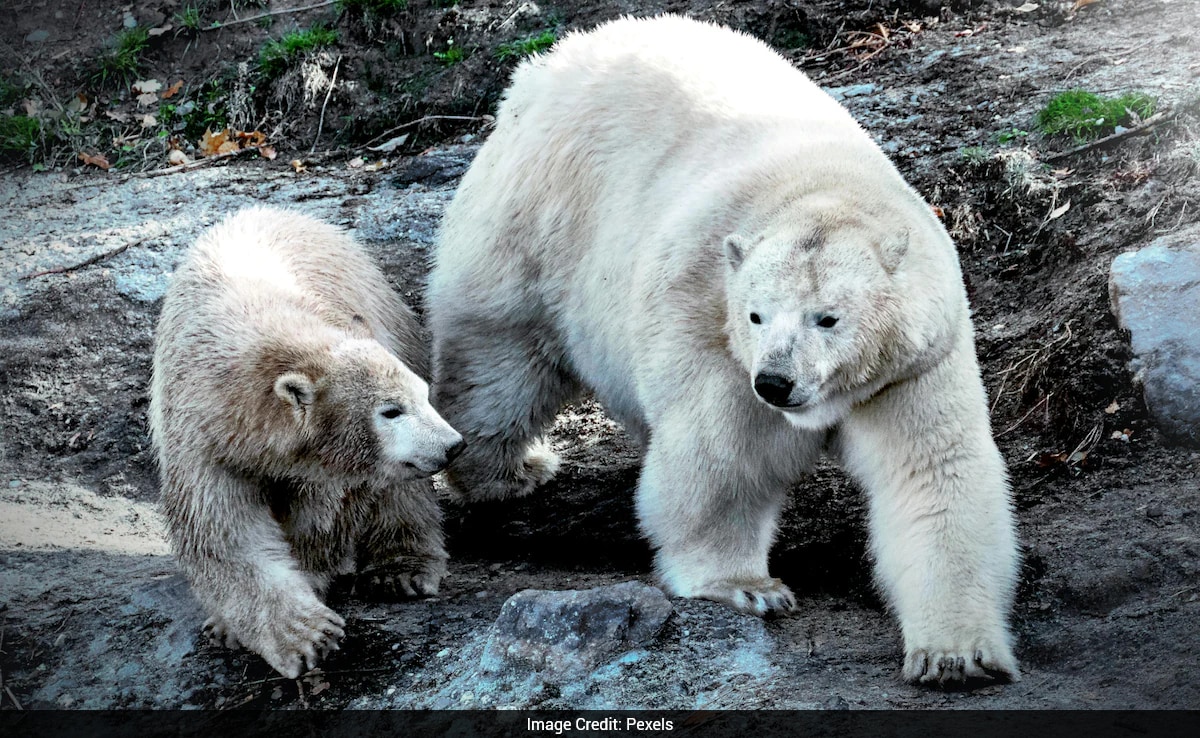
The wind on the Svalbard archipelago doesn't just blow; it carves. It is a place of sharp edges, ancient ice, and a silence so profound it feels heavy. Here, halfway between mainland Norway and the North Pole, the apex predator—the polar bear—has reigned for millennia. But in late 2023, the silence was broken by a discovery that signaled a terrifying shift in the natural order. A carcass was found near Longyearbyen. It wasn't the result of a hunter’s bullet or the slow, hollow ache of starvation.
This bear died from Highly Pathogenic Avian Influenza (HPAI). Specifically, the H5N1 strain.
It is the first time in history that bird flu has been documented in a polar bear in Europe. While a single death in the high Arctic might seem distant from the bustling streets of Oslo, London, or New York, it represents a bridge being crossed. It is a warning written in the snow.
The Hunger that Invited the Fever
Imagine a bear we will call Nanuk. Nanuk is a creature of immense power, a thousand pounds of muscle and ivory fur designed for one thing: survival in an environment that wants everything dead. For months, the sea ice has been his hunting ground. But the ice is fickle now. It thins earlier; it retreats further. Nanuk is forced onto the rocky shores, where the pickings are slim.
He finds a carcass. A glaucous gull, perhaps, or a migrating goose that fell from the sky. To a starving bear, this isn't just a meal; it's a lifeline. But the bird died because its nervous system was being shredded by H5N1. When Nanuk consumes the bird, he isn't just taking in calories. He is inhaling a pathogen that has spent the last few years perfecting its ability to jump between species.
This isn't a hypothetical fear. This is the reality of how the virus moves. Scientists from the Norwegian Polar Institute and the Norwegian Veterinary Institute confirmed that the bear succumbed to the virus after likely scavenging on infected carcasses. The virus, which we once thought was the exclusive burden of poultry and wild birds, has found a new, mammalian host in one of the most remote corners of the planet.
A Virus Without Borders
We often talk about viruses as if they have intent. They don't. They have math.
$R_0$—the basic reproduction number—tells us how many people one sick person will infect. But in the wild, the math is more chaotic. H5N1 has been sweeping through bird populations with a lethality that is hard to comprehend. Millions of birds have perished. From the beaches of South America to the cliffs of the Arctic, the sky is literally falling.
The danger lies in the "spillover." Every time the virus moves from a bird to a mammal—a fox, a seal, a grizzly, and now a polar bear—it undergoes a high-stakes lottery of mutation. It is searching for the right genetic key to unlock the mammalian respiratory system. The more mammals it infects, the more chances it has to win that lottery.
The bear in Svalbard is a sentinel. It tells us that no ecosystem is isolated. The "invisible stakes" here aren't just about the conservation of a majestic species, though that is a tragedy in itself. The stakes are about the proximity of this virus to the human frontier. When a virus proves it can thrive in the harsh biology of a polar bear, it proves it is adaptable. It is resilient. It is patient.
The Fragility of the Far North
We have a tendency to view the Arctic as a pristine, frozen vault. We think of it as a place where the problems of the "lower world" cannot reach. But the Arctic is actually a funnel. Migratory paths from every continent converge there. A bird that spent its spring in a crowded European wetland might spend its summer on a cliffside in Svalbard.
The local authorities in Longyearbyen now face a surreal challenge. They are used to managing the risk of bear encounters with fences and flare guns. Now, they must manage a microscopic threat. The death of this bear forced a grim realization: the biosecurity of the wilderness is a myth.
Consider the logistical nightmare of monitoring a disease in a place where the sun doesn't rise for months at a time. Researchers have to track these animals across shifting ice and through blinding drifts. They aren't just looking for tracks anymore; they are looking for signs of neurological distress—the telltale tremors and disorientation that H5N1 brings to its victims.
The Mirror in the Ice
Why does this matter to someone who will never see a polar bear outside of a documentary?
Because the bear is a mirror. The biological barriers that separate us from the wild are thinning. As climate change reshapes the planet, species are being pushed into new territories and into closer contact with one another. A bear scavenging a bird is a symptom of a world out of balance.
The Norwegian Veterinary Institute’s report isn't just a necropsy of an animal; it is a diagnostic report on our global environment. If the most secluded predator on earth can catch a "bird" flu, then our definitions of safety are outdated. We are living in an era of "One Health," a concept that recognizes that the health of humans, animals, and the environment is a single, tangled web. You cannot pull a thread in the Arctic without feeling the vibration in the tropics.
The Weight of the Silence
There is a specific kind of grief in knowing that the king of the north was brought down by something so small. It feels like a betrayal of the wild's integrity.
When the news broke, some reacted with clinical detachment. They looked at the spreadsheets of avian mortality and added one more tally under "Mammalian Cases." But those who live in the high north felt something else. A shudder. The polar bear is the symbol of endurance. To see it rendered vulnerable by a virus from a distant farm or a polluted marsh is a reminder that we have exported our ecological footprints to the very ends of the earth.
We are not bystanders in this story. Our global trade, our industrial farming, and our warming climate are the engines driving this viral expansion. The bear didn't just get sick. It was caught in the crossfire of a world moving too fast for its biology to keep up.
The carcass in Svalbard was eventually disposed of, the site disinfected as best as it could be in a land of permafrost. But the ghost of that bear remains. It lingers in the minds of the scientists who now scan the horizon with a new kind of dread. They are no longer just looking for the white shape of a predator; they are looking for the invisible drift of a fever.
The ice continues to groan and shift. The wind continues its tireless carving. Somewhere out there, another bear is walking across the frozen crust, searching for a meal, unaware that the sky above it is no longer just a source of light, but a carrier of a quiet, relentless end. The silence of the Arctic has never felt more fragile.


