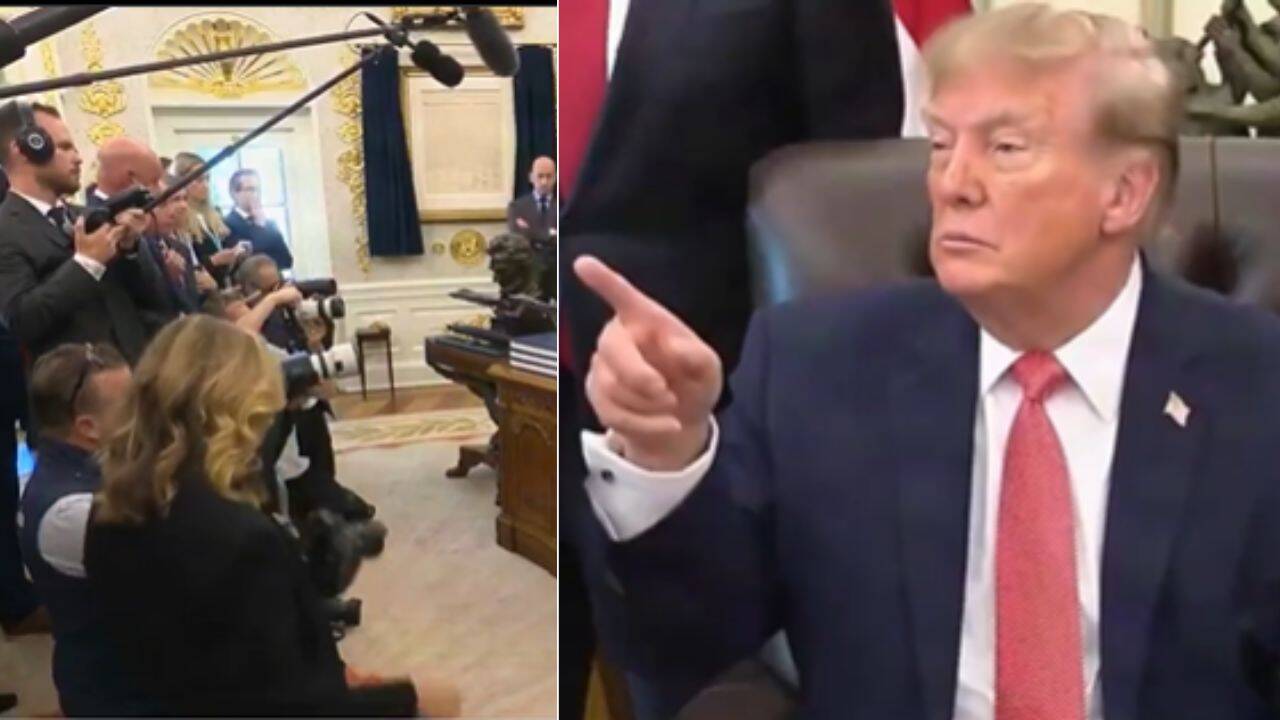
Standard clip-and-quote journalism treats a viral Oval Office clash as an isolated outburst, missing the strategic incentives that turn personal insults into political leverage. When US President Donald Trump told The Independent reporter Andrew Feinberg to be quiet and asked, "Are you a sick person?" during an October 2026 event tied to a fraud whistleblower initiative and questions over East Potomac Park golf course changes, conventional coverage stopped at the spectacle. A rigorous breakdown separates what happened on camera from the underlying mechanics of attention economics, institutional friction, and information control.
To outclass reactive commentary, we have to map the underlying logic of that coverage and rebuild the analysis around four analytical pillars: The Attention Arbitrage Model, The Institutional Gatekeeping Cost Function, The Topic-Shift Mechanism, and The Verification Boundary. Each pillar shows where surface-level reporting leaves analytical value on the table.
Deconstructing the Competitor's Logic
Typical wire-style and video-led pieces built around a headline like "Quiet, quiet, are you a sick person?" Trumps snaps at reporter at White House; watch follow a predictable sequence:
- Lead with the clip hook. The opening pairs a dramatic verb ("snaps," "blasts," "erupts") with the most quotable line to maximize immediate click-through and video watch time.
- State the setting and minimal context. Readers learn the clash happened at the White House or in the Oval Office, often linked to a question about golf courses or a government announcement, without tracing why that pairing matters.
- Recount the exchange linearly. The narrative moves sentence by sentence—interruption, repeated orders to be quiet, personal question, reporter's reaction or social media follow-up—treating the dialogue as self-explanatory.
- Close with broad history. The piece ends by noting that clashes between the president and reporters happen frequently across terms, folding the specific moment into a generic pattern.
That structure is fast to read and easy to publish, yet it has three structural blind spots:
- Cause-and-effect compression. By treating the insult as the main event, the report obscures the shift in agenda control—the moment the subject moves from an announced policy or potential conflict of interest to the reporter's tone, credibility, or sanity.
- Asymmetric framing of escalation. When Vice President JD Vance or surrogates weigh in online after an exchange, standard reporting logs the post as extra color rather than measuring how cross-platform amplification converts a brief room exchange into a multi-day news cycle.
- Unexamined evidentiary limits. Short reports rarely separate verified video and audio from unverified claims about motives, tax implications, or legal doctrines like the False Claims Act.
The Attention Arbitrage Model
In modern political media, a public confrontation operates like an attention arbitrage market. The principal (here, the president speaking before cameras) holds high baseline reach; the challenger (a reporter asking an unscripted question) holds access to a specific institutional platform and a newsroom distribution channel.
When a sharp personal rebuke occurs on camera, three effects happen simultaneously:
- Salience transfer. Audience focus shifts from the underlying policy or property question—such as public park redevelopment or fraud enforcement rules—to the interpersonal clash itself.
- Clip portability. Short, punchy exchanges travel across short-form video feeds and social platforms far faster than nuanced explanations of procurement, park leases, or statutory scope.
- Polarized reinforcement. Supporters read the rebuke as toughness against a hostile press, while critics read it as intimidation or poor temperament, locking in existing priors rather than changing minds.
Consider a practical operational comparison. Suppose a press briefing features a forty-minute policy rollout followed by a twenty-second confrontation. A newsroom algorithm and social feed routinely reward the twenty-second clip because anger and conflict generate higher engagement per second than technical policy detail. The first limitation of this model is that we do not have exact platform-level retention or impression numbers from a single public event; what we observe is the mechanism by which high-emotion segments outperform procedural reporting in distribution.
Why Personal Rebuke Outperforms Policy Rebuttal
A dry rebuttal ("That characterization of the project is inaccurate") rarely travels outside specialist circles. A personal challenge ("Are you a sick person?") creates an instant narrative frame with a villain, a victim, and a punchline. From a communications standpoint, turning a substantive question into a character test forces the reporter onto the defensive—even when the reporter answers calmly or posts a retort online afterward.
The Institutional Gatekeeping Cost Function
White House press interactions sit inside a tight institutional constraint set. Unlike a live call-in show or a town hall with open microphones, Oval Office and briefing-room exchanges are governed by physical proximity, camera pools, and time limits.
Every participant faces a distinct cost function:
- The officeholder's cost. Interrupting or insulting a reporter risks alienating swing observers who dislike hostility toward journalists, yet it carries low short-term cost among loyalists and captures headline dominance.
- The reporter's cost. Pushing a sharp question about personal business interests or public land use can trigger an immediate shut-down, a loss of follow-up time, or online pile-ons from officials and partisans, while backing down forfeits accountability.
- The editor's cost. Publishing a dry summary of the exchange risks losing traffic to faster outlets running the video clip, whereas publishing only the insult drowns out the substance behind the question.
This cost structure explains why escalation is rational for an executive seeking narrative control. Cutting off a line of inquiry before the full question lands prevents the premise from sitting cleanly in the broadcast record. At the same time, overusing harsh personal attacks has diminishing returns over years in office: audiences habituate to familiar friction, reducing shock value while keeping baseline hostility elevated.
The Topic-Shift Mechanism
Look closely at what happens right before and right after a snap response in an official setting. In the October 2026 Oval Office exchange, the event involved a fraud whistleblower incentive announcement while a reporter began raising questions connected to golf courses and public park changes, followed by commentary from Vance touching on dishonesty and the False Claims Act.
A rigorous analyst tracks four stages of a topic shift rather than stopping at the quote:
- Triggering premise. The reporter introduces an angle tied to potential conflicts of interest, public assets, or legal accountability.
- Preemptive interruption. The speaker cuts in early ("Wait, wait..." or "Quiet, quiet...") before the question reaches its core point.
- Ad hominem pivot. Rather than answering the substance—such as how public access or legal standards apply—the speaker questions the reporter's motives, identity, or mental fitness.
- Secondary reinforcement. Allies amplify the pivot outside the room, reframing the exchange as a test of loyalty or honesty rather than an unanswered question.
That four-stage sequence is a hypothesis about strategic effect, not proof of a scripted rehearsal. People lose temper spontaneously all the time. What matters analytically is that spontaneous anger and deliberate agenda control can produce the same downstream result: the original question gets buried under reaction to the tone.
The Verification Boundary and What People Also Ask
When readers encounter a viral headline about a White House clash, they typically want four things answered cleanly: what was actually said, what prompted it, whether any legal or factual claims raised in the exchange hold up, and what it changes in press-executive dynamics.
Sorting known facts from educated hypotheses keeps the analysis honest:
- Known facts: Video and contemporaneous accounts show a sharp back-and-forth in the White House involving Trump, reporter Andrew Feinberg, and subsequent remarks by Vance, centering on quiet commands, a question about being a "sick person," and topics spanning fraud enforcement, the False Claims Act, and golf course or park plans.
- Educated hypotheses: High-visibility clashes likely help keep base attention locked on the executive while discouraging follow-up depth in time-constrained settings, though exact shifts in public approval or newsroom behavior require longitudinal measurement beyond a single clip.
- Open evidentiary questions: Legal arguments about how fraud statutes apply to specific arrangements, or exact operational terms of park and course projects, require primary documents, statutory text, and contract records—not an inference drawn from a heated exchange.
Tactical Playbook For Reading And Covering Viral Clashes
If you manage a news desk, run communications, or simply want to read political news without getting played by outrage cycles, apply this five-step sequence whenever a confrontational clip goes viral:
- Pull the full unedited context first. Watch or read past the five-second clip to see what topic was on the table immediately before the interruption.
- Separate tone from substance. Log the personal insult in one column and the underlying policy, legal, or financial question in another so neither erases the other.
- Check secondary amplification. Note who piles on afterward—officials, surrogates, or partisan accounts—and whether they introduce new factual claims or only character attacks.
- Verify primary claims independently. Treat any passing reference to laws, audits, tax rules, or public contracts as a lead to check against official records rather than an established fact.
- Measure downstream policy impact. Ask whether the clash altered any decision, rule, or investigation, or merely consumed a day's attention budget.
None of these steps is a silver bullet. Media ecosystems still reward speed and conflict, and readers have finite time. Yet applying structured checks prevents a clever camera moment from substituting for real accountability—or from being misread as a constitutional crisis when it is really a familiar battle over the microphone.
Strategic Action For Editors And Analysts
Stop leading coverage with the insult when the underlying question touches public money, public land, or enforcement rules; open with the substantive question at issue, embed the exact exchange in context, and force every follow-up paragraph to answer what changed on the record. That single editorial shift denies pure spectacle the steering wheel while giving readers the facts they actually need to judge both the questioner and the answered—or unanswered—claim.
Watch the Oval Office confrontation clip
This video directly shows the Oval Office exchange where Trump tells the reporter to be quiet and asks if he is a sick person, letting you see the exact pacing and interruption dynamic analyzed above.