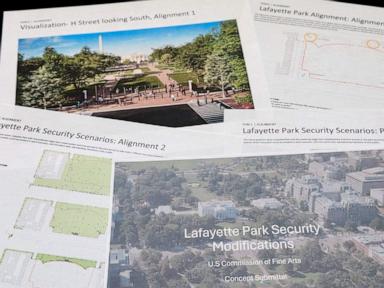
The federal government is building a medieval moat in the middle of Washington, D.C., and calling it modern security.
The National Capital Planning Commission, the Secret Service, and the National Park Service have spent years coordinating a massive security overhaul. Their solution to protect the Executive Mansion? A bigger, heavier 13-foot iron fence and a massive, permanent pedestrian screening center. Meanwhile, you can find similar stories here: The Cost of Spontaneity: Analyzing the Operational Friction of Vice Presidential Travel.
It is a classic bureaucratic reflex. When a system fails, double down on physical hardware. Build the wall higher. Make the checkpoint bigger.
But this heavy-handed approach is a dangerous delusion. To explore the bigger picture, check out the excellent report by NBC News.
The proposed White House security upgrades are not just an eyesore that ruins the aesthetic of Lafayette Square. They represent a fundamental misunderstanding of modern threat dynamics. By focusing on keeping physical bodies out with steel bars, the federal government is actively creating new vulnerabilities, wasting millions of dollars, and fighting a war that ended decades ago.
The Illusion of the Iron Curtain
Every time a fence-jumper makes it over the White House lawn, Congress panics. The media runs loops of a confused trespasser sprinting toward the North Portico. The immediate, lazy consensus is always the same: "The fence is too low."
But height is a psychological band-aid, not a structural solution.
For decades, physical security specialists have understood the concept of "delay time" versus "response time." A fence is not an impenetrable shield. It is a timer. A standard 13-foot iron fence delays an athletic, determined intruder by roughly eight to twelve seconds. If they have basic tools, a ladder, or a vehicle, that delay time drops significantly.
If your entire security posture relies on those extra four seconds of delay time provided by a slightly taller fence, your perimeter defense has already failed.
The Secret Service has a multi-layered security apparatus. It includes ground sensors, infrared cameras, K-9 units, and armed tactical teams. The physical fence is supposed to be the outermost, least critical layer. Elevating it to the center of the security strategy ignores the actual point of failure in historical breaches: human error, poor communication, and lagging response times.
When Omar Gonzalez successfully entered the White House in 2014, he did not succeed because the fence was too short. He succeeded because the alarm systems had been muted, the guard dog was not released, and the officers inside failed to coordinate. Adding five feet of iron to the perimeter does not fix a broken chain of command. It just hides it behind a taller wall.
The Bottleneck Trap: Creating Soft Targets
Perhaps the most misguided element of the new plan is the construction of a permanent visitor screening center.
The logic seems sound on paper: screen tourists before they get close to the actual structure. But this ignores a basic principle of counter-terrorism: threat displacement.
When you harden a target, you do not eliminate the threat. You shift it to the nearest vulnerable point. By building a massive, highly visible screening center outside the White House gates, the government is creating a dense, slow-moving bottleneck of tourists.
In security circles, we call this a "soft target."
Imagine a crowd of hundreds of tourists standing in a slow-moving line on a hot summer day, penned in by barriers, waiting to enter the screening facility. They are completely exposed to the open street. They are a sitting duck for a vehicle-ramming attack, a suicide bomber, or an active shooter.
We saw this exact vulnerability exploited at the Brussels Airport in 2016 and the Istanbul Atatürk Airport, where attackers targeted the crowds waiting outside the security checkpoints. The checkpoint itself becomes the hazard.
By pushing the security perimeter outward to protect the political elite inside the building, the state is effectively transferring the risk onto the civilian public standing on the sidewalk. It is a cowardly trade-off wrapped in the language of public safety.
Fighting 21st-Century Threats with 19th-Century Steel
The focus on physical barriers is a symptom of a deeper, systemic failure to adapt to modern threat vectors. The threats of today do not care about a 13-foot iron fence.
Consider the reality of modern consumer technology:
- Unmanned Aerial Vehicles (UAVs): A standard, off-the-shelf commercial drone carrying a pound of explosive payload can easily fly over a 13-foot fence. It can bypass every physical barrier on the ground in seconds.
- Cyber Infiltration: The modern presidency relies on heavily integrated communication networks, smart building systems, and digital databases. A hostile actor sitting in an apartment three miles away can do more damage to the administration by breaching a local network than fifty fence-jumpers could ever dream of doing.
- Insider Threats: The most catastrophic security breaches in modern history did not come from people scaling walls. They came from individuals who were cleared through the front gate with valid credentials.
Building taller fences to stop physical intruders is like locking your front door while leaving all your windows wide open. It is a performative display designed to show the public that "something is being done," while the real, complex vulnerabilities remain unaddressed.
Dismantling the "People Also Ask" Assumptions
To understand why the current approach is so flawed, we have to dismantle the basic assumptions the public—and the media—make about White House security.
"Why can't we just make the White House completely inaccessible to the public?"
Because doing so concedes defeat to the very forces of terror and chaos the state claims to oppose. The White House is not just an office building; it is a symbol of a democratic republic. It was designed to be open, visible, and integrated into the fabric of the nation's capital.
When you turn the People's House into an inaccessible military green zone, you signal to the world that your democratic institutions are fragile and terrified. The psychological cost of absolute physical security is the death of open democracy. If safety is the only metric that matters, the safest place for the President is a deep underground bunker in the mountains of Colorado. But we do not do that, because the symbol matters.
"Don't motion sensors and cameras make the fence effective?"
Only if the data they produce is acted upon instantly. The issue has never been a lack of technology. The White House perimeter is packed with some of the most sophisticated sensor arrays in the world.
The failure lies in the cognitive overload of the operators. When you have hundreds of sensors constantly flagging false positives—caused by wind, birds, stray animals, or tourist activity—alarm fatigue sets in. Security personnel begin to tune out the alerts. A taller fence does not reduce false positives; if anything, it increases the complexity of the sensor arrays, making the system more prone to failure.
The Hard Truth of Effective Security
True security is quiet, invisible, and highly intelligent. It does not rely on imposing iron bars that ruin historic landscapes.
If we want to actually secure the White House without turning it into a medieval fortress, we must shift our focus:
- Invest in Active, Predictive Intelligence: Stop trying to catch people at the fence. Focus on identifying and neutralizing threats before they ever reach Pennsylvania Avenue. This means better integration between local police, federal agencies, and behavioral threat assessment teams.
- Deploy Non-Lethal, Invisible Deterrents: Advanced microwave barriers, acoustic warning devices, and automated, non-lethal intercept systems can stop intruders in their tracks without requiring a single piece of iron.
- Redesign for Natural Surveillance: Use landscape architecture—strategic elevation changes, reinforced water features, and hardened, hidden bollards—to create natural barriers that blend into the environment instead of screaming "keep out."
The downside to this approach? It is incredibly difficult to pull off. It requires high-level coordination, continuous training, and a willingness to abandon the comfort of physical walls. It requires politicians to trust systems they cannot physically see or touch.
It is far easier to write a multi-million-dollar check for a bigger fence and call it a day. But lazy security is dangerous security.
Until we stop treating physical barriers as the ultimate solution to complex, asymmetrical threats, we will continue to spend millions of dollars building higher walls, only to find that the world has already moved past them. We are building a bigger cage, but we are leaving the door unlocked.


