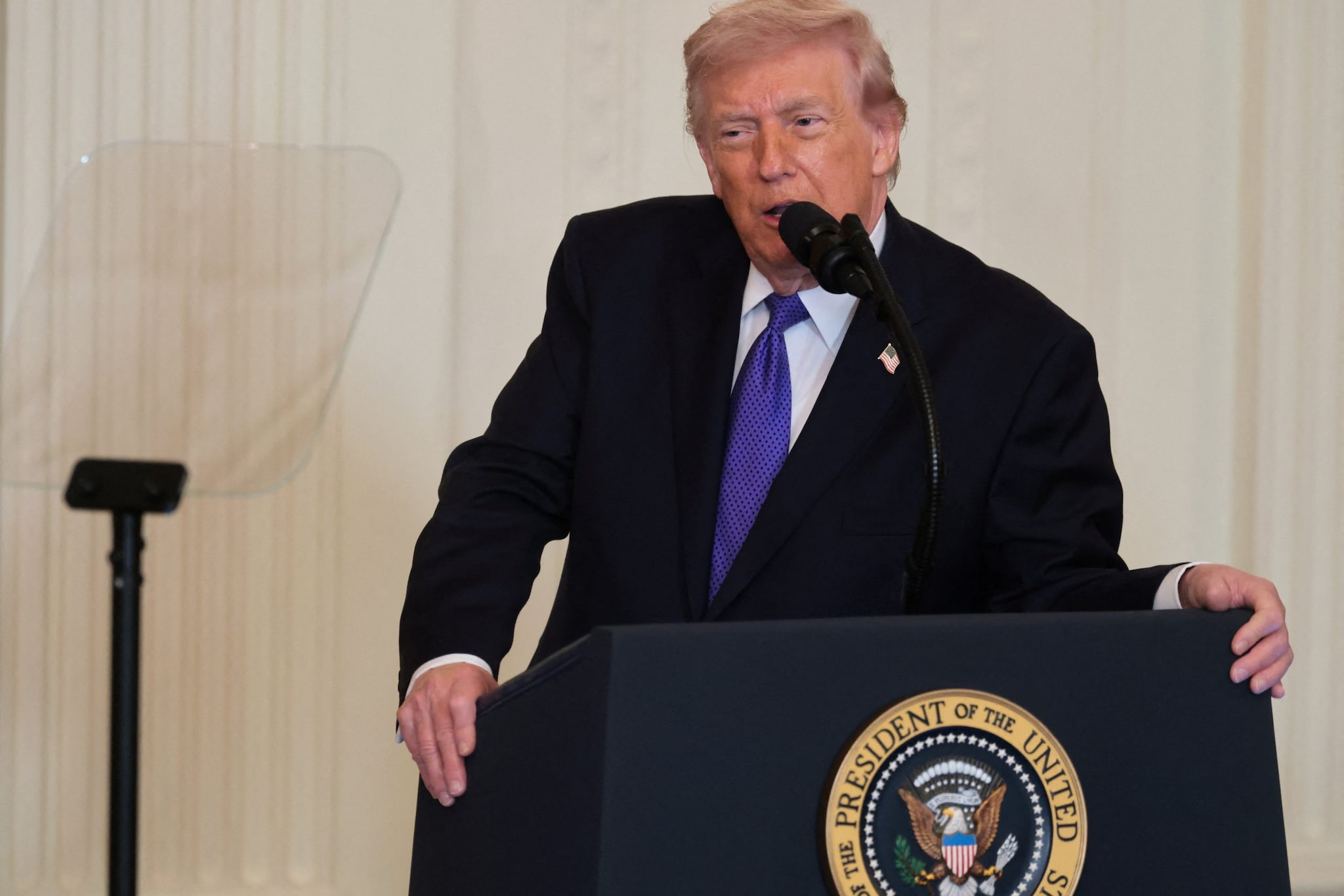
Donald Trump wants to handpick the next Supreme Leader of Iran, a demand that fundamentally rewrites the rules of engagement in the Middle East. Speaking from the White House following a week of devastating joint US-Israeli airstrikes that claimed the life of Ayatollah Ali Khamenei, the President made it clear that Washington will not accept a successor who mirrors the old guard. He specifically took aim at Mojtaba Khamenei, the late leader’s son and a perceived frontrunner, labeling him a "lightweight" and "unacceptable." Trump’s goal is not just the end of a conflict, but the installation of a pliant figurehead who will oversee what he calls "strategic submission."
This isn’t just rhetoric; it is a policy of "regime management" borrowed directly from the recent American playbook in Caracas. By citing the elevation of Delcy Rodríguez in Venezuela as his blueprint, Trump has signaled that the United States is moving away from the messy, long-term nation-building of the Bush era toward a model of surgical decapitation and rapid political replacement.
The Venezuela Doctrine in Tehran
The comparison to Venezuela reveals the mechanics of the current administration’s strategy. Earlier this year, a US-led operation resulted in the capture of Nicolás Maduro, followed by the swift recognition of a new executive. Trump intends to replicate this in Tehran. He isn't looking for a democratic revolution or a grassroots uprising; he is looking for a deal-maker within the existing power structure who is willing to trade ideology for survival.
"I have to be involved in the appointment," Trump told reporters, framing the succession not as an internal Iranian religious process, but as a mandatory settlement negotiation. He is betting that the sheer scale of the recent bombardment, which reportedly flattened the building where the Assembly of Experts was meeting to count votes, has broken the will of the clerical establishment.
The military reality on the ground supports this aggressive posture. In six days of strikes, Iran has lost significant naval assets and large portions of its missile infrastructure. With the "armada" still loitering in the Persian Gulf and the threat of a ground invasion—which Trump describes as "a waste" but hasn't fully ruled out—the White House is operating on the assumption that the Iranian regime is currently a hollow shell.
The Rejection of Mojtaba Khamenei
The internal mechanics of Iranian succession are usually shrouded in secrecy, handled by the 88-member Assembly of Experts. Traditionally, the process is a balance of clerical seniority and Revolutionary Guard (IRGC) backing. By publicly vetoing Mojtaba Khamenei, Trump is attempting to wedge the IRGC against the clerical elite.
Mojtaba has long been the "gatekeeper" of the system, a man with deep ties to the security apparatus but no formal government title. To the Trump administration, he represents "Khamenei 2.0"—a continuation of the proxy wars and nuclear brinkmanship that led to the current war. By calling him a "lightweight," Trump is not just insulting the man; he is signaling to the IRGC generals that backing the son will result in their continued destruction.
The Search for a Middle Man
If the son is out, who is in? Trump has hinted at a preference for "somebody from within" who is "currently popular." This suggests the administration is scouting for a "Gorbachev" figure—a regime insider who understands that the system is failing and is willing to dismantle its most hostile elements in exchange for staying in power.
This approach carries massive risks. Iran is not Venezuela. The ideological glue of the Islamic Republic is far more resilient than the populist patronage of Chavismo. Any leader seen as being installed by a "Veto from Washington" faces an immediate crisis of legitimacy, potentially sparking a civil war between IRGC factions that refuse to surrender and those looking for a way out.
The Demand for Unconditional Surrender
Trump’s recent Truth Social posts have added a new layer of friction: the demand for "unconditional surrender." This isn't just about picking a leader; it’s about a total reset of Iran’s regional footprint. The administration’s list of demands is non-negotiable:
- Permanent termination of the nuclear program.
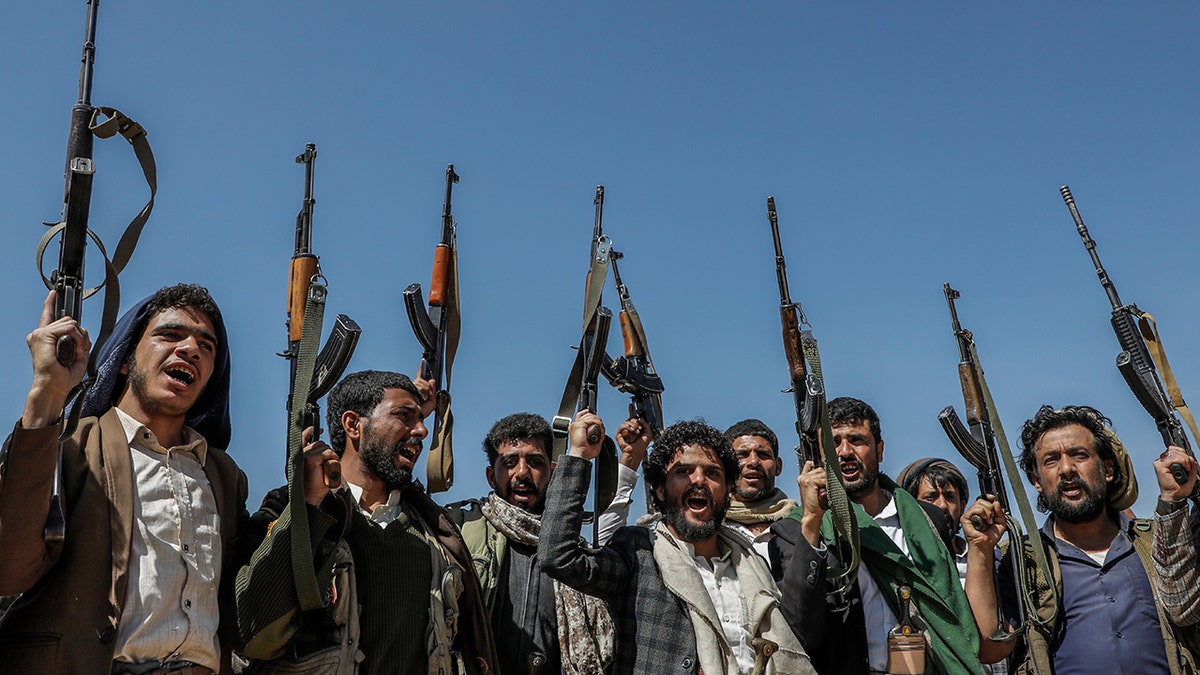
- Total cessation of support for regional proxies like Hezbollah and the Houthis.
- Direct oversight of the succession process by "allies and partners."
The President has even floated a "Make Iran Great Again" slogan, promising that an "acceptable leader" would receive massive American economic investment. It is a classic "carrot and stick" approach, but the stick is a precision-guided munition and the carrot is a theoretical promise of trade that the Iranian people haven't seen in decades.
A Vacuum Filled by Chaos
The danger of handpicking a leader in a vacuum is that the vacuum rarely stays empty. While Trump dismisses the idea of a ground invasion as a waste of time, his own military commanders are quietly warning that without "boots on the ground," they cannot control who actually seizes the levers of power in the provinces.
Kurdish militias in the west are already being encouraged to "win," with the White House offering air cover for their offensives. If the central government in Tehran collapses without a clear, US-approved successor, the country risks fracturing along ethnic and sectarian lines. This would leave Washington with a "managed" leader in Tehran who rules over nothing but a smoking capital.
The administration’s gamble is that the Iranian elite values self-preservation over the revolutionary cause. If they are wrong, the "involved" role Trump seeks will quickly devolve from a political appointment into a generational occupation. The President believes he can "clean out everything" and install a new CEO for Iran. History, particularly in this region, suggests that countries are rarely managed like real estate portfolios.
I can provide a more detailed breakdown of the internal factions within the IRGC currently vying for control if you would like to explore the potential candidates Trump might actually consider.