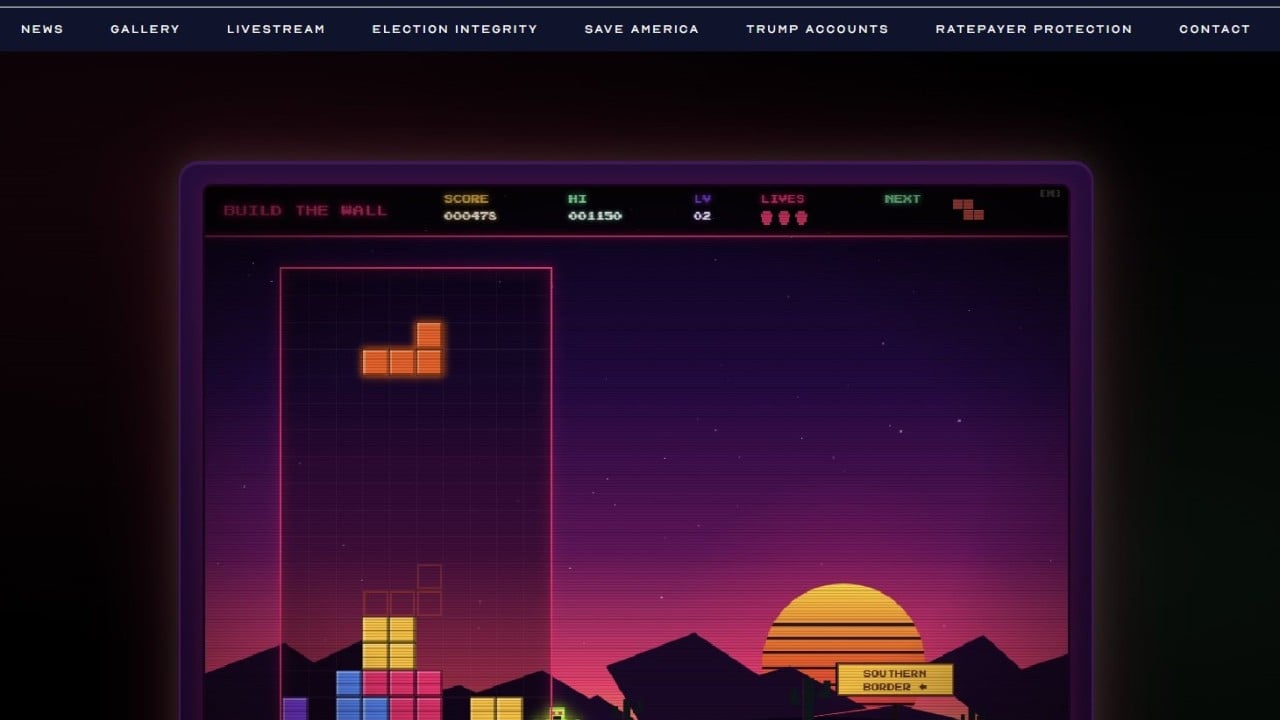
The media narrative surrounding the White House pulling its retro-styled browser game "Build the Wall" reads like a standard corporate compliance victory. The lazy consensus goes like this: The Tetris Company flexed its intellectual property muscle, issued a stern public reprimand, and forced a flustered administration to tuck tail and scrub the code from arcade.gov.
Everyone is cheering for the copyright holder. Everyone thinks the government got punked. Everyone is missing the entire strategic point of the exercise.
This was never about maintaining a permanent web arcade. It was a classic attention arbitrage play executed with surgical precision, and political commentators fell for the trap on the very first bounce.
The Mechanics of Manufactured Compliance
Let us look at how copyright law actually functions in the digital age. Code functionality, game mechanics, and abstract rules are notoriously difficult to protect under US intellectual property statutes. What Alexey Pajitnov’s successors own is the specific expression, audiovisual assets, and trademarked name. Did the White House clone the falling tetromino paradigm? Yes. Could they have won a protracted fair-use or parody defense in court? Absolutely they could have dragged it out for months.
Instead, they took the game down quietly. Why? Because the asset had already served its exact purpose.
Imagine a scenario where a digital marketing team spends ten million dollars trying to secure front-page coverage across every major tech blog, political broadsheet, and social media feed. They would run ads, hire consultants, and pitch op-eds.
The Trump administration skipped the ad spend entirely. They deployed a low-cost, high-satire browser mini-game, waited for the inevitable moral panic from corporate copyright holders, watched the outrage cycle saturate the news cycle for seventy-two hours, and then complied with a polite letter. They got billions of impressions for free. The takedown was the climax of the marketing campaign, not its defeat.
The Intellectual Property Paradox
Intellectual property fundamentalists love to argue that copyright protection is the sacred glue holding creative industries together. They treat corporate brands as fragile entities that must be shielded from political contamination.
The Tetris Company rushed to release a statement declaring that they believe "in the power of connection and bringing people together, not dividing them." It sounds noble. It plays well on Instagram. But legally and economically, it walks right into a branding trap. By elevating a cheap web parody into a monumental ideological battleground, the copyright holders amplified the exact political message they claimed to oppose.
If the company had ignored the stunt, the game would have vanished into the digital graveyard of government subpages within forty-eight hours, visited only by curious web scrapers. By threatening legal action, they guaranteed permanent cross-platform immortality for a connection between their brand and a polarizing border policy.
Why the Opposition Falls for the Bait Every Time
People asking whether government resources should be spent building web arcades are asking the wrong question entirely. The real question is why political opposition groups continue to take the bait on superficial cultural skirmishes while structural policy fights happen completely unobserved.
Every hour spent debating whether a Tetris-inspired block-stacking animation constitutes copyright infringement is an hour diverted away from substantive critique. The administration understands modern attention economics better than its legacy critics. They know that outrage is currency, and humor—no matter how polarizing—disarms rigorous institutional analysis.
We have entered an era where political communication is judged not by its legislative viability, but by its algorithmic velocity. By that metric, the "Build the Wall" arcade rollout was a resounding success, even in its prompt deletion.
Stop pretending corporate legal letters stop a communications machine that thrives on the very friction those letters create. The game is gone, but the message already rendered the copyright defense obsolete.