Courts love a good David-versus-Goliath story. A single property owner stares down a municipal legal juggernaut over a 361-home flooding disaster, dodges the city's sovereign immunity shield on appeal, and suddenly the headlines treat it like a finish line.
It isn't. It's the starting gun to a much uglier fight.
Standard coverage of municipal flooding disputes reads like a sports box score. Immunity granted? City wins. Immunity waived or pierced? Owner wins. That binary framing misses the actual mechanics of municipal litigation, public finance, and water law. Winning an appeal over a city's immunity defense only means you get to prove liability and damages on the merits. It does not hand you a check, fix your drainage, or stop a city attorney from bleeding your legal budget dry for another four years.
I have watched property owners and developers burn through seven figures celebrating procedural victories while the underlying engineering and fiscal realities quietly crushed their claims. When a 361-home flooding dispute reaches appellate review on immunity, the real battle has barely begun.
You Are Asking the Wrong Question About Sovereign Immunity
Most readers look at a headline about a property owner beating a city's immunity defense and ask, "Does the city have to pay now?"
Wrong question. The right question is: Which hat was the city wearing when the water rose, and what happens to a city's budget if a jury actually agrees with you?
In municipal law, courts routinely distinguish between governmental functions and proprietary functions. A governmental function is something the municipality does for the general public good under state authority—like maintaining public roads, enforcing codes, or operating a broad public flood-control system. Sovereign immunity frequently shields cities from tort liability when they perform governmental functions, unless a specific statutory waiver applies or the plaintiff proves a constitutional taking or nuisance claim that survives state doctrine.
A proprietary function looks more like a business. Think of a municipal utility billing customers for water or sewer service, or running a commercial enterprise. Immunity is often narrower or absent there, though statutory caps, public-duty doctrines, and causation hurdles still stand like concrete barriers.
When an appellate court reverses a dismissal based on sovereign immunity, it usually isn't declaring the city guilty of flooding 361 homes. It is holding that the plaintiff alleged enough facts—under a particular legal theory such as inverse condemnation, negligence in a proprietary capacity, or a recognized exception—that the case should not be thrown out at the pleading stage.
That distinction gets lost in lazy coverage. A surviving claim is oxygen, not victory.
The Lazy Consensus Around "Big Wins" Against Cities
Conventional legal commentary treats every appellate setback for a municipality as a seismic shift in local government accountability. Let's tear that apart.
Cities do not operate like private corporations. A private developer or industrial landowner who floods 361 homes faces solvency risk, insurance pressure, or asset seizure. A municipality has taxing power, bond ratings, legislative immunity on policy choices, and political staying power. Even when a homeowner clears the immunity hurdle, the city still has an arsenal of defenses left on the table:
- Causation: Did the city's specific act or omission cause the water to enter those homes, or did a historic rainfall event, upstream private development, soil saturation, or natural topography do the heavy lifting?
- Discretionary vs. ministerial acts: Courts heavily scrutinize whether municipal officials made high-level planning and policy decisions (often protected) versus failing to execute clear, mandatory duties (sometimes actionable).
- Inverse condemnation standards: Under Fifth Amendment takings principles and state analogues—classic frameworks analyzed in property jurisprudence from Pennsylvania Coal Co. v. Mahon to modern flood-control takings cases like Arkansas Game and Fish Commission v. United States—temporary or recurring flooding does not automatically equal a compensable taking. Courts look closely at duration, foreseeability, severity, and reasonable investment-backed expectations.
- Damages math: Proving harm across 361 homes is a statistical and evidentiary nightmare. Individualized proof of property value drops, repair costs, diminution, or lost rent can fracture a unified narrative fast.
I have seen plaintiffs' teams walk into settlement talks after an appellate immunity win acting like they already hold a blank check, only to get humbled when discovery exposes shifting hydrological models and decades-old permitting records. Municipal attorneys know how to play the long clock. Taxpayers fund the defense. Plaintiffs fund their own lawyers.
Dismantling What Everyone Gets Wrong About Flood Litigation
When a major residential flooding dispute hits the news, the public asks the same predictable questions. Almost all of them rest on shaky assumptions.
"If the city approved the drainage or development, isn't it automatically liable?"
No. Approval is not a warranty against high water. Municipalities review plats, issue permits, and adopt stormwater ordinances every day. Treating every flawed growth decision or aging culvert as automatic municipal liability turns local government into a universal flood insurer for every parcel in town. Courts resist that result fiercely because it bankrupts small and mid-sized cities and chills infrastructure planning. To win, a claimant usually needs far more than "the city signed off on it." You need a legally cognizable duty, a breach or taking that crosses the constitutional or statutory line, and tight proof of causation.
"Does beating immunity mean the city has to fix the drainage problem?"
Not automatically. Money damages and injunctive relief are two very different animals. Even if a court finds liability or a taking, forcing a municipality to re-engineer a multi-parcel watershed or rebuild major stormwater infrastructure runs straight into separation-of-powers concerns, engineering feasibility limits, and budget constraints. Sometimes a city would rather pay for past harm—or fight for years over valuation—than overhaul an entire drainage basin overnight.
"Why do 361-home disputes take so many years?"
Because 361 homes is not one simple factual story. Lot elevations vary. Retention ponds sit in different spots. Some homes sit near swales or creeks; others sit slightly higher with garage intrusion or crawlspace moisture. One homeowner's expert might point to an undersized pipe while a defense expert points to unmaintained private grading or extreme storm return intervals. Every single variable gives the defense room to argue against uniform causation and uniform damages.
How the Mechanics Actually Work When the Water Hits
To see why an immunity appeal is just round two of a twelve-round fight, look at how these disputes actually get built and broken.
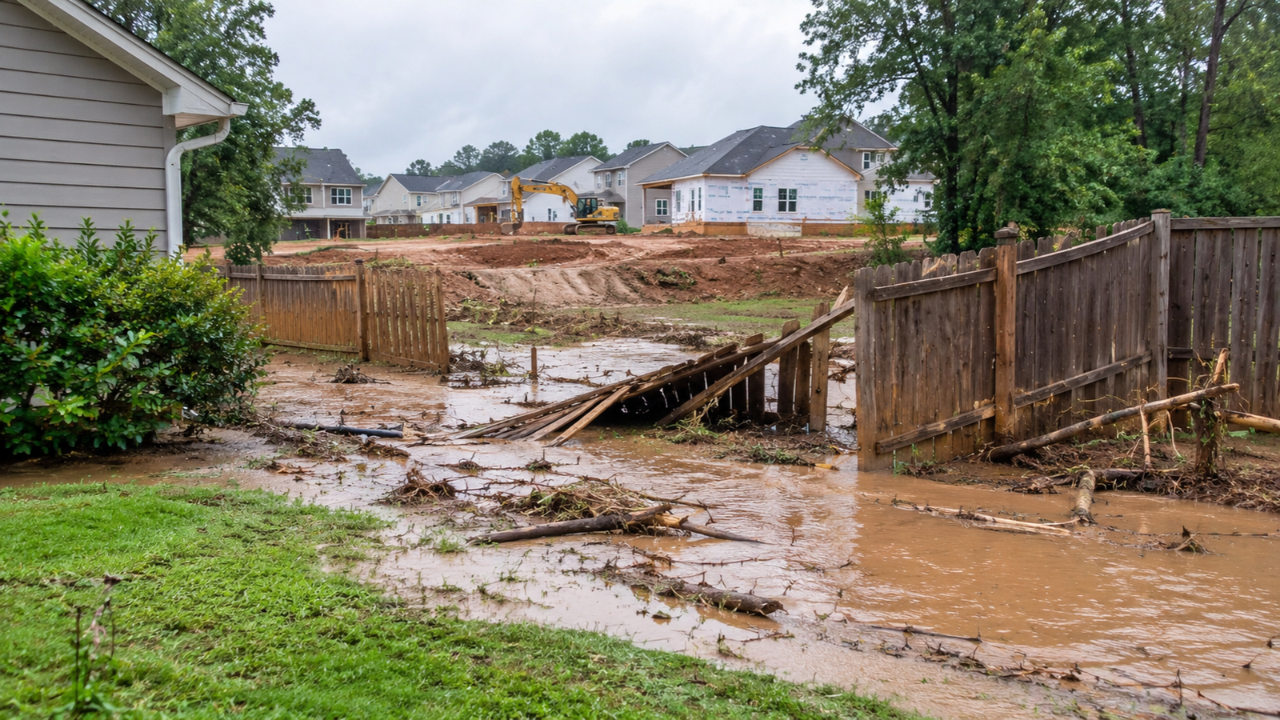
Imagine a scenario where a rapidly growing municipality allows hundreds of homes to go up over a decade while updating its stormwater rules piecemeal. Heavy storms hit, 361 properties take on water, and an owner brings claims testing the boundary between protected municipal policy and actionable harm. The city moves to dismiss on immunity. The trial court grants it or denies it, an appeal follows, and the owner comes out on top of that threshold issue.
Now the real work starts.
1. The Paper Trail Outlives Memories
Municipal files from ten or twenty years ago are goldmines for both sides. Master stormwater plans, engineering memos warning about downstream capacity, maintenance logs, and variance approvals tell the true story. Usually, neither side gets a clean smoking gun. You get emails full of caveats, budget trade-offs, and competing engineering opinions.
2. Hydrology Is an Argument, Not a Photograph
Laypeople think water flow is simple: rain falls, pipes carry it, houses flood if pipes fail. Real hydrology models account for antecedent soil moisture, impervious surface ratios, storm duration curves, tailwater conditions, and localized obstructions. Two licensed engineers can look at the same watershed and reach sharply different conclusions about what would have happened under alternative designs.
3. Procedural Posture Shapes Everything
An appeal over immunity tests legal sufficiency and threshold defenses; it does not weigh credibility or resolve factual disputes. Winning that round keeps your courthouse key. It does not persuade twelve jurors that a city crossed the line from imperfect governance into compensable legal wrong.
Where This Contrarian Take Can Bite You
I am telling you to treat an immunity appeal win with cold-eyed skepticism, not champagne. Still, any sharp strategy has blind spots, and I will own mine.
First, downplaying an appellate immunity victory can understate its real leverage. In litigation, surviving a dispositive motion changes settlement dynamics. A city that thought it could walk away on immunity suddenly faces years of discovery, public scrutiny of internal engineering records, and the risk of an adverse precedent on its books. Sometimes leverage is enough to bring a serious offer to the table.
Second, pushing too hard on the "municipalities are practically untouchable" angle ignores jurisdictions where statutory waivers, state constitutional provisions, or egregious facts give property owners real teeth. Law is local, and state appellate courts draw their own lines around public-duty rules, nuisance exceptions, and inverse condemnation.
If you treat an immunity win as a guaranteed payout, you will mismanage your budget and your expectations. If you treat it as worthless, you will leave real negotiation leverage on the table.
Actionable Moves for Anyone Caught in the Crossfire
Whether you own one of those 361 homes, represent a group of affected owners, or advise on land and infrastructure risk, stop celebrating headlines and start working the mechanics.
| Stakeholder | What Most People Do (And Why It Fails) | What Actually Works |
|---|---|---|
| Affected Property Owner | Assumes an appellate win means quick money or immediate ditch/pipe repairs. | Documents exact water lines, photos, repair invoices, and maintenance history immediately; prepares for a multi-year timeline. |
| Claimant Group / Counsel | Treats all 361 homes as identical without mapping parcel-level differences. | Segments properties by elevation, flood path, and damage type early so causation and damages don't collapse under scrutiny. |
| Developer / Landowner | Relies on informal assurances from local staff that drainage is "covered." | Audits municipal ordinances, engineering reviews, and discharge obligations in writing before building or buying. |
| Municipal Leader | Pretends immunity is an impenetrable wall and ignores aging infrastructure data. | Tracks system vulnerabilities candidly and evaluates long-term risk rather than fighting every procedural point to the bitter end. |
Do three concrete things right now if you are tied to a major flooding dispute:
- Build a granular property file today. Pull inspection reports, elevation data, date-stamped photos of water entry, contractor estimates, and any prior communications with the city. Memories fade; contemporaneous records win credibility.
- Audit the legal theory, not just the headline. Know whether the fight turns on statutory immunity exceptions, state nuisance law, inverse condemnation, or proprietary utility operations. Each path has different proof burdens and remedies.
- Budget for endurance, not a sprint. Appellate victories over immunity clear the runway; they do not fly the plane.
Water finds the low ground, and litigation finds every weak link in your proof. Win the appeal, keep your head down, and get ready to prove every drop.