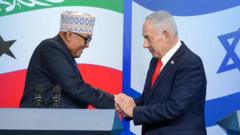
The opening of Somaliland's embassy in Jerusalem's Har Hotzvim technology park represents a calculated transaction in the market for sovereign legitimacy. By establishing a top-level diplomatic mission in a contested capital, Hargeisa has traded diplomatic alignment for primary state recognition. This exchange operates outside traditional multilateral frameworks, offering a blueprint for how unrecognized states can convert geographic and strategic assets into formal sovereignty.
To evaluate the long-term viability of this alignment, the transaction must be deconstructed into its component economic, military, and diplomatic mechanics. For a closer look into this area, we suggest: this related article.
The Sovereign Exchange Framework
The relationship between Israel and Somaliland operates as a reciprocal value exchange designed to bypass the traditional gatekeepers of international law. For 35 years following its 1991 secession from Somalia, Somaliland maintained de facto independence—possessing a defined territory, permanent population, governance structure, and military—yet lacked the de jure recognition required to access international capital markets, sovereign loans, and bilateral defense pacts.
The structural mechanics of this bilateral transaction rest on three distinct pillars. For further context on this issue, in-depth analysis is available on Associated Press.
The Legitimacy Premium
Somaliland required a single United Nations member state to break the recognition deadlock. Israel's December 2025 decision to recognize Somaliland's independence provided the legal precedent. By reciprocating with an embassy in Jerusalem, Somaliland offers Israel scarce diplomatic validation, becoming the eighth nation to locate its mission there. The transaction cost for Hargeisa includes immediate condemnation from the African Union and a coalition of 14 Muslim-majority nations; the return is the formalization of its statehood.
The Maritime Security Axis
Somaliland controls 850 kilometers of coastline along the Gulf of Aden, a critical choke point for global trade and a highly vulnerable vector for maritime transit. For Israel, securing access to this corridor acts as a counterweight to hostile actors operating around the Bab-el-Mandeb strait and Yemen. The strategic utility of Somaliland's coastline outweighs the diplomatic friction generated by bypassing Mogadishu's claims of territorial integrity.
Asymmetric Resource Interdependence
Somaliland faces existential operational bottlenecks in water scarcity and agricultural infrastructure. Israel holds a structural surplus in desalinization, precision irrigation, and remote security technology. This creates a highly efficient trade architecture where Somaliland exports geographic access and diplomatic alignment in exchange for vital infrastructure technologies.
Technology and Infrastructure Integration
The civilian foundation of this state-level partnership focuses on technical skill transfer designed to stabilize Somaliland's domestic resource constraints. Rather than relying on standard financial aid models, the strategy emphasizes direct integration across two critical sectors.
Advanced Resource Management
Somaliland's agricultural output is severely capped by arid conditions and inefficient distribution networks. In February 2026, specialists from municipal water agencies across Somaliland, including the Hargeisa Water Agency, began technical training in Tel Aviv focused on specialized water management systems. The objective is the deployment of closed-loop irrigation and automated distribution grids to optimize water allocation in urban and agricultural clusters, directly increasing domestic food security.
Critical Infrastructure Protection
The commercial entry point for Israeli capital into the Somaliland market is led by targeted technology joint ventures. Tech firm VisiRight has partnered with Amore Capital to deploy remote inspection systems and automated security protocols across Somaliland's borders and maritime ports. This infrastructure serves a dual purpose: it secures international trade routes passing through the Port of Berbera and establishes the technical verification systems required to meet global customs and maritime safety standards.
The Geopolitical Cost Function
While the immediate returns to Hargeisa include institutional survival and formal recognition, the strategy carries severe geopolitical risks. The alignment creates a highly complex cost function across regional security and international law.
The Federal Government of Somalia views the recognition as a direct violation of its territorial sovereignty. This friction elevates the probability of proxy conflicts along the shared border, creating an ongoing security tax on Somaliland's budget. Furthermore, because East Jerusalem is classified as occupied territory under international law by the United Nations, Somaliland's embassy placement alienates traditional European and African development partners who adhere strictly to multilateral consensus.
The military dimension introduces further volatility. Intelligence assessments indicate that the diplomatic breakthrough was accelerated by multi-year, quiet intelligence coordination. Discussions regarding an explicit Israeli military presence on the Somaliland coast demonstrate that Hargeisa has integrated itself into broader Middle Eastern security architectures. While 50 Somaliland special forces have completed training in Tel Aviv to enhance domestic counter-terrorism capabilities, the presence of foreign defense infrastructure exposes Somaliland to long-range asymmetric retaliation from regional adversaries.
Strategic Forecast
The durability of the Israel-Somaliland axis will not be determined by diplomatic declarations, but by the velocity of economic execution. If the technical partnerships in water management, port security, and infrastructure tracking yield measurable increases in Somaliland’s GDP and maritime throughput over the next 24 months, Hargeisa will have successfully leveraged its geographic position to secure permanent statehood.
The immediate tactical requirement for Somaliland is to prevent regional isolation. Hargeisa must utilize its newly secured technology pipelines to position itself as the primary logistics and security hub for the Horn of Africa, rendering its de jure independence an unalterable reality on the ground before opposing regional coalitions can effectively mobilize economic or military counter-measures.