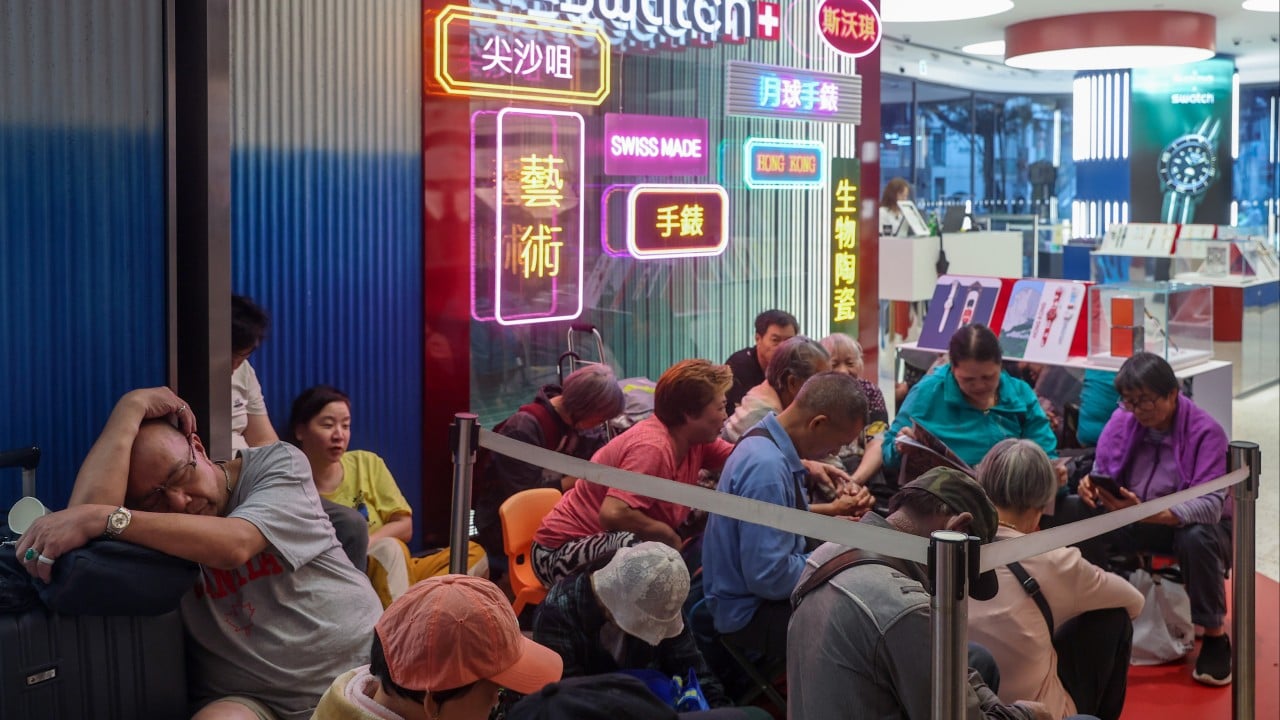
The humidity in Hong Kong does not just sit in the air. It weighs on you. At 4:00 AM outside the Tsim Sha Tsui storefront, the air felt like a wet wool blanket draped over the shoulders of three hundred people who had forgotten what sleep felt like. They were not horology enthusiasts. They could not tell you the difference between a coaxial escapement and a quartz oscillator.
They were there for the plastic.
Specifically, they were there for a bioceramic casing housing a quartz movement, stamped with two names that historically belonged to entirely different universes: Swatch and Audemars Piguet. It was the latest collaboration designed to democratize luxury, or perhaps, more accurately, to commodify scarcity.
To understand the madness of that morning, you have to look past the glossy marketing campaigns and into the eyes of someone like Ming. He is twenty-four, works in logistics, and does not wear a watch. Yet, he spent fourteen hours sitting on a collapsible stool on Nathan Road, drinking lukewarm milk tea and shielding his face from the neon glare of closed jewelry shops. Ming was not buying a piece of watchmaking history. He was buying a ticket out of a credit card debt hole.
When the doors finally opened, the tension was visceral. It was the same fever that gripped the world during the MoonSwatch drop, resurrected and amplified. But the real story did not happen at the cash register. It happened three minutes later, two blocks away, under the fluorescent lights of a 7-Eleven.
That is where the boxes were opened, photographed on plastic trash cans, and uploaded to the internet.
The Digital Arbitrage
Within two hours of the official launch, the digital marketplace was flooded. Platforms like Carousell and Chrono24 became the real battlegrounds. The retail price of the watch, set at a modest three hundred and fifty dollars, became a distant memory.
Consider the mathematics of modern hype. The listings did not creep up in price. They leaped.
- Retail Price: $350 USD
- Initial Resale Asking Price: $1,200 USD
- Average Settled Secondary Price (Hour 3): $950 USD
The markup is not a reflection of material value. Bioceramic is, at its core, a proprietary blend of plastic and ceramic. It is lightweight, colorful, and inexpensive to produce. The premium is purely psychological. It is the cost of bypassing the line, the price of immediate gratification in a culture that treats waiting like a financial loss.
For Ming, the transaction was swift. A man in a black tracksuit met him near the subway station, handed over a stack of Hong Kong dollars, and took the bag. Ming walked away with a profit that equaled half his monthly salary for a night’s work of sitting on pavement.
But where does that watch go next? It rarely ends up on the wrist of someone who loves it. Instead, it enters a secondary ecosystem of professional flippers, moving from digital wallet to digital wallet, gaining nominal value while losing its soul. It ceases to be a timekeeper. It becomes a speculative asset class, no different from a cryptocurrency token or a tech stock options contract.
The Illusion of Democratic Luxury
The traditional Swiss watch industry is built on a foundation of deliberate exclusion. To buy a steel Audemars Piguet Royal Oak at retail, you cannot simply walk into a boutique with fifty thousand dollars. You must build a relationship. You must buy the jewelry you do not want, attend the dinners, and wait for years on a list that might be a polite myth.
When these collaborations happen, the narrative sold to the public is one of accessibility. The executives argue they are opening the gates of the temple to the masses. They want the teenager in Kowloon to feel the thrill of owning a design inspired by the holy trinity of watchmaking.
The reality on the ground offers a stark correction to that philosophy.
When luxury is priced down to the mass market but produced in limited quantities, the gates do not open. They just get a new set of bouncers. The professional scalper networks use sophisticated tracking algorithms, coordinate localized line-standing rings, and deploy capital to sweep up inventory before a genuine enthusiast can even find a parking spot.
The democracy of the line is a farce. The person who truly loves the design, who spent weeks reading about the geometry of the bezel and the history of the collaboration, is priced out by noon. They are left with two choices: pay a three-hundred percent premium to a stranger on the internet or accept that the democratization of luxury was never meant for them.
The Changing Face of Value
There was a time when value in horology was derived from the invisible. It was the hundred hours a master artisan spent anglage-polishing a bridge under a microscope. It was the resonance of a minute repeater chimes tested in a silent room in the Vallée de Joux.
Now, value is determined by the speed of an upload.
The modern consumer has been conditioned to view products through the lens of liquidity. A purchase is no longer just a consumption choice; it is an investment decision. The question is no longer "Do I like how this looks on my wrist?" but rather "What can I get for this if I sell it tomorrow?"
This shift alters our relationship with objects. When everything is a potential flip, nothing is permanent. We become temporary custodians of commodities, moving them along the chain before the hype cycle decays and the next drop renders them obsolete. The shelf life of excitement has shrunk from years to hours. By the time the sun set over Victoria Harbour on the day of the launch, the prices on Carousell had already begun their slow, inevitable drift downward as the market realized the supply was not quite as finite as the rumors suggested.
The line outside the store is gone now. The pavement is clean, save for a few discarded plastic wrappings and a crushed paper cup. The watches are scattered across the globe, sitting in padded shipping boxes, waiting for the next transaction. Ming is asleep in his apartment, his credit card balance temporarily wiped clean. The system worked perfectly, yet everyone involved feels a little more hollow. The watch still ticks, indifferent to the price tag attached to its face, measuring out the seconds of an era that knows the price of everything and the value of nothing.