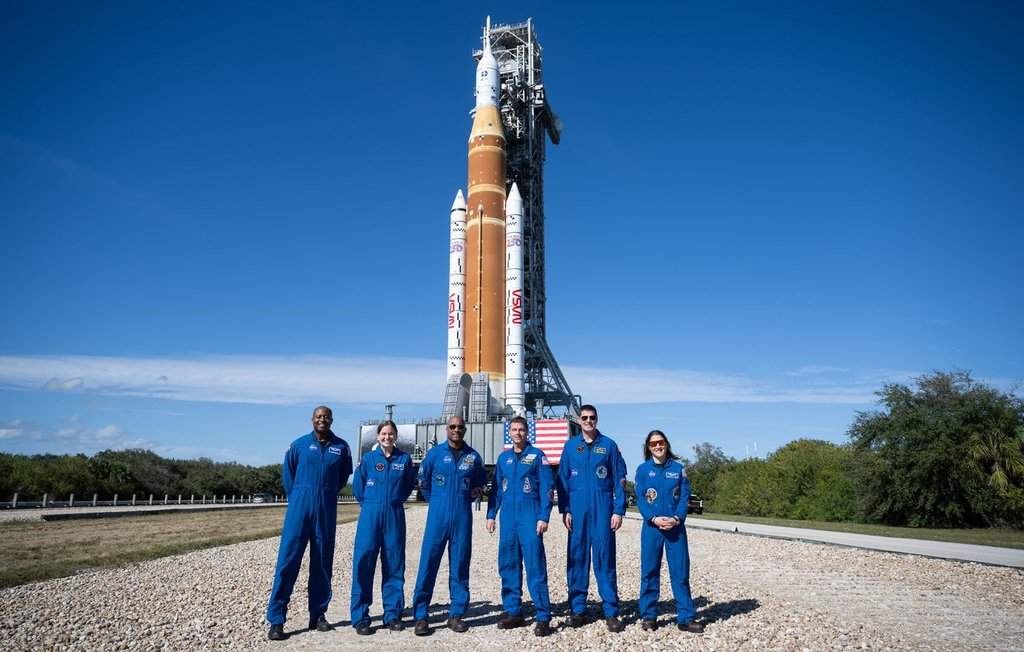
Humans haven't left low Earth orbit since 1972. Think about that for a second. We’ve spent over fifty years tethered to our home planet, sending robots to do the dirty work while we stayed in the relative safety of the International Space Station. That changes with Artemis II. This isn't just another launch or a flashy PR stunt by NASA. It’s the first time in a generation that actual people will feel the kick of a moon-bound rocket.
The crew chosen for this ten-day trip around the moon isn't just a random assortment of pilots. They represent a massive shift in how we approach space. We're moving away from the "test pilot only" era and into a phase where diversity of experience and international partnership define the mission. This is about proving the Orion spacecraft can keep humans alive in deep space before we try to land on the surface with Artemis III.
Meet the four people riding the tip of the spear
The crew consists of three Americans and one Canadian. They're veterans, but none of them have been to the moon. They're about to become the first humans to see the lunar far side with their own eyes since the Apollo era ended.
Reid Wiseman the mission commander
Reid Wiseman is a naval aviator who knows his way around a cockpit. He previously spent 165 days in space, which gives him the "space legs" needed to lead this group. Before getting this seat, he served as the Chief of the Astronaut Office. That means he was basically the boss of all other astronauts. He stepped down from that administrative role specifically to get back into the flight rotation. Wiseman is known for being technically precise but also incredibly relatable. He’s the guy you want making the hard calls when a sensor glitches 200,000 miles from home.
Victor Glover the pilot
Victor Glover is making history as the first person of color to go on a lunar mission. But don't let the milestones overshadow his raw talent. Glover was the pilot of the SpaceX Crew-1 mission. He’s got thousands of hours in over 40 different aircraft. He’s also an engineer. During his time on the ISS, he participated in four spacewalks. He knows the Orion systems inside and out. If something breaks, Glover is the one who’s going to troubleshoot the flight dynamics in real time.
Christina Koch the mission specialist
If you want to talk about endurance, you talk about Christina Koch. She holds the record for the longest single spaceflight by a woman—328 days. She’s an electrical engineer by trade and has experience working at the South Pole and in remote islands. She's used to isolation. Koch has performed six spacewalks, including the first three all-female spacewalks. On Artemis II, her job is to manage the complex payloads and ensure all the scientific data we're gathering is actually useful. She’s arguably the most experienced "space dweller" on the team.
Jeremy Hansen the Canadian specialist
Jeremy Hansen represents the "International" part of this mission. He’s a colonel in the Royal Canadian Air Force and this will be his first trip to space. Some people wondered why a rookie got a seat on such a high-stakes flight. The answer is simple: Hansen has been a leader on the ground for years. He was the first Canadian to lead a NASA astronaut class. Canada’s contribution of the Canadarm3—the robotic arm for the future Gateway station—earned them this seat. Hansen is the bridge between the US and its closest space partners.
What Artemis II actually does
A lot of people think they’re landing. They aren't. Artemis II is a "flyby" mission. The crew will blast off on the Space Launch System (SLS) rocket, the most powerful rocket ever built. Once they're in orbit, they’ll perform a series of maneuvers to check that Orion’s life support systems are working.
They’ll use a trajectory called a "free return." This is brilliant engineering. Basically, they use the moon’s gravity to whip them back toward Earth without needing to fire the engines to get home. It’s a safety net. If things go south, physics brings them back. They’ll fly about 6,400 miles beyond the far side of the moon. That’s further than any human has ever traveled.
Why we can't just skip to the landing
It’s tempting to ask why we're "wasting" a trip just to fly around the moon. Why not just land? Because space is hard and unforgiving. The Orion capsule is a completely different beast than the Apollo Command Module. It’s got millions of lines of code, advanced heat shielding, and modern avionics that haven't been tested with humans in the loop under deep-space radiation conditions.
Artemis I was the uncrewed test. It proved the rocket works. Artemis II proves the life support works. We need to know that the nitrogen-oxygen mix stays stable, that the water recycling doesn't fail, and that the crew can manually fly the ship if the computers go dark. You don't test those things for the first time while also trying to navigate a tricky lunar landing.
The real risks involved
Don't buy into the "routine" narrative. This mission is dangerous. The crew will pass through the Van Allen radiation belts twice. They'll be moving at speeds exceeding 25,000 miles per hour during re-entry. The heat shield will have to endure temperatures of 5,000 degrees Fahrenheit.
There's also the psychological factor. Once they leave Earth's orbit, there's no "abort and come home in three hours" like there is on the ISS. They are committed. If a medical emergency happens or a fire breaks out, they have to finish the loop around the moon before they can hit the atmosphere. That takes days. These four astronauts are essentially test pilots in a very expensive, very fast laboratory.
What this means for the average person
Space exploration often feels like a billionaire's playground or a government black hole for tax dollars. But Artemis II is different. It’s the foundation for the Lunar Gateway, a station that will orbit the moon and serve as a jumping-off point for Mars.
The technologies being developed for these missions—like advanced water purification, high-efficiency solar cells, and compact medical devices—always find their way back to Earth. More importantly, it’s a moment of global unity. In a world that feels increasingly fractured, seeing four humans from different backgrounds heading into the void together is a powerful image. It’s a reminder of what we can do when we stop arguing about borders and start looking at the stars.
Preparing for the launch
Training is already intense. The crew is spending hundreds of hours in simulators at Johnson Space Center. They're practicing every possible failure scenario. They’re also training for the splashdown. When they return, they’ll hit the Pacific Ocean, and the US Navy will have to fish them out.
If you want to keep track of the progress, follow the official NASA Artemis social media channels or the individual astronauts. They share a lot of behind-the-scenes footage of their training runs and the hardware assembly. You can also check the NASA SLS progress reports to see the status of the "Mega Moon Rocket" as it gets stacked at Kennedy Space Center. Keeping an eye on the flight readiness reviews is the best way to know if the launch date is actually going to hold.