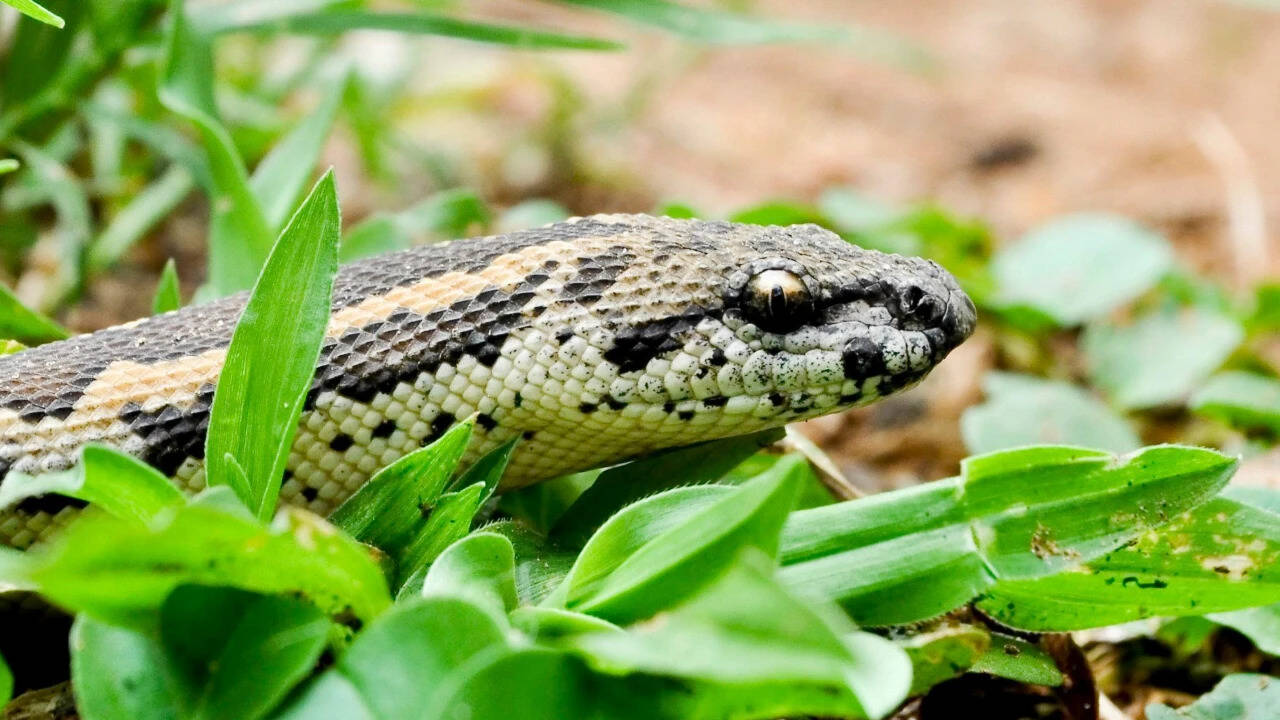
Documenting three individuals of the Sistan sand boa (Eryx sistanensis) in Rajasthan's Sikar district is not a minor regional wildlife note; it is a critical data point that recalibrates the known eastern distribution limits of an understudied fossorial boid and exposes severe sampling biases in Indian arid-zone herpetology. Standard wildlife reporting treats a multi-specimen sighting as a simple novelty. A rigorous ecological assessment treats those three records as evidence of an established, reproducing subpopulation operating within a heavily modified semi-arid agricultural matrix.
To understand the operational significance of three verified specimens in Sikar, one must separate surface-level observation from underlying biological and geographical mechanisms. The discovery intersects three distinct scientific problems: the taxonomic resolution of Old World sand boas, the ecological permeability of the Thar-Aravalli ecotone, and the mathematical realities of low detection probability in burrowing reptiles.
The Taxonomic Baseline and Diagnostic Resolution
For decades, herpetological surveys across northwestern India defaulted to a simplified classification model for sand boas. Field biologists routinely assigned blunt-tailed, heavy-bodied fossorial snakes in Rajasthan and Gujarat to the red sand boa (Eryx johnii) or the common sand boa (Eryx conicus). This taxonomic compression obscured the presence of Eryx sistanensis, a species originally described from the Sistan Basin spanning eastern Iran and southwestern Afghanistan.
Taxonomic resurrection and morphological re-evaluation demonstrated that Eryx sistanensis represents a distinct evolutionary lineage rather than a mere geographical variant. Misidentification persisted because casual visual inspection relies on overall body proportions and fossorial adaptations that converge across the genus Eryx. Separating Eryx sistanensis from Eryx johnii requires precise meristic and morphometric verification.
- Scalation Metrics: Diagnostic separation depends on exact counts of dorsal scale rows at midbody, ventral scales, and subcaudal plates, alongside the configuration of circumorbital and interorbital scales. Eryx sistanensis exhibits specific scale-row reductions and cephalic plate arrangements that distinguish it from sympatric congeners.
- Caudal Morphology: Both Eryx sistanensis and Eryx johnii possess a blunt, rounded tail tip adapted for defensive mimicry and subterranean leverage, yet the degree of caudal tapering and the terminal scale structure show consistent interspecific divergence.
- Coloration and Pattern Ontogeny: Juveniles of Eryx sistanensis frequently display distinct dorsal banding or blotching that fades or shifts in contrast as the animal reaches adult mass, creating an identification trap when field workers encounter different age classes without standardized dichotomous keys.
When researchers confirm three separate individuals in Sikar, the primary achievement is diagnostic precision. It proves that previous baseline checklists for northeastern Rajasthan suffered from false-negative errors driven by taxonomic lumping rather than true biological absence.
Biogeographical Mechanics of the Sikar Ecotone
Sikar district sits in the Shekhawati region of northeastern Rajasthan, occupying a critical ecological transition zone. To the west lies the hyper-arid core of the Thar Desert, characterized by shifting parabolic dunes, extreme diurnal temperature swings, and sparse xerophytic scrub. To the east and southeast rises the Aravalli Range, an ancient Precambrian mountain belt with rocky outcrops, higher seasonal precipitation, and dry deciduous thorn forest remnants.
Sikar functions as an environmental filter between these two biomes. The district's substrate consists largely of stabilized alluvial plains, wind-blown aeolian sand sheets, and sandy loam soils interspersed with agricultural fields. For a specialized burrower like Eryx sistanensis, soil mechanics dictate survival.
- Particle Size and Shear Strength: Sand boas do not excavate permanent open tunnels like rodents; they move through loose substrates using lateral undulation and concertina locomotion beneath the surface. If soil clay content is too high, compaction during dry periods creates a hardpan barrier that prevents subsurface movement. If sand is entirely unconsolidated without vegetative root binding, thermal fluctuations penetrate too deeply, exposing the snake to lethal surface heat.
- The Alluvial-Aeolian Sweet Spot: Sikar's sandy loam provides optimal mechanical resistance. It allows rapid vertical burrowing to escape surface temperatures exceeding 45 degrees Celsius while maintaining enough structural cohesion to support subterranean microclimates with stable humidity.
- The Aravalli Barrier Hypothesis: Historically, biogeographers modeled the Aravalli Range as a physical and climatic barrier restricting Saharo-Sindian desert fauna from expanding further east into the Indo-Gangetic Plain. Recording three Sistan sand boas in Sikar demonstrates that the species successfully navigates the semi-arid western flanks of the Aravallis, utilizing sandy riverbeds, paleochannels, and rain-fed agricultural bunds as dispersal corridors.
This distribution pattern mirrors broader biogeographical dynamics seen in other Saharo-Sindian reptiles, such as certain spiny-tailed lizards and fringe-toed lizards, whose eastern range boundaries track the precise isohyets where annual rainfall transitions from arid to semi-arid regimes.
Why Three Specimens Indicate an Established Population
In wildlife biology, sample size carries non-linear inferential weight. Observing a single animal at the periphery of a known range can be dismissed as a vagrant, a storm-displaced individual, or an accidental human translocation via transported agricultural goods or construction sand. Observing three individuals within the same district eliminates the vagrant hypothesis.
Cryptic fossorial snakes exhibit notoriously low detection probabilities. An organism that spends upward of 90 percent of its life cycle underground, emerging primarily during narrow nocturnal thermal windows or following monsoon soil saturation, is largely invisible to standard transect surveys.
To evaluate what three detections actually represent, analysts apply the fundamental detection equation:
$$N = \frac{C}{p}$$
In this model, $N$ represents the true local abundance, $C$ represents the count of observed individuals (three), and $p$ represents the probability of detecting an individual during a given survey effort. For nocturnal, subterranean boids in scrub-agricultural mosaics, $p$ typically falls below 0.05, and often approaches 0.01 during dry seasons.
- Statistical Implication of Low $p$: When $p$ is exceptionally small, the denominator compresses, meaning a count of three observed animals implies a substantial underlying population density. Even under conservative detection assumptions, finding three specimens in a single district requires dozens of resident adults maintaining overlapping home ranges.
- Demographic Viability: A persistent population in a fragmented agro-ecosystem must maintain sufficient effective population size to avoid inbreeding depression and stochastic local extinction. Three records suggest successful recruitment, indicating that Sikar provides viable prey densities—primarily small rodents, shrews, and ground-dwelling lizards—alongside suitable thermal refugia for gestation and viviparous birth.
- Behavioral Synchronization: Multiple detections frequently occur when environmental triggers force simultaneous surface activity. Heavy monsoon rains saturate soil pore spaces, displacing oxygen and forcing fossorial snakes to the surface. Similarly, seasonal breeding movements increase male surface travel distances, elevating road mortality and accidental encounters with farmers or researchers.
Anthropogenic Pressure and the Agro-Ecosystem Paradox
Sikar district is not a pristine wilderness reserve; it is an intensively cultivated landscape dominated by pearl millet, pulses, mustard, and irrigated winter crops. Understanding how Eryx sistanensis persists here requires analyzing the dual-edged impact of agriculture on fossorial reptiles.
Traditional agricultural practices inadvertently create favorable microhabitats for sand boas. Raised earthen field boundaries, known locally as bunds, remain unplowed throughout the year. These elevated strips of loose, root-stabilized soil serve as linear refugia above flood-irrigated fields and provide concentrated burrowing sites for gerbils and field mice. Because Eryx sistanensis is an ambush predator that relies on chemical cues to locate rodent burrows and constricts prey underground, agricultural fields with high rodent biomass act as trophic magnets.
This ecological advantage carries severe mortality costs, creating an ecological trap.
- Mechanized Tillage Trauma: The shift from shallow animal-drawn plows to deep tractor-mounted disc harrows and rotavators destroys subterranean refugia. Snakes resting 15 to 30 centimeters below the surface suffer direct mechanical mortality during pre-monsoon soil preparation.
- Pesticide Bioaccumulation: Intensive rodenticide and insecticide application reduces prey availability and introduces secondary toxicity risks to predators occupying higher trophic levels.
- Road Network Fragmentation: Expanding rural road infrastructure bisects dispersal corridors. Because sand boas move slowly on smooth asphalt and often pause on paved surfaces to absorb residual evening heat, vehicular mortality disproportionately removes reproductive adults from the population.
The Illegal Wildlife Trade Contagion Risk
Any public documentation of Eryx species in India carries an immediate operational security dimension. Sand boas—specifically Eryx johnii, and by visual confusion, Eryx sistanensis—are among the most heavily trafficked reptiles in South Asia.
Trafficking networks target these species based on fabricated folkloric beliefs associating blunt-tailed snakes with black magic, illicit medicinal properties, and miraculous wealth generation. Syndicates routinely assign arbitrary value metrics based on specimen weight, length, or the visual symmetry of the blunt tail, fueling an organized poaching supply chain that stretches from rural villages to urban transit hubs.
Publishing precise locality records creates an information asymmetry problem. While conservation planners require granular spatial data to map biodiversity hotspots, poachers monitor scientific publications and local news reports to identify unexploited collection zones.
- Taxonomic Spillover: Poachers and local collectors do not differentiate between Eryx johnii and Eryx sistanensis. To an illicit buyer, any heavy-bodied, blunt-tailed boid fulfills the market criteria. Confirmed populations in Sikar immediately become vulnerable to opportunistic harvesting if exact micro-habitats or village-level coordinates are exposed.
- Demographic Collapse Vulnerability: Unlike colubrid snakes that produce large clutches of eggs annually, Eryx species exhibit K-selected life history traits. They have slow growth rates, delayed sexual maturity, and relatively small litter sizes, with females often reproducing biennially depending on fat reserves. Removing even a small cohort of adult females for the illegal trade triggers multi-year population declines that cannot be rapidly offset by juvenile recruitment.
Methodological Limitations of Opportunistic Records
While recording three specimens in Sikar advances regional biogeography, relying on opportunistic sightings or rescue records introduces severe analytical constraints. A rigorous assessment must account for what these three data points cannot prove.
- Absence of True Abundance Trends: Three records establish presence, not trajectory. Without standardized, repeatable survey protocols—such as pitfall trap arrays, drift fences, or systematic nocturnal road cruising normalized per kilometer driven—researchers cannot determine whether the Sikar population is expanding, stable, or actively declining toward extirpation.
- Spatial Sampling Bias: Detections in agricultural districts cluster heavily around human habitation, roadways, and cultivated plots where observers are present. Uncultivated scrublands, rocky foothills, and interior dune fields remain under-sampled, potentially distorting habitat preference models.
- Genetic Isolation Unknowns: Morphological confirmation proves species identity, but it does not reveal gene flow. Without mitochondrial and nuclear DNA sequencing, it remains an educated hypothesis whether the Sikar population maintains genetic connectivity with core populations in western Rajasthan and Sindh, or represents a relictual, isolated pocket cut off by urban and agricultural expansion.
Strategic Framework for Regional Herpetofaunal Monitoring
To convert isolated species records into durable conservation outcomes, regional wildlife authorities and academic institutions must shift from passive documentation to structured ecological management.
First, implement data obfuscation protocols for all sensitive herpetofaunal publications. Scientific papers and public releases covering Eryx species must report distribution at the district or coarse grid-cell level rather than publishing exact GPS coordinates or specific village names, neutralizing poaching intelligence while preserving biogeographical utility.
Second, integrate molecular barcoding into routine rescue operations. Forest department staff and licensed snake rescuers across Shekhawati routinely intercept displaced reptiles. Collecting non-invasive buccal swabs or shed skin samples from every rescued sand boa, paired with standardized dorsal and cephalic photography, will build a georeferenced genetic and morphometric database at minimal operational cost.
Third, target agricultural extension programs toward boundary conservation. Rather than attempting to restrict farming across Sikar, conservation managers should incentivize the preservation of wide, unplowed vegetative field margins and minimize deep pre-monsoon mechanical tillage in known sandy-loam corridors. Protecting these subterranean micro-refugia sustains natural rodent predation by native boids while preserving viable habitat across Rajasthan's semi-arid agricultural frontier.