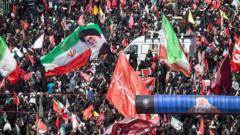
The air in Mashhad does not move. It hangs heavy, thick with the scent of rosewater, burning wild rue, and the sweat of four million bodies pressed shoulder to shoulder under a blinding mid-day sun.
To understand what happened in the northeastern sanctuary city of Iran during the burial of the country’s top leadership, you have to step away from the sterile wire agency reports. The international tickers spoke of crowd sizes, logistics, and state television broadcasts. They used numbers that lose their meaning after the fourth zero. But numbers do not capture the sound of a million open palms striking a million chests in perfect, rhythmic unison. They do not capture the low, vibrating hum that shakes the ancient stone of the Imam Reza shrine, a sound that feels less like human voices and more like the shifting of tectonic plates.
From the window of a third-story tea house overlooking the main boulevard, the city looks altered. The asphalt has vanished. In its place flows a slow, undulating river of black chadors and dark suits, choked so tightly that a single fallen shoe remains crushed where it dropped, impossible to retrieve.
Grief on this scale is rarely simple. It is an industry, a religious obligation, a political statement, and, for many wrapped in its center, an intensely personal reckoning.
The Choreography of the Boulevard
Consider a man standing near the edge of the Tabarsi crossroads. Let us call him Reza. He is fifty-two years old, with graying stubble and a back that aches from standing since dawn. Reza did not fly in on a state-subsidized charter. He walked from the outskirts, his leather shoes biting into his heels. In his left hand, he holds a crumpled portrait printed on cheap cardstock; in his right, a plastic bottle of warm water distributed from the back of an open-air military truck.
For Reza, the spectacle is familiar yet overwhelming. Iran is a nation built on the theater of martyrdom. From the ancient stories of Ashura to the murals of teenage soldiers line-painted on the brick walls of every Tehran alleyway, mourning is the vernacular of power. When a towering figure of the state dies, the state does not merely bury them. It stages an epic.
Buses lined the highways for miles outside the city limits, having ferried workers from government offices, factories, and remote villages across Khorasan province. Attendance is a complex calculus. For some, it is driven by fierce, unyielding loyalty to the Islamic Republic and the promise of religious merit. For others, it is a matter of administrative survival, a checked box on a departmental ledger that ensures a contract renewal or a promotion remains secure.
The heat is the true adversary. It hits the pavement and bounces back, creating a shimmering haze that makes the approaching funeral truck look like a mirage. The vehicle moves at a crawl, a heavy green truck covered in floral wreaths, its roof crowded with security personnel who look down at the sea of upturned faces with a mix of vigilance and exhaustion. They throw small white hand towels soaked in ice water into the crowd. People fight for them. Hands reach out, desperate for a moment of cool moisture against burning skin.
The Sound of the Shrine
As the procession nears the holy shrine of Imam Reza, the emotional architecture changes. The political slogans chanted on the outer avenues give way to something older.
The shrine is the spiritual heart of Iran. Its golden dome reflects the harsh sun with a brilliance that forces you to squint. For centuries, Iranians have come here to weep for their broken hearts, their sick children, and their lost fortunes. It is a place where public crying is not merely accepted; it is expected.
Inside the courtyard, the density reaches a breaking point. The crowd moves not by individual will, but by hydrostatic pressure. If the person to your left sways, you sway. If the crowd surges forward toward the inner sanctum where the burial plot has been prepared, you are carried with it, your feet barely scraping the marble floor.
The sensory overload is total. The loudspeakers wail with the high-pitched, warbling lamentations of a state maddened by sorrow, his voice cracking on cue as he recounts the virtues of the deceased. The sound bounces off the intricate mirror-work of the vaulted ceilings, fracturing into thousands of tiny, glittering needles of noise.
The complexity of the moment lies in the silence between the chants. Watch the faces closely. You see young men with fashionable haircuts standing next to clerics in turbans. You see women weeping so hard they must be supported by their companions, their grief raw and unmistakable. But look deeper into the shadows of the arcades, and you see others. Those who watch with crossed arms. Those whose eyes are blank, heavy with the knowledge of what comes after the mourning ends.
The Unspoken Arithmetic
A state funeral is always an audition for the future. The massive turnout is weaponized immediately by state media, presented as a nationwide referendum on the legitimacy of the system. The message broadcast to the world is simple: look at these millions, we are unified.
But unity in a crowded square does not mean unity in the kitchen or the marketplace.
The real story of Mashhad is the tension between the physical reality of the crowd and the economic reality waiting for them at home. The people in the street are living through a historic moment of inflation, international isolation, and social friction. When the funeral truck passes and the dust settles, the fundamental questions facing the country remain unchanged. Who will fill the vacuum? What happens to the promises left unfulfilled?
The burial itself happens away from the cameras, in a designated tomb within the vast complex of the shrine. It is a privilege reserved for the select few who have shaped the trajectory of the nation. As the body is lowered into the earth, the loudspeakers reach a crescendo, a final, desperate collective cry that echoes through the ancient brickwork.
Then, the slow deflation begins.
The Long Walk Home
By late afternoon, the energy changes. The sun dips behind the jagged mountains surrounding Mashhad, casting long, purple shadows across the avenues. The formal program is over.
The river of people begins to break into smaller streams, then into individual trickles. The streets are left covered in a thick carpet of discarded items. Tens of thousands of crushed plastic water bottles, abandoned banners, torn posters, and single shoes create a strange, modern archaeological layer over the historic city.
The vendors who had closed their shops out of respect or requirement begin to roll up their iron shutters. The smell of saffron ice cream and grilled mutton begins to replace the heavy scent of funeral incense. Life, stubborn and demanding, reasserts itself.
Reza sits on the curb two miles from the shrine, his legs numb. He has rolled up the portrait he carried all day, using it now as a makeshift fan to cool his neck. He has to find a bus back to his village, but the transportation system is choked, paralyzed by the sheer volume of humanity trying to leave all at once.
He looks at his watch. Tomorrow, the offices reopen. The bakeries will have lines. The banks will count the declining value of the currency. The high-stakes political maneuvers in Tehran will accelerate as factions scramble to secure their positions in the new order. The funeral was a pause, a massive, breathless punctuation mark in the middle of a long, turbulent sentence.
The crowd did not just bury a leader in Mashhad. They buried an era. And as the millions disperse into the cooling night, the silence that settles over the city feels heavier than any chant that preceded it.