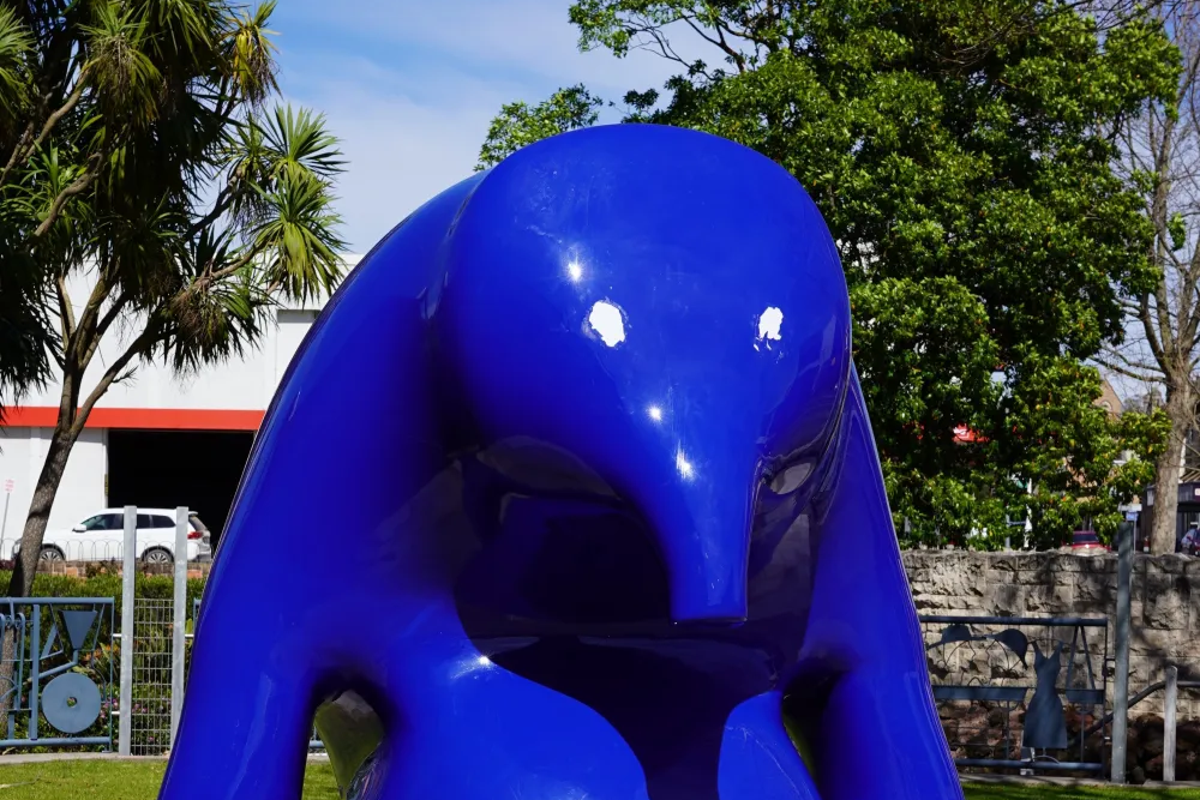
An Australian woman just learned the hard way that one person’s "harmless prank" is another person's criminal record. The "Blue Blob" sculpture in Perth, officially titled Grow Your Own, has been a magnet for criticism and mockery since it landed in the Wellington Street bus station. It's weird. It’s lumpy. It looks like a pile of intestinal transit gone wrong. But after a local activist decided to give the statue a pair of massive googly eyes, the law decided the joke wasn't funny anymore.
The 48-year-old woman was recently convicted in a Western Australian court for her part in the "be-eying" of the $1.1 million public art piece. It sounds like a scene from a low-stakes sitcom, but the legal consequences are real. This isn't just about some plastic eyes and a bit of adhesive. It’s a messy collision between public frustration over "ugly" art and the strict reality of property damage laws. For another view, see: this related article.
The high cost of a million dollar eyesore
The Grow Your Own sculpture, created by artist James Angus, cost taxpayers a staggering $1.1 million. Since its installation in 2011, it’s been the literal and figurative punching bag of the Perth CBD. People hate it. They really, really hate it. It’s been called a "blue turd," a "smurf poop," and a waste of public funds.
When you spend seven figures on something that looks like an unfinished science experiment, you’re asking for trouble. The "Blue Blob" has become a symbol of the gap between elite art circles and the people who actually have to walk past the thing every morning. The woman convicted in this case wasn't just acting on a whim. She was part of a broader sentiment that if the public has to pay for it, the public should at least like looking at it. Similar reporting on the subject has been provided by The Guardian.
The court didn't care about the aesthetic debate. They cared about the fact that she climbed onto a structure and stuck things to it. That’s "graffiti" or "damage" in the eyes of the law, regardless of whether the addition makes the statue look 100% more charismatic.
Why the court didn't see the humor
The defendant argued that the googly eyes were a harmless addition that actually improved the statue’s appeal. Honestly, she’s not wrong. The eyes gave the blob a personality. It turned a cold, confusing shape into a goofy monster. For a few days, people were actually smiling at the Blue Blob instead of scoffing at it.
But here’s where things get sticky for pranksters. The prosecution argued that removing the eyes and the adhesive used to stick them on required professional cleaning. When you're dealing with high-end public art, you can’t just scrape it off with a spatula. The materials used in these sculptures are often sensitive to chemicals or physical abrasion.
The conviction sends a clear message. Don't touch the art.
You might think a bit of double-sided tape is no big deal. The Western Australian judicial system disagrees. By convicting the woman, the court is protecting the "integrity" of the work, even if the work itself is widely loathed. It’s a defense of the artist’s vision against the public’s desire to participate in it.
The weird history of the Blue Blob
This isn't the first time the Grow Your Own sculpture has been targeted. It’s been a target for years.
- It’s been covered in stickers.
- It’s been used as a climbing frame.
- It’s been the subject of countless petitions for removal.
The artist, James Angus, intended the piece to represent the organic growth of plants, specifically the way cells multiply. Most people just see a giant blue blob. That disconnect is exactly why these pranks happen. When art feels forced upon a community without their input, the community feels entitled to "fix" it.
The woman’s conviction included a fine and a requirement to pay for the cleaning costs. It’s a pricey prank. While many in Perth see her as a folk hero, the law sees her as a vandal. This case highlights a growing tension in cities worldwide. We’re seeing more "statement" art that lacks any connection to the local culture, leading to more "corrective" vandalism.
What this means for public art in Australia
If you’re thinking about bringing a pair of googly eyes to your local park, maybe keep them in your pocket. This conviction sets a precedent that "creative commentary" is not a valid defense against property damage charges.
Public art is supposed to provoke a reaction. The Blue Blob certainly does that. But there’s a line between a digital critique on social media and a physical intervention on the street. Once you cross that line, you’re in the territory of the criminal code.
The real lesson here isn't that googly eyes are bad. It’s that the government will spend more money defending a million-dollar mistake than it will listening to why people hate the mistake in the first place. The cleaning bill for those eyes likely cost more than the eyes themselves by a factor of a thousand.
If you want to change the art in your city, the ballot box or the local council meeting is the only legal way to do it. Everything else is just an expensive way to get a court date.
Keep your hands off the sculptures. If it's ugly, let it be ugly. Document the eyesore, complain to your local member of parliament, and let the sun fade the paint naturally. The "Blue Blob" will probably outlast us all, lumpy and unblinking, because the law ensures that even the most hated art remains untouched by the people who paid for it.
Check your local council’s public art policy before you get ideas about "improving" a landmark. Most cities have a process for reporting damaged or unpopular art, which is a lot safer than carrying a ladder and a bucket of glue into the city center at midnight.