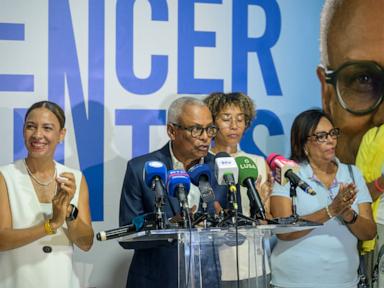
Provisional results from Cape Verde's presidential election confirm that the incumbent president has secured a second five-year term, avoiding a runoff by clearing the required majority threshold in the first round of voting. While regional observers quickly praised the island nation for another peaceful transfer of democratic validation, the surface-level stability masks a much more complicated reality. Beneath the orderly ballot boxes in Praia and Mindelo lies a deepening structural tension between a ceremonial presidency, an assertive prime minister, and an electorate quietly signaling fatigue with the two-party duopoly that has governed the archipelago since 1991.
Most wire reports treat Cape Verdean elections as predictable exercises in West African democratic maturity. They miss the real story. In a semi-presidential republic where executive power resides primarily with the prime minister and the National Assembly, the presidency is often dismissed by outsiders as a prestige post. That reading is dangerously naive. Over the past five years, the office of the president has evolved into the primary institutional counterweight to single-party dominance, turning every constitutional review, judicial appointment, and foreign policy pronouncement into a quiet tug-of-war over who actually steers the country.
The Architecture of Coexistence in Praia
To understand why this reelection matters, you have to look at how power is divided on paper versus how it operates in the humid corridors of Praia. Under the 1992 Constitution, Cape Verde operates a semi-presidential system modeled loosely on Portugal. The prime minister runs the government, controls the budget, and commands the legislative majority. The president acts as head of state, commander-in-chief of the armed forces, and guarantor of constitutional regularity.
It sounds neat in a textbook. In practice, it creates a permanent pressure cooker whenever the president and the prime minister hail from rival political camps.
In Cape Verde, political life has long been defined by two dominant forces. On one side stands the African Party for the Independence of Cape Verde (PAICV), the historic liberation movement that transitioned from single-party rule to center-left social democracy. On the other stands the Movement for Democracy (MpD), the center-right party that broke the monopoly in 1991 and has traded power with the PAICV ever since. When the presidency is held by a figure aligned with the opposition to the sitting cabinet, cohabitation becomes the defining feature of governance.
During his first term, the president mastered the art of strategic friction. Without direct control over ministries or spending, a Cape Verdean head of state relies on three primary levers:
- The Veto Power: Sending legislation back to the National Assembly forces a supermajority override or uncomfortable public concessions, stalling government priorities without firing a single political shot.
- Constitutional Referral: Requesting preventive review from the Constitutional Court allows the president to freeze controversial bills on legal grounds, shifting political battles into the judicial arena.
- The Bully Pulpit: In a small, tightly knit society of roughly 500,000 resident citizens, a presidential speech questioning economic inequality or administrative transparency reverberates through every radio broadcast and neighborhood café from Santo Antão to Brava.
Winning a second five-year term removes the constraint of seeking reelection. A second-term president in Praia owes nothing to future voters. That freedom transforms the office from a cautious diplomatic post into an uninhibited political referee during a period when the country faces acute economic headwinds.
What the Provisional Turnout Numbers Actually Reveal
Headline coverage of the election focused almost exclusively on the margin of victory. Analysts who spent time looking at the precinct-level returns saw something far more unsettling for the political establishment. Voter participation across the ten islands—and within the massive Cape Verdean diaspora—remained stubbornly low compared to the enthusiastic turnouts of the 1990s and early 2000s.
Abstention has become the silent third party in Cape Verdean politics.
For decades, international indices ranked Cape Verde near the top of African governance charts, right alongside Mauritius and Botswana. Those rankings are earned. Elections are free, ballots are counted transparently, and defeated candidates concede within hours rather than taking disputes to the streets. Yet high institutional marks do not pay electricity bills on Santiago or create steady jobs on São Vicente.
A young graduate in Mindelo looking at the provisional results sees the same familiar political surnames that have dominated public life for thirty years. When voter turnout hovers around or below the halfway mark, a first-round majority represents a plurality of engaged partisans rather than a sweeping mandate from the entire nation. The incumbent won because his party machinery mobilized its base efficiently and his opponents failed to construct a unified alternative capable of breaking through voter apathy.
The Diaspora Factor
No analysis of a Cape Verdean election is complete without accounting for the diaspora vote. More people of Cape Verdean descent live abroad—concentrated heavily in the United States, Portugal, France, the Netherlands, and Luxembourg—than reside on the islands themselves.
Overseas polling stations routinely exhibit sharp divergence from domestic results. Emigrant communities track island politics intensely through digital media and family networks, yet their voting behavior is shaped by different anxieties. Diaspora voters care deeply about consular efficiency, property rights on the islands, customs duties on shipped goods, and the stability of the Cape Verdean escudo, which remains pegged to the euro. In this election, logistical friction at overseas consulates and chronic registration bottlenecks once again dampened turnout abroad, leaving tens of thousands of eligible voices on the sidelines.
Tourism Dependence and the Vulnerability of the Island Economy
The economic backdrop to this second term is unforgiving. Cape Verde possesses almost no extractable natural resources, scarce arable land, and chronic freshwater deficits that require expensive desalination infrastructure. Its modern development miracle was built on three pillars: remittances from abroad, concessional foreign aid, and high-volume European beach tourism concentrated heavily on the flat, arid islands of Sal and Boa Vista.
That model is showing severe structural cracks.
When global shocks hit—whether pandemic travel freezes or European inflation squeezing household vacation budgets—Cape Verde feels the tremor immediately. Tourism accounts for roughly a quarter of the nation's gross domestic product and an even larger share of formal employment and foreign exchange earnings. Yet the economic benefits remain heavily concentrated. All-inclusive resorts on Sal import much of their food, beverages, and construction materials, meaning a substantial portion of every tourist euro leaks right back out of the local economy before reaching a farmer in Fogo or a fisherman in Maio.
Meanwhile, inter-island connectivity remains an enduring domestic grievance. Moving goods and people across an archipelago scattered over hundreds of kilometers of open Atlantic ocean is expensive and unreliable. Domestic air travel has suffered repeated financial restructurings, cancellations, and state bailouts, while maritime ferry schedules regularly test the patience of residents and small business owners.
A president cannot single-handedly rewrite fiscal policy or negotiate airline leases. However, by using the second term to spotlight regional disparities between the tourism hubs and the agricultural islands, the presidency can force the cabinet to defend budget allocations it would prefer to pass quietly.
Geopolitics in the Mid-Atlantic
Outside observers often overlook Cape Verde's strategic geography, though Washington, Brussels, Beijing, and Lisbon never do. Sitting roughly 570 kilometers off the coast of Senegal, the archipelago occupies prime real estate astride major Atlantic shipping lanes and undersea fiber-optic cables connecting Europe, Africa, and South America.
During his first term, the president walked a delicate diplomatic tightrope. Cape Verde maintains a Special Partnership with the European Union, deep historical and security ties with Portugal, and expanding defense cooperation with the United States, particularly around maritime domain awareness and counter-narcotics patrols. At the same time, China has financed major infrastructure projects across Praia, including government buildings, port upgrades, and the campus of the University of Cape Verde.
Keeping all four partners satisfied requires constant calibration.
Over the next five years, pressure from Western allies to scrutinize Chinese involvement in port logistics and telecommunications infrastructure will intensify. Simultaneously, maritime security threats in the Gulf of Guinea and across the broader Atlantic corridor—ranging from transnational narcotics trafficking to illegal, unreported, and unregulated fishing—demand sustained international cooperation. As commander-in-chief and the nation's chief diplomatic representative, the reelected president will serve as the primary interlocutor managing these competing external interests while trying to extract development financing without surrendering strategic autonomy.
The Succession Shadow Over Both Major Parties
Perhaps the most consequential impact of this election has nothing to do with immediate legislation. By locking in the presidency for another five years, the incumbent has effectively frozen the top tier of his party's hierarchy while forcing the rival camp into an uncomfortable period of introspection.
In small democracies, political networks are intensely personal. A second-term president naturally becomes a focal point for younger politicians looking beyond the current legislative cycle. Every diplomatic appointment, every honorary decoration, and every regional visit over the next sixty months will be scrutinized by local commentators for clues about who the president favors to carry the mantle in the next national cycle.
For the opposition, failing to force a runoff is a sobering blow. When a challenger cannot even push an incumbent into a second round, internal recriminations follow quickly. Questions immediately surface about candidate selection, campaign messaging, and whether the party's economic platform resonates with urban youth in Praia who care less about historical liberation credentials and more about housing costs, digital connectivity, and visa access to Europe.
Where the Institutional Guardrails Stand
Critics of the reelected president argue that his first term occasionally blurred the line between constitutional arbitration and partisan obstruction. Supporters counter that an assertive head of state is the only thing preventing a parliamentary majority from treating state institutions, public media, and state-owned enterprises as party property.
Both arguments carry weight.
Cape Verde's democratic durability has never rested on the perfection of its politicians. It rests on institutional friction—the deliberate arrangement of overlapping authorities that forces rival leaders to negotiate rather than rule by decree. A tame presidency rubber-stamping every government initiative weakens that architecture just as surely as a reckless presidency paralyzing legitimate administration.
The Five-Year Reality Check
Winning reelection is the easy part of Cape Verdean politics. Governing through the aftermath is vastly harder.
Over the next five years, the reelected president will preside over a nation grappling with climate vulnerability, rising sea levels threatening coastal infrastructure, persistent youth unemployment, and an aging diaspora whose remittances may gradually taper off as second- and third-generation emigrants integrate deeper into Boston, Lisbon, and Rotterdam. International praise for another smooth election day will fade within forty-eight hours, replaced by the stubborn arithmetic of an island economy trying to diversify beyond sun, sand, and foreign aid.
The ballot boxes in Praia have been sealed and the provisional tallies logged, leaving the incumbent with five unencumbered years to prove that a constitutional referee can actually move the needle on the daily economic anxieties his voters quietly carried into the polling booth.