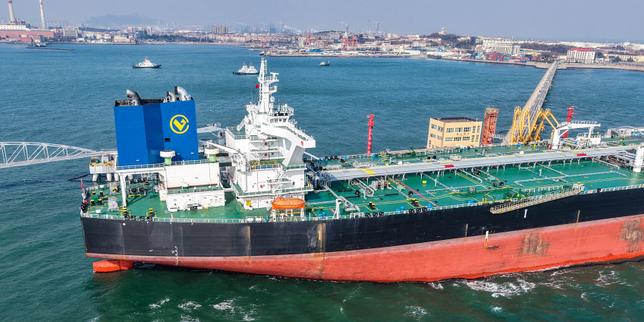
Beijing is currently attempting to navigate a geopolitical minefield in the Strait of Hormuz to secure its energy lifeline. While general news reports focus on the immediate friction between regional powers, the real story lies in China’s frantic diplomatic and economic maneuvering to ensure that its oil supply remains uninterrupted by a conflict it cannot afford. China imports roughly 40 percent of its crude oil from the Persian Gulf, and the Strait of Hormuz serves as the singular, narrow gateway for this massive energy flow. Any prolonged blockage or significant disruption in these waters would trigger an immediate industrial paralysis within the Chinese mainland, a reality that keeps the leadership in Beijing awake at night.
The situation is not merely a matter of regional instability. It is a fundamental threat to the Chinese economic model. Unlike the United States, which has achieved a high degree of energy independence through domestic shale production, China remains tethered to the Middle East. This dependency creates a massive strategic vulnerability. If the Strait closes, the global price of oil shoots into the stratosphere, and China’s manufacturing edge evaporates instantly.
The Energy Trap and the Malacca Dilemma
To understand why China is so desperate to "unblock" or preemptively secure the Strait of Hormuz, one must look at the map. The Chinese strategy has long been haunted by the "Malacca Dilemma," the fear that a rival power could choke off its energy supplies at the Malacca Strait. However, the Strait of Hormuz is even more critical because it is the source. If the tap is closed at the Persian Gulf, the Malacca Strait becomes irrelevant.
Beijing has spent the last decade building a network of "special relationships" with every major player in the region, from Iran to Saudi Arabia. The goal is simple. China wants to be the indispensable customer that no one wants to offend. By positioning itself as a neutral, pro-trade partner, China hopes to exert enough soft power to prevent any one actor from taking the "nuclear option" of closing the Strait.
The Belt and Road as a Safety Valve
The vast investments in the Belt and Road Initiative (BRI) are often discussed in terms of infrastructure and debt, but in the context of the Strait of Hormuz, they are survival mechanisms. China is pouring billions into the Gwadar port in Pakistan and various pipelines through Central Asia. These projects are designed to bypass the maritime choke points entirely.
If a tanker cannot leave the Persian Gulf, these land routes are supposed to fill the gap. However, the math does not yet add up. The capacity of current and planned pipelines through Russia and Central Asia is a fraction of what moves through the Strait of Hormuz daily. China is essentially trying to build a secondary circulatory system for its economy while the primary artery remains under constant threat of a clot.
The Limits of Naval Projection
China’s People’s Liberation Army Navy (PLAN) has expanded at a record pace, but its ability to protect the Strait of Hormuz remains limited. While they have a base in Djibouti and have conducted joint drills with Iran and Russia, they lack the "blue water" sustained presence required to clear a naval blockade thousands of miles from their home ports.
For now, China’s primary weapon is the checkbook. They have signed a 25-year, $400 billion strategic pact with Iran, which on paper ensures energy cooperation. In reality, this is a bribe for stability. By investing in Iranian infrastructure, China is betting that Tehran will think twice before causing a disruption that would hurt its only major global backer. At the same time, China remains the largest buyer of Saudi oil, playing both sides of the regional rift to keep the water open.
The Hidden Cost of Neutrality
This balancing act is becoming increasingly expensive and politically fraught. As tensions between Israel, Iran, and various proxy groups escalate, the expectation for China to "do something" grows. The West often criticizes Beijing for benefiting from the security provided by the U.S. Fifth Fleet while simultaneously undermining Western diplomatic efforts.
China’s "unblocking" strategy involves a heavy dose of "shuttle diplomacy." Chinese envoys are constantly moving between Riyadh and Tehran, urging restraint. They are not doing this out of a sense of global peace-making. They are doing it because they are the world's largest importer of oil and cannot survive a $150-a-barrel world.
Private Security and Shadow Fleets
One of the more overlooked aspects of China’s approach is the use of "shadow fleets" and private maritime security. To circumvent sanctions and keep the oil moving through contested waters, Chinese companies often utilize older tankers with obscured ownership. These ships operate outside the traditional insurance and tracking frameworks, making them harder to target through legal or diplomatic means.
Furthermore, Chinese private security companies are increasingly visible in the region. These are not official military forces, but they provide protection for Chinese assets and personnel on the ground and at sea. This allows Beijing to protect its interests without the political fallout of a formal military intervention. It is a gray-zone tactic that fits perfectly with their broader strategy of achieving security through non-traditional means.
The Economic Consequences of a Black Swan Event
What happens if the diplomatic efforts fail? If the Strait of Hormuz is mined or blocked by a sunken vessel, the global economy enters a tailspin. For China, the fallout would be catastrophic.
- Inflationary Shock: The cost of everything from plastics to transportation would skyrocket.
- Factory Closures: Small and medium enterprises in China’s coastal provinces, already operating on thin margins, would go bankrupt within weeks.
- Social Unrest: Historically, the Chinese government’s legitimacy is tied to economic growth. A sudden, sharp contraction caused by an energy crisis is the ultimate nightmare for the Communist Party.
Beijing is aware that their current "unblocking" efforts are a temporary fix. They are essentially buying time. They are racing to transition to electric vehicles and renewable energy not just for the environment, but for national security. Every wind turbine installed in Inner Mongolia is one less drop of oil they need to shepherd through the Strait of Hormuz.
The Reality of Regional Hegemony
China’s ultimate goal is a regional order where the U.S. is no longer the primary security guarantor. They want a "multipolar" Middle East where local powers manage their own security under the benevolent gaze of a Chinese trade partner. This is a tall order. The deep-seated religious and territorial animosities in the region do not simply disappear because there is a new buyer for the oil.
The current attempts to de-escalate tensions in the Strait are a test of China’s maturity as a global power. Can they actually mediate a peace, or are they just a wealthy passenger on a ship they don't control? The evidence suggests the latter. While they have successfully brokered a symbolic rapprochement between Saudi Arabia and Iran, the underlying volatility remains.
Strategic Stockpiling as a Final Defense
In the background of all these diplomatic moves, China has been quietly building the world's largest Strategic Petroleum Reserve (SPR). They have filled massive underground caverns and coastal tank farms with hundreds of millions of barrels of oil.
This stockpile is intended to give China a three-to-six-month window of survival in the event of a total blockade. It is a "break glass in case of emergency" measure. The speed at which they are filling these reserves indicates that they view a disruption in the Strait of Hormuz not as a remote possibility, but as an impending probability.
The Future of the Choke Point
The Strait of Hormuz will remain the world's most dangerous piece of water for the foreseeable future. China’s strategy of "unblocking" the traffic through a mix of diplomacy, shadow shipping, and alternative land routes is an admission of their current naval weakness. They are trying to solve a hard military problem with soft economic tools.
Whether this works depends entirely on the restraint of regional actors who may value their own ideological goals over China’s economic health. Beijing is betting that money talks louder than history. It is a high-stakes gamble with the entire global economy on the table.
Companies operating in the global supply chain must prepare for the reality that the "Hormuz Risk" is no longer a theoretical exercise but a daily factor in Chinese strategic planning. The move toward diversifying supply chains away from China is, in part, a reaction to this very vulnerability. If China cannot guarantee its own energy security, it cannot guarantee the reliability of its exports.
The clock is ticking for Beijing to complete its transition to a post-oil economy or to find a way to secure the Strait without sparking the very conflict they are trying to avoid.
Monitor the daily tanker transit counts through the Strait of Hormuz as the primary indicator of regional stability.