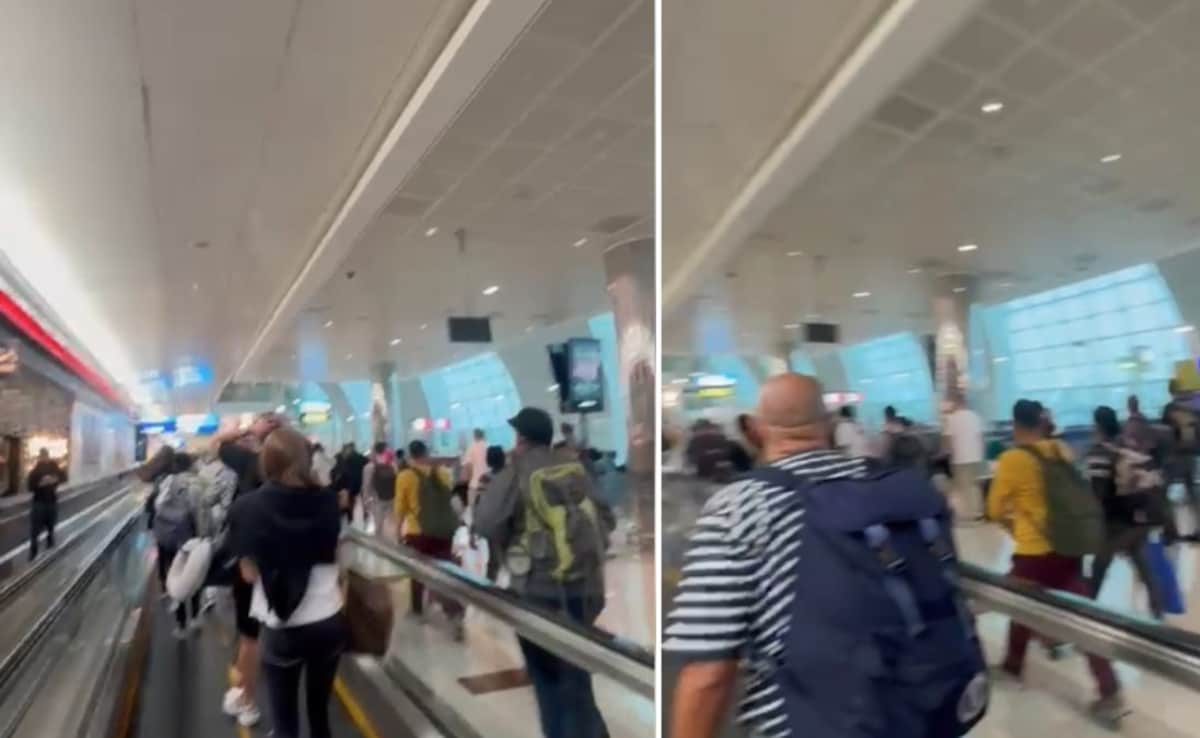
The marble floors of Dubai International Airport usually hum with the sound of a million distinct lives intersecting for a fleeting, pressurized second. It is a city that never sleeps because the sun is always rising somewhere else, and DXB is the lung through which that global movement breathes. But when the sky turned a bruised, impossible purple and the clouds emptied a year’s worth of rain in twenty-four hours, the lung seized.
The water didn’t just flood the runways. It drowned the clock.
Consider a traveler we will call Elena. She is not a statistic in a flight delay report, though the spreadsheets would later categorize her as such. She is a consultant from Madrid who found herself sitting on her carry-on suitcase in Terminal 3, watching the water rise against the glass barriers. For Elena, the "operational disruption" cited in official bulletins translated to the smell of damp wool, the dimming of terminal lights to conserve power, and the haunting sight of Emirates’ massive A380s sitting in a lake of silvered rainwater, their engines silent like beached whales.
The logistics of a global hub are delicate. They rely on a terrifyingly precise choreography of fuel, food, and human stamina. When the record-breaking deluge hit the United Arab Emirates, that choreography collapsed into a chaotic improvisational dance.
The Mechanics of a Stalled Giant
Dubai Airports eventually issued the update the world was waiting for: a transition from total paralysis to a "limited" resumption of flights. But "limited" is a word that carries a heavy weight when fifty thousand people are displaced within a single building. At Dubai International (DXB) and the secondary Al Maktoum International (DWC), the priority shifted from moving people to simply managing the human tide.
The recovery of an airport is not as simple as mopping the floor and opening the gates.
Every plane that didn't take off during the storm is a plane that isn't where it needs to be for its next three flights. It is a mathematical nightmare of cascading failures. If a flight from London to Dubai is canceled, the aircraft isn't there to take the next group of passengers to Sydney. The crew times out. They reach their legal limit of wakefulness and must rest, yet there are no hotel rooms because the city’s roads are submerged.
This is the invisible gridlock. Even as the water receded from the tarmac, the digital backlog remained a towering wall.
The Protocol of the Patient
The official advice from airport authorities was stark: Do not come to the airport unless your flight is confirmed.
In a world where we are used to "refreshing" our way out of problems, this was a hard pill to swallow. Thousands ignored the warning, driven by the desperate hope that being physically present would somehow conjure a seat on a plane. They turned the check-in areas into a sprawling, makeshift village. Business travelers in tailored suits shared blankets with backpackers; families used duty-free bags as pillows.
The authorities weren't being cold when they told people to stay away. They were trying to prevent a humanitarian crisis inside a transit hub. An airport is designed to process people, not to house them. When the bathrooms reach capacity and the food supplies in the lounges begin to dwindle, the glamorous facade of the world’s busiest international gateway thins out, revealing the fragile infrastructure beneath.
A Slow Return to the Skies
Check-in eventually reopened for Emirates and flydubai at Terminal 3, but it was a staggered, limping start. The airline staff, many of whom had slept under their desks or waded through waist-deep water to reach their shifts, faced a sea of exhausted, frustrated faces.
The priority was clear but painful. Perishable goods, medical supplies, and those who had been stranded longest were moved toward the front of the metaphorical line.
But the "confirmed" status became a moving target. Travelers would see a green light on their app, fight their way through still-flooded side streets to reach the terminal, only to find that the "limited" nature of the reopening meant their flight had been pushed back another twelve hours. The volatility of the schedule was its own kind of weather system—unpredictable and unforgiving.
The sheer scale of the UAE's rainfall—the heaviest since records began in 1949—served as a reminder that even the most high-tech cities are secondary to the whim of the elements. Dubai is a city built on the mastery of its environment, a shimmering testament to what human engineering can achieve in a desert. Yet, for forty-eight hours, the desert reclaimed its right to be inhospitable.
The Human Cost of Lost Time
We often talk about travel in terms of miles or money. We rarely talk about it in terms of the moments it steals.
In the corner of Terminal 1, an elderly man stared at a blank departure screen. He was trying to get to a wedding in Mumbai. He had the gift in his bag—a heavy, ornate clock. He joked darkly with a passerby that by the time he arrived, the couple would already be celebrating their anniversary.
Behind the jokes, there was a genuine, aching fatigue. This is the emotional core of a travel disaster. It is the fear of missing a funeral, the stress of a job interview that won't be rescheduled, or the simple, crushing exhaustion of a mother trying to keep a toddler calm in a room with five thousand strangers and no clean diapers.
The resumption of flights at DWC provided a small relief valve, but the recovery remained a grueling climb. It wasn't just about clearing the runways; it was about re-syncing the world’s watches.
The Ghost in the Machine
As the sun finally broke through the clouds, reflecting off the standing water that still hugged the perimeter fences, the first few planes began to roar back into the sky. The sound, usually a background hum for the city, felt like a victory.
But the lesson of the Great Deluge remains.
Our global connectivity is a marvel, yet it is held together by a surprisingly thin thread. We have built a world that assumes "normal" is a permanent state. We assume the planes will always fly, the apps will always update, and the rain will always be manageable. When that assumption breaks, we find ourselves stripped back to the basics: looking for a place to sit, a bottle of water, and a glimmer of news from someone in a uniform.
The backlog will eventually clear. The marble floors will be polished until the footprints of the stranded are gone. The schedules will align, and the "limited" tag will be removed from the headlines.
Elena eventually boarded a flight. She looked down at the city as the plane climbed, seeing the pools of water still gathered in the lowlands of the desert. She felt a strange pang of loss—not for the time she spent on the floor of the terminal, but for the illusion of control she had carried with her when she checked in.
The desert is still there, beneath the concrete. The sky still holds more water than we can fathom. We are just moving through it, whenever the clouds allow us passage.
The gates are open, but the silence of the grounded fleet still echoes in the back of the mind.