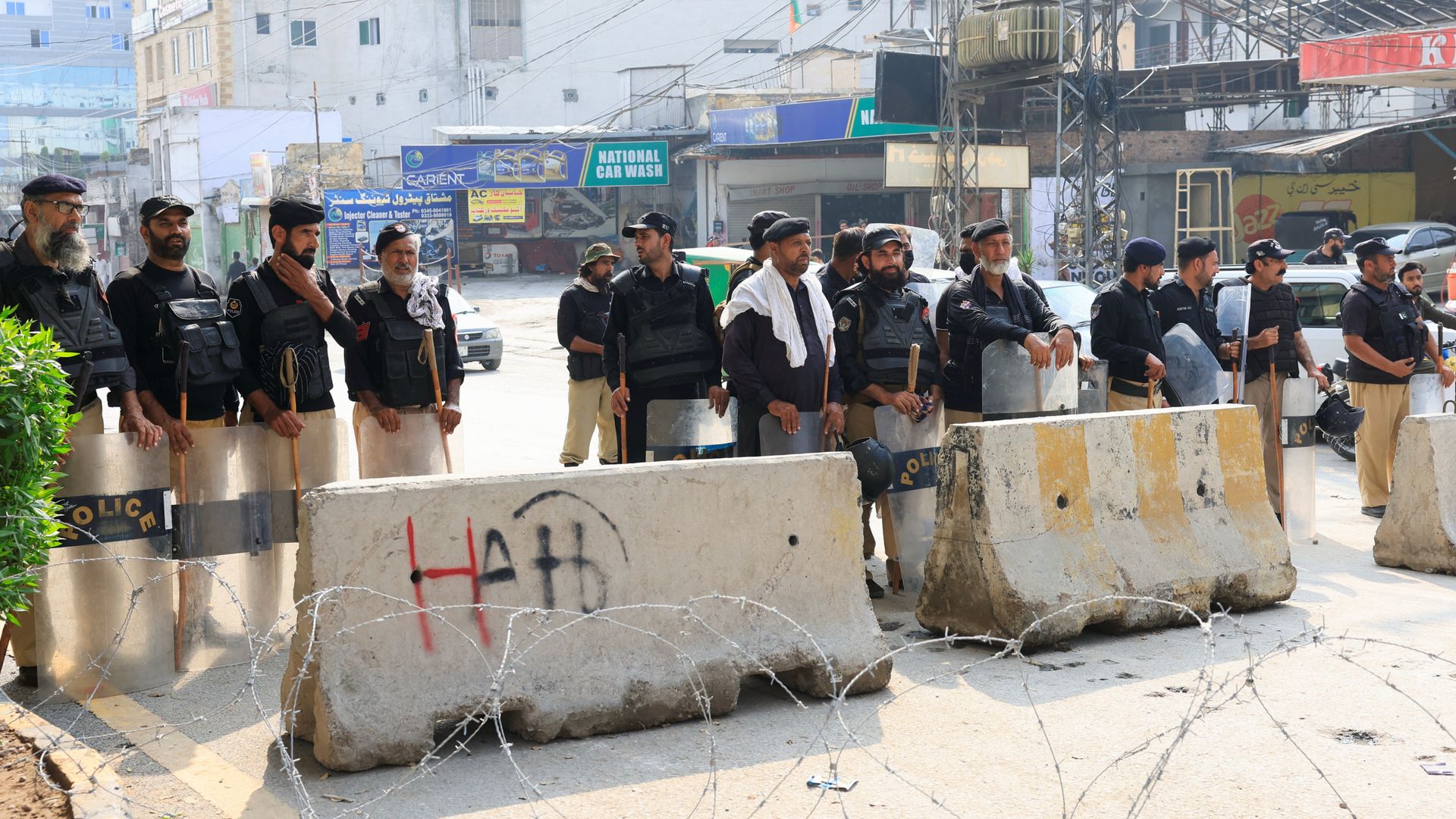
The proclamation of a state of emergency in Khyber Pakhtunkhwa under Articles 232 and 233 of the Constitution of Pakistan marks a structural escalation in the country's institutional power struggle. By suspending the provincial administration—controlled by Pakistan Tehreek-e-Insaf (PTI), the party of imprisoned former Prime Minister Imran Khan—the federal government led by Prime Minister Shehbaz Sharif and President Asif Ali Zardari bypassed standard democratic subnational federalism. The intervention fundamentally alters the operational mechanics of governance in Pakistan's northwest, replacing subnational autonomy with direct federal executive control.
The Institutional Mechanics of Federal Intervention
Under Pakistan's constitutional framework, the declaration of an emergency is designed as an exceptional mechanism for acute territorial threats, such as war, external aggression, or internal disturbances beyond the administrative capacity of a provincial government. The federal administration utilized this instrument to achieve three distinct operational outcomes: Recently making news lately: Stop Demanding Palestinian Elections That Only Serve Autocrats and Donors.
- Executive Supersession: The suspension of the elected provincial cabinet strips local leadership of policy execution, transferring executive authority directly to the federally appointed governor and chief secretary.
- Security Redirection: The centralization of police and administrative apparatuses subordinates regional security forces to federal directives, neutralizing the province's capacity to act as a staging ground or protective shield for opposition movements.
- Logistical Interdiction: The deployment of federal security forces and the strategic blocking of major transit corridors, such as those leading into Islamabad, effectively disrupt the logistics of mass political mobilization.
This institutional pivot illustrates a recurring dynamic in developing federal states: when subnational governments become political counterweights to the central regime, constitutional emergency provisions are frequently repurposed as instruments of administrative realignment.
The Divergent Cost Functions of Conflict
The confrontation between Islamabad and the PTI administration in Khyber Pakhtunkhwa operates within a high-stakes cost matrix for both actors. Further insights into this topic are covered by Reuters.
For the federal government and the military establishment, the primary risk was the consolidation of a hostile regional government capable of bankrolling and facilitating sustained mass protests directed at the capital. The cost of inaction involved a paralyzed federal writ, ongoing legislative paralysis, and a deteriorating security narrative. By imposing emergency rule, Islamabad accepted the immediate cost of severe international and domestic criticism—including accusations of executing a civilian coup—to eliminate a localized institutional base of opposition.
For PTI, the cost function centers on organizational survival. Deprived of executive control in its primary geographic stronghold, the party faces a severe contraction of administrative resources, patronage networks, and institutional leverage. Yet, the centralization of power also deepens the grievances of its electoral base, reinforcing the narrative of political marginalization that underpins Khan's enduring popularity.
Strategic Trajectories
The federalization of Khyber Pakhtunkhwa does not resolve the underlying structural friction of Pakistan's political economy; it merely suppresses it through administrative fiat. Subnational resistance is likely to shift from institutional obstruction to decentralized civil disobedience and protracted legal challenges regarding the proportionality and constitutional validity of the emergency decree. The durability of the federal control depends entirely on the capacity of security forces to sustain operational lock down without triggering a systemic breakdown in civil administration across the northwestern frontier.


