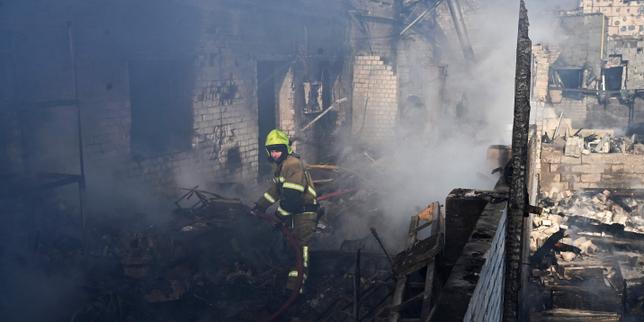
The Silence of the Sirens
In the Donbas, the silence is heavier than the noise. When the artillery is firing, you know where the world stands. You know the distance of the impact, the caliber of the shell, and the direction of the threat. But when the air goes still, the tension migrates from the ears to the marrow of the bone.
Olena lives in a basement in a village whose name has been erased from most maps but remains etched in the daily briefings of military commanders. She is sixty-eight. Her world has shrunk to the size of a flashlight beam and the rhythmic drip of condensation from a concrete ceiling. To the analysts in Brussels or Washington, Olena’s village is a "strategic vector" or a "contested node." To Olena, it is simply the place where her husband’s rosebushes used to grow before the shrapnel turned them into blackened wire.
This is the reality behind the headline updates. While the world tracks "incremental gains" on a digital map, the human cost is measured in the calories of a cold tin of soup and the dwindling supply of heart medication.
The Geometry of Survival
Modern warfare is often described through the lens of technology—drones, electronic jamming, and satellite imagery. We talk about the frontline as if it were a mathematical line drawn in the dirt. It isn’t. The frontline is a shifting, breathing organism of mud and iron.
Consider the current stalemate. On paper, it looks like a pause. In reality, it is a frantic race against physics. The Ukrainian defense relies on a complex web of Soviet-era grit and Western precision. When a battery of Patriot missiles intercepts a cruise missile over Kyiv, the "win" is recorded as a statistic. But for the family sleeping in a subway station directly beneath the interception, that statistic is the difference between waking up to breakfast or never waking up again.
The logistics of this conflict are a nightmare of incompatible parts. Imagine trying to fix a Swiss watch with a sledgehammer, or vice versa. Technicians in secret workshops near the Polish border are currently performing mechanical miracles, mating German leopard tanks with spare parts scavenged from half a dozen different nations. They work in the dark to avoid thermal detection. Their hands are permanently stained with oil and cold. This isn't just "military support." This is a desperate, makeshift engineering project upon which the sovereignty of a nation hangs.
The Invisible Stakes
Why does a patch of charred forest in Eastern Europe matter to a baker in Ohio or a programmer in Seoul?
The answer isn't found in the soil, but in the precedent. We are currently watching the slow, agonizing stress-test of the post-1945 global order. If the lines on the map can be redrawn by the weight of artillery alone, then every border on the planet becomes a suggestion rather than a rule.
There is a psychological exhaustion setting in. It’s a natural human reflex. We see a tragedy, we feel the surge of empathy, and then—slowly—we look away. The "news cycle" is a cruel mechanism. It demands novelty. But there is nothing novel about a trench in winter. There is nothing "breaking" about a grandmother waiting for a bread truck that might never arrive because the road is under fire-control.
The stakes are invisible because they are systemic. We are talking about the stability of the grain markets that feed North Africa. We are talking about the price of neon gas used to etch the microchips in your smartphone. Most importantly, we are talking about the soul of international law.
The Arithmetic of Loss
Let’s look at the numbers, but let’s look at them through the eyes of a recruiter.
The average age of a soldier on the front lines has climbed. These are not just nineteen-year-olds with dreams of glory. These are forty-year-old fathers, history teachers, and taxi drivers. When a "brigade" is depleted, it isn't just a unit being removed from an order of battle. It is a generation of institutional knowledge, parenting, and civic life being burned away.
The data tells us that thousands of shells are fired every day. Each shell costs more than a luxury car. The sheer economic absurdity of it is staggering. We are watching decades of accumulated wealth—both Western and Russian—being converted into smoke and scrap metal in a matter of hours.
Hypothetically, imagine a young man named Serhiy. Before the escalation, Serhiy was a software developer in Kharkiv. He liked craft beer and cycling. Today, Serhiy spends his time calculating the trajectory of mortar rounds. He hasn't touched a keyboard in two years. His hands are calloused, and he has a permanent tremor from the concussive force of nearby blasts. If the war ended tomorrow, Serhiy wouldn't go back to his old life. That life is gone. The city he knew is a patchwork of boarded-up windows and "glory to the heroes" murals.
The Winter Gamble
Weather is the ultimate commander. As the ground freezes and thaws, the tactical advantage shifts like sand. Mud—the thick, black chernozem of the region—is a literal trap for armored vehicles. It turns a billion-dollar offensive into a slow-motion target practice.
The current strategy on both sides has become a grim endurance test. Russia is betting on the "fatigue" of the West. They are waiting for the headlines to move on, for the budgets to tighten, and for the political will of the European Union to fracture under the weight of energy costs and refugee logistics.
On the other side, Ukraine is betting on a "asymmetric" victory. They are using sea drones—essentially explosive jet skis—to push back a massive Black Sea fleet. They are using consumer-grade drones to take out multi-million dollar air defense systems. It is David versus Goliath, but David is out of stones and is currently asking the neighbors if he can borrow some.
The Echo in the Room
There is a specific sound that haunts the residents of frontline cities. It isn’t the explosion. It’s the whistle.
If you hear the whistle, the shell isn't for you. It’s passing over. You only fear the ones you don't hear coming. This creates a strange, distorted way of living. People in Kramatorsk still go to cafes. They sit behind sandbagged windows, sipping lattes while the horizon thuds. It isn't bravado. It’s the only way to keep from going mad. If you stop living, the invasion has already won.
We often hear about "fatigue" in the comfortable West. We are tired of the news. We are tired of the debates over funding. But consider the fatigue of a mother who has to explain to her six-year-old why the playground is a "red zone." Consider the fatigue of a surgeon who has performed twenty amputations in a single shift.
The "point on the situation" isn't a line on a map. It is the endurance of the human spirit against an industrial-scale attempt to break it.
The Horizon of Uncertainty
No one knows how this ends. Anyone who claims to have a "peace plan" that fits in a tweet is lying to you. The grievances are too deep, the craters too wide, and the graveyards too full for a simple handshake.
But there is a truth that remains even when the facts are dry: the cost of a quiet sky is immeasurable. For Olena in her basement, for Serhiy in his trench, and for the world watching on its screens, the silence isn't peace. It’s just the breath taken before the next scream.
The dust settles on the ruins of a school in Avdiivka, and for a brief moment, a single bird lands on a twisted piece of rebar. It chirps, a fragile, ridiculous sound in a landscape of iron. Then, from ten miles away, the heavy thud of a howitzer begins the cycle all over again.
Would you like me to analyze the specific economic impacts of these frontline shifts on global energy markets for 2026?