The air in the hangar at the edge of Ankara is thin and tastes of ozone and hydraulic fluid. There is no applause here, only the rhythmic, metallic clinking of wrenches against titanium. A technician, perhaps thirty years old, wipes a streak of grease across his forehead as he stares at the sleek, matte-grey fuselage of an Akinci drone. He isn't thinking about geopolitical shifts or the delicate rebalancing of the NATO scales. He is thinking about the flight software stabilization for a bird that can stay aloft for twenty-four hours without blinking.
Yet, this single hangar is the epicenter of a quiet earthquake.
For decades, the story of European defense was a tale of two sides of the Atlantic. You bought American if you wanted power; you bought German or French if you wanted craftsmanship. Turkey was the perennial outsider, the gatekeeper of the Bosporus, useful for its geography but rarely invited to the main table of the high-tech arms industry.
That table has been flipped.
While European capitals spent thirty years enjoying a "peace dividend" that left their ammunition stockpiles bone-dry and their factories dormant, Ankara was quietly building a fortress. This wasn't an accident. It was a reaction to being left out in the cold. When the West hesitated to sell Turkey the eyes and ears it needed for its own borders, the engineers in Istanbul and Ankara stopped waiting. They started soldering.
Consider the Bayraktar TB2. It is not the most expensive drone in the world. It isn't even the fastest. But in the muddy trenches of Ukraine and the rugged mountains of Nagorno-Karabakh, it became a legend. It did something the multi-billion-dollar defense programs of the West often fail to do: it worked, it was affordable, and it was available immediately. It turned the tide of modern warfare before the bureaucracies in Brussels could even finish their first subcommittee meeting on procurement.
The reality on the ground is stark. Europe is waking up to a continent where the old security umbrellas are fraying at the edges. The war in Ukraine didn't just break the peace; it broke the supply chains. When Poland or the Baltic states look for a partner who can deliver sophisticated hardware without a ten-year waiting list, they are increasingly looking southeast.
It is a strange irony. The nation that was once told it wasn't "European enough" for the Union has become the literal backbone of Europe's rearmament.
But why Turkey? Why now?
The answer lies in the concept of "sovereign tech." Turkey realized earlier than most that in the 21st century, if you don't own the code and the carbon fiber, you don't own your own foreign policy. They invested heavily in a localized ecosystem. They didn't just buy parts; they built the machines that make the parts. Today, the Turkish defense industry boasts over 1,500 companies. Their export volume didn't just grow; it exploded, reaching $5.5 billion in 2023.
Imagine a Polish commander sitting in a command center near the Suwalki Gap. He isn't worried about the philosophical definitions of Europe. He is worried about the 200 kilometers of flat, vulnerable land in front of him. When he sees Turkish-made drones or Kaan fighter jet prototypes, he sees a pragmatic solution to an existential problem. Turkey provides a bridge between the hyper-expensive, politically tangled American systems and the often-gridlocked European defense initiatives.
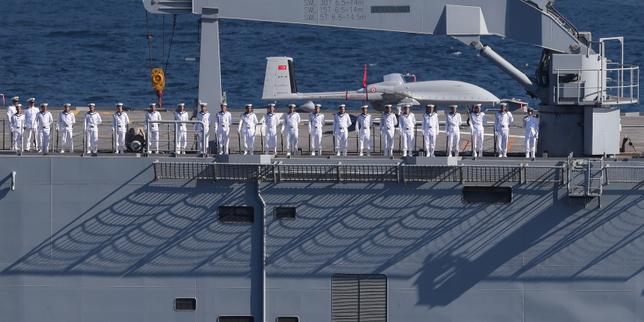
This isn't just about drones, though they are the headline-grabbers. It is about the entire spectrum of steel. We are talking about the MILGEM corvettes patrolling the seas, the Altay tanks, and the HISAR air defense systems. Turkey is building a full-stack military-industrial complex that mirrors the rapid industrialization of post-war miracles.
There is a visceral, human cost to this rise. It requires a generation of engineers to work through the night, fueled by a mixture of national pride and the memory of being denied. There is a chip on the shoulder of the Turkish defense sector. It is the drive of the underdog who finally realized they have the faster, leaner, and more adaptable dog in the fight.
However, this shift creates a profound tension within the halls of NATO. For years, the alliance operated on a predictable hierarchy. Now, a middle power has leveraged its industrial might to become an indispensable pillar. You cannot talk about the defense of the eastern flank without talking about Turkish logistics and Turkish hardware.
Some call it "drone diplomacy." It is a potent tool. By selling high-end tech to countries like Ukraine, Azerbaijan, and various African nations, Ankara isn't just making money. It is making friends—and making itself a partner that cannot be ignored or sanctioned into submission without hurting the buyer as much as the seller.
The math is simple but devastating for the status quo. If a country can buy a fleet of effective, combat-proven drones for the price of a single aging Western fighter jet, the choice isn't even a choice. It's survival.
We often talk about the "rearmament of Europe" as a series of budget increases and legislative acts. That is the sterile version. The real version is the sound of Turkish cargo planes landing in Rzeszów, unloading crates of optics and munitions that were designed, tested, and built in a land that bridge-links two continents.
There is a certain vulnerability in admitting that the center of gravity has moved. For the traditional power players in Paris and Berlin, the rise of the Turkish defense sector is a mirror held up to their own sluggishness. It reveals the cracks in a system that prioritized elegance over efficiency, and prestige over production speed.
The technician in the Ankara hangar doesn't care about these high-level anxieties. He snaps a final panel into place on the wing. He knows that in a few weeks, this machine will be scanning a horizon thousands of miles away, its sensors feeding data into a network that keeps a small nation's borders secure.
The ghost of the Cold War has returned to Europe, but the weapons being used to exorcise it no longer bear only the stamps of the old superpowers. They bear the star and the crescent.
This is the new architecture of the continent. It is built of reinforced concrete, advanced composites, and a relentless, pragmatic ambition that refuses to wait for permission. The map of power hasn't just been redrawn; it has been forged in the heat of a thousand local foundries, creating a reality where the security of the West now depends on the industrial heartbeat of the East.
As the sun sets over the Anatolian plateau, the lights in the factories stay on. The clinking of the wrenches continues. Every turn of a screw is a testament to a world that changed while we were busy looking the other way, a world where the quiet rise of a new titan has become the loudest sound in the room.