The Narrative of the Villain
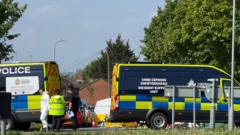
A BMW. A motorbike. Two dead. A woman and a teenager in handcuffs.
The standard news cycle has already done its job. It has identified the "bad actors," processed the arrests, and filed the tragedy under the "criminality" tab. We love these stories because they provide a clean, moralistic resolution. If there is a person to blame, there is a person to hate. If there is a person to hate, the rest of us can feel safe in our own superiority.
But focusing on the arrests is a distraction. It’s a lazy consensus that treats every road death as an isolated moral failure rather than a predictable outcome of systemic design. While the public thirsts for a courtroom drama, we ignore the cold, hard physics of our transit environments that virtually guarantee these collisions will happen again next week, in another city, with different names and the same result.
The Myth of the "Accident"
The legal system thrives on the concept of intent or negligence. The media thrives on the concept of the "freak accident." Both are wrong.
In the engineering world, "accident" is a banned word. We use "crash" or "collision." Why? Because accidents imply randomness. Crashes are the result of specific variables. When you mix high-speed limits, heavy kinetic mass like a BMW, and vulnerable road users like a motorcyclist on a road designed primarily for throughput rather than safety, the outcome isn't a surprise. It’s a calculation.
I have spent years looking at the data behind urban planning and road safety. Here is the uncomfortable truth: you can arrest every "reckless" driver in the country tomorrow, and the body count on our roads wouldn't drop by more than a fraction. We are obsessed with the psychology of the driver because we are too cowardly to address the geometry of the street.
Kinetic Energy Doesn't Care About Your Arrest Record
Let’s look at the physics that the headlines conveniently skip. Kinetic energy is defined by the formula $E_k = \frac{1}{2}mv^2$.
Notice that the velocity is squared. A BMW traveling at 50 mph carries significantly more than double the lethal potential of one traveling at 25 mph. When that energy meets the unprotected frame of a motorcycle, the result is biological erasure.
We allow vehicles weighing two tons to share space with vehicles weighing 400 pounds. We then paint a thin white line on the asphalt and pretend it's a structural barrier. When someone crosses that line—whether through malice, a medical episode, or a momentary lapse in judgment—we call the police. We should be calling the engineers.
The Fallacy of Deterrence
The popular outcry after a double fatality usually involves a demand for "justice." Longer sentences. Harsher penalties. A "crackdown" on speeding.
Deterrence is a phantom. It doesn't work in the heat of a high-speed maneuver. A driver in the middle of a high-stakes traffic situation isn't weighing the possibility of a ten-year sentence against the urge to overtake. They are reacting to the environment.
If a road is wide, straight, and clear, a human being will naturally drive fast. It is a subconscious physiological response to the "optical width" of the road. If you build a road that looks like a landing strip, people will drive like they are taking off, regardless of the number on the speed limit sign.
We arrest the woman. We arrest the teen. We leave the road exactly as it was. The road is the accomplice that never sees a courtroom.
The High Cost of the "Safety" Illusion
The competitor’s coverage of this event focuses on the arrests to provide a sense of closure. It’s a lie. There is no closure when the underlying conditions remain.
I’ve seen municipalities spend millions on "Safety Awareness" campaigns—billboards telling people not to speed or to "Look out for bikers." It’s a waste of taxpayer money. You cannot educate your way out of a design problem.
If you want to stop motorcycles from being crushed by BMWs, you don't need more handcuffs. You need:
- Physical Segregation: Not paint. Concrete.
- Modal Filtering: Restricting heavy vehicle access in areas with high volumes of vulnerable users.
- Self-Explaining Roads: Designing streets so that it feels physically uncomfortable to drive at lethal speeds.
The Victim Blaming Subtext
Often, when a motorbike is involved, there is a subtle, nauseating undercurrent of "they knew the risks." This is the ultimate cop-out. It shifts the burden of safety onto the person with the least amount of armor.
By focusing on the arrest of the car driver, we reinforce the idea that as long as everyone "follows the rules," the system works. It doesn't. The rules are a fragile social contract easily shredded by a distracted teenager or a momentary surge of adrenaline. Relying on 100% human compliance is a failed strategy. We don't design elevators that fall if someone pushes the wrong button; why do we design transport systems that kill if someone misses a turn?
Stop Looking at the Drivers
We need to stop being distracted by the "who" and start looking at the "where."
The arrest of a woman and a teen for murder suggests a level of intent that fits a narrative of "good vs. evil." It’s a convenient story. It lets the Department of Transportation off the hook. It lets the car manufacturers—who continue to build heavier, faster, more insulated tanks—off the hook.
The "lazy consensus" says this was a tragedy caused by two bad people. The contrarian reality is that this was a failure of a system that prioritizes vehicle flow over human life.
The Accountability Gap
If a bridge collapses, we don't just arrest the guy who drove the heaviest truck over it. We look at the steel. We look at the bolts. We look at the inspectors.
When a crash like this happens, the "inspectors" are the city planners and the politicians who refuse to implement traffic calming measures because it might add ninety seconds to a commute. They are the ones who should be in the headlines, yet they are nowhere to be found.
We are addicted to the drama of the arrest because it’s cheap and it’s fast. Real safety is expensive and slow. It requires ripping up asphalt and challenging the supremacy of the automobile.
The Actionable Truth
If you actually care about the two lives lost in that BMW and motorbike collision, stop reading about the court dates.
Start looking at the street where it happened. Was it a "Stroad"—a dangerous hybrid of a street and a road that tries to move cars quickly while providing multiple access points for turns? Was the lighting sufficient? Were there physical measures to prevent high-speed overtaking?
If the answer is no, then the arrests are a performance. They are a way for the state to say "we did something" without actually doing anything to prevent the next pair of bodies from hitting the pavement.
Burn the "accident" report. Stop waiting for the verdict. Demand a redesign.