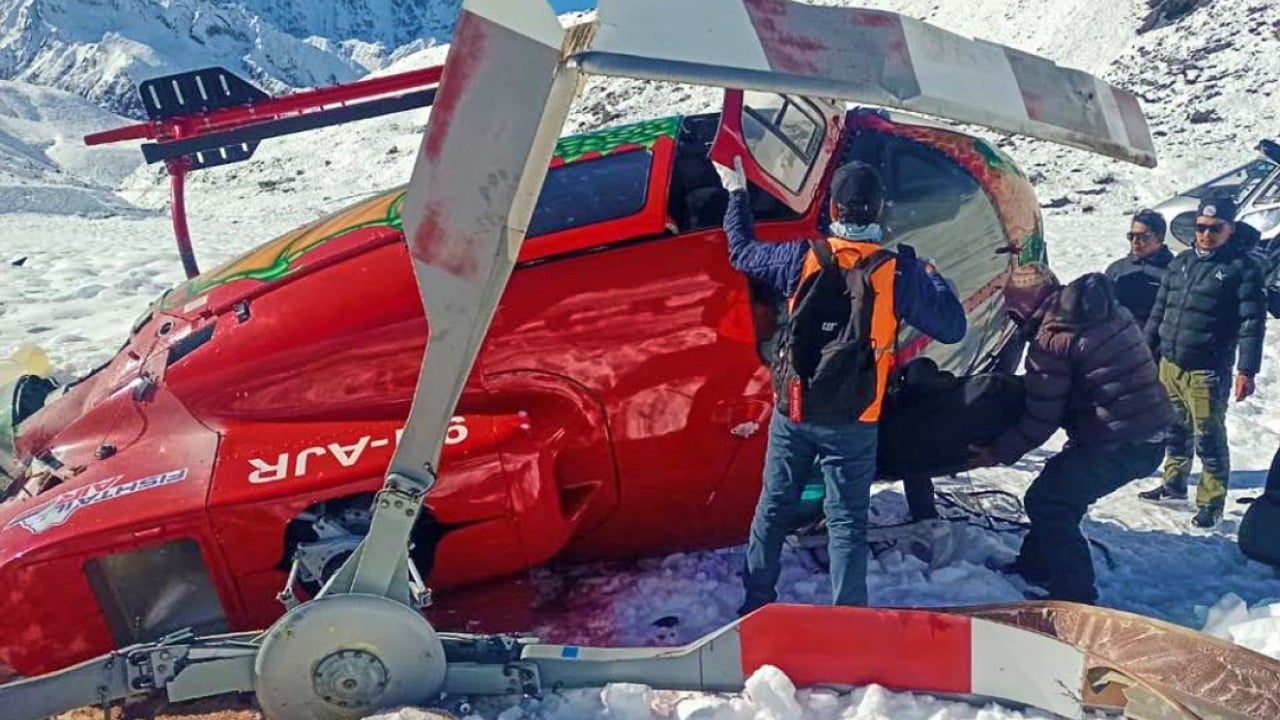
Two helicopters crashed near Everest Base Camp in Nepal's Solukhumbu district, killing an Indian tourist and reigniting fierce scrutiny over the booming, often underregulated commercial rotorcraft industry operating in the world's highest mountain range. The incident, which involved aircraft operated by local charter companies ferrying passengers in the treacherous Khumbu region, underscores a grim reality that aviation experts and veteran mountaineers have warned about for years. As commercial demand for rapid, luxury access to the Himalayas outpaces meteorological forecasting and infrastructure, pilots and passengers are routinely pushed to the razor's edge of aerodynamic survival.
The immediate facts surrounding any crash in the Khumbu valley tend to get buried beneath official statements citing sudden weather shifts. Weather changes fast at 17,000 feet. Yet blaming the mountain alone ignores the systemic economic pressures, regulatory blind spots, and brutal physics that turn routine sightseeing flights into fatal gambles. To understand why helicopters keep falling out of the sky near Everest, you have to look past the snowstorms and examine the business model built on top of them.
The Physics of Thin Air and Heavy Demands
Flying a helicopter at sea level is a complex balancing act of lift, thrust, drag, and weight. Flying one near Everest Base Camp—which sits at an elevation of roughly 17,598 feet (5,364 meters)—is an entirely different discipline that pushes machines to their absolute mechanical limits.
At high altitudes, air density plummets. The atmosphere at Base Camp contains roughly half the oxygen and air molecules found at sea level. Helicopter rotor blades generate lift by pushing air downward; when there is half as much air to push, the blades must work exponentially harder to keep the aircraft aloft. Engineers refer to this operational ceiling as density altitude, a measurement that combines physical elevation with temperature and humidity. On a warm afternoon in the Khumbu valley, the density altitude can easily exceed 20,000 feet, robbing a helicopter of critical lift reserve.
Under these conditions, the margin for error shrinks to nearly zero. A pilot cannot simply pull up on the collective pitch control to climb out of trouble. Pulling too much pitch increases aerodynamic drag on the rotor blades, which can cause the rotor RPM to decay. Once rotor RPM drops below a critical threshold, the blades stall, and the helicopter drops like a stone.
This aerodynamic reality makes weight management a matter of life and death. Every extra kilogram of fuel, luggage, or human body weight requires more power to lift. In the commercial charter sector around Lukla and Everest Base Camp, operators routinely use light utility helicopters like the Airbus H125 (formerly the Eurocopter AS350 B3e), an aircraft renowned for its high-altitude performance. Even this workhorse, however, is bound by strict payload charts. When an operator tries to maximize revenue by packing an extra passenger onto a flight, or when fuel loads are miscalculated to avoid a refueling stop, the aircraft operates right at the edge of its power curve. If a sudden downdraft hits—a common occurrence when wind spills over jagged Himalayan ridges—the engine simply does not have the surplus power to arrest the descent.
The Illusion of Luxury and the Rush to the Summit
For decades, reaching Everest Base Camp required a grueling, ten-to-twelve-day trek up steep stone staircases, across swaying suspension bridges, and through thin, freezing air. That physical barrier acted as a natural filter, ensuring that most visitors acclimatized slowly while keeping daily foot traffic manageable.
That barrier no longer exists. Over the past ten years, helicopter tourism has transformed the Everest region into a drive-thru destination for affluent travelers short on time. Today, a tourist can eat breakfast in a five-star hotel in Kathmandu, board a charter flight, land at Kala Patthar or near Base Camp for a fifteen-minute photo session, and return to the capital in time for lunch.
This convenience has created a massive, lucrative market. A single round-trip charter from Kathmandu to Everest can command upwards of $4,000 to $5,000, while shared seat-in-coach flights bring the price down to roughly $1,000 to $1,500 per person. Indian tourists represent one of the fastest-growing demographics in this sector, driven by geographic proximity, rising disposable incomes, and aggressive marketing by regional tour operators promising effortless Himalayan vistas.
The financial incentives are staggering, and they warp decision-making on the ground. In Nepal, the spring and autumn climbing and trekking seasons are short, spanning only a few months each year. Helicopter companies must generate the bulk of their annual revenue during these narrow windows. Every day a helicopter sits grounded on the tarmac at Lukla or Kathmandu due to marginal weather represents thousands of dollars in lost income.
The Pressure to Launch
Consider a hypothetical scenario that plays out regularly during peak season. A group of four tourists has booked a non-refundable charter to Base Camp for Tuesday morning, with international flights home scheduled for Wednesday. Tuesday dawns with low cloud ceilings in the Dudh Koshi river valley and forecasts of building afternoon winds. A cautious pilot might want to scrub the flight. However, the tour agency is demanding delivery, the passengers are threatening chargebacks, and a competing helicopter company on the adjacent pad is already spooling up its turbine.
In an industry where pilots are often paid bonuses based on flight hours and completed shuttles, the subtle, unspoken pressure to "go take a look" becomes immense. Pilots push into narrowing valleys, banking on the hope that a gap in the clouds will open up just ahead. When that gap closes behind them, flying blind in mountainous terrain without ground-based radar or instrument landing systems becomes a lethal trap.
Nepal's Aviation Oversight Problem
Whenever a fatal crash occurs in Nepal, the Civil Aviation Authority of Nepal (CAAN) forms an investigation committee, issues a preliminary report months later, and promises stricter enforcement. Yet the structural flaws within Nepal's aviation regulatory framework remain largely untouched.
For over a decade, the European Union has kept all Nepali airlines on its EU Air Safety List, effectively banning them from flying into European airspace due to persistent safety oversight deficiencies. While this ban primarily affects fixed-wing international carriers, it reflects a broader institutional crisis that directly impacts domestic helicopter operations.
One of the most glaring issues cited by international aviation auditors is CAAN's dual mandate. The agency acts simultaneously as the service provider—managing airports, air traffic control, and aviation infrastructure—and the safety regulator tasked with policing airlines and enforcing compliance. Aviation safety standards set by the International Civil Aviation Organization (ICAO) strongly advise separating these two functions to prevent conflicts of interest. When the same entity profits from airport landing fees and airspace usage while also overseeing the operators generating those fees, enforcement naturally softens.
Furthermore, the physical infrastructure in the Everest region has failed to keep pace with air traffic volume. During peak morning hours in April, May, October, and November, the airspace between Lukla (Tenzing-Hillary Airport) and Everest Base Camp resembles an aerial highway. Dozens of helicopters criss-cross the narrow valleys simultaneously, ferrying trekkers, hauling cargo, and conducting medical evacuations.
Despite this congestion, there is no radar coverage in the high Khumbu. Pilots rely on visual flight rules (VFR) and self-announce their positions over shared radio frequencies. Language barriers, clipped transmissions, and terrain blocking radio signals create frequent blind spots. When cloud cover drops or fog rolls in, pilots are forced to fly low, hugging the riverbeds and ridges, dramatically increasing the risk of mid-air collisions or Controlled Flight Into Terrain (CFIT).
The Gray Area of Mountain Rescue and Insurance Fraud
To understand the full operational strain on Nepal's helicopter fleet, you also have to look at the blurred lines between sightseeing, cargo hauling, and medical evacuation.
In theory, emergency medical evacuations are prioritized above commercial sightseeing. In practice, the distinction has become notoriously murky. Over the last several years, investigations by international insurance providers and journalists uncovered widespread helicopter rescue fraud across the Everest region. Certain trekking agencies, guides, and local clinics colluded to convince mildly ill trekkers—some suffering from nothing more than a common cold or mild altitude headache—that they were in mortal danger and required an immediate helicopter airlift to Kathmandu.
Operators would then bill foreign travel insurance companies exorbitant sums, sometimes bundling multiple "rescued" trekkers onto a single flight while charging each insurer for a dedicated emergency charter. While government crackdowns and stricter insurance verification protocols curbed the most brazen abuses, the financial ecosystem built around high-volume helicopter evacuations permanently inflated the size of Nepal's rotorcraft fleet.
More helicopters meant more fixed costs—lease payments, maintenance contracts, insurance premiums, and pilot salaries—that had to be paid off every month. When insurance companies tightened their belts and rescue payouts dipped, operators turned even more aggressively toward high-turnover sightseeing tours to keep their blades spinning and their balance sheets solvent.
Maintenance in a Harsh Environment
Operating machinery in the Himalayas destroys components faster than standard manufacturer timelines anticipate. Fine glacial dust, extreme temperature swings, and constant maximum-power takeoffs accelerate wear on turbine engines, gearboxes, and rotor blades.
Proper maintenance requires strict adherence to inspection schedules and immediate access to certified replacement parts. In Nepal, however, spare parts must be imported, often facing customs delays and high tariffs. Grounding an aircraft for three weeks to wait for a replacement sensor or hydraulic pump during the height of the tourist season is financially devastating for a small operator. While reputable mechanics and pilots refuse to compromise on airworthiness, the economic temptation to defer non-critical maintenance or push component lifespans to their absolute legal limits is a constant undercurrent in the industry.
Why Accidents Keep Happening Despite Better Technology
Modern helicopters flying in the Himalayas are equipped with sophisticated avionics, GPS moving maps, terrain awareness systems, and powerful turbines capable of reaching altitudes unimaginable fifty years ago. On paper, flying in the Khumbu should be safer today than at any point in aviation history.
The crash near Everest Base Camp proves that technology cannot compensate for human vulnerability and flawed incentives. GPS tells a pilot where the mountain is, but it cannot see the localized downdraft plunging off the Lhotse face at 3,000 feet per minute. Terrain warning systems lose their utility when a pilot is intentionally flying fifty feet above a rocky moraine because clouds prevent climbing higher.
The aviation industry refers to this phenomenon as normalization of deviance. When pilots successfully push through bad weather, overload an aircraft by fifty kilograms, or land on an unimproved snow pad without incident, those risky behaviors gradually become accepted as standard operating procedure. Nothing bad happened yesterday, so the thinking goes, which means today will be fine too. The mountain allows this illusion to persist right up until the moment weather, weight, and topography align against the cockpit.
What Tourists Never See
Passengers boarding a flight in Kathmandu or Lukla rarely have any visibility into the operational standards of the company they are hiring. A glossy website, a clean cabin, and a confident pilot create an aura of routine commercial travel. Tourists assume that flying to Everest Base Camp carries the same baseline regulatory protections as taking a domestic flight in Europe, North America, or major Asian hubs.
They do not see the density altitude calculations. They do not know if the pilot has already flown six back-to-back shuttles since dawn, battling fatigue and hypoxia in an unpressurized cabin. They have no way of verifying whether the weather briefing at the destination consisted of an automated meteorological station or a quick phone call to a tea house owner holding a cell phone out a window.
The Uncomfortable Path Forward
Fixing the safety crisis in Everest's skies requires measures that are deeply unpopular with the very stakeholders who profit most from the status quo.
First, Nepal must decouple CAAN's regulatory arm from its service-provider operations. As long as the agency overseeing safety is tied to the commercial growth of the aviation sector, independent oversight remains compromised.
Second, strict flight caps and slot allocations must be enforced in the Khumbu region. Allowing dozens of commercial sightseeing flights to flood narrow valleys simultaneously during unstable weather windows is an invitation for disaster. Restricting non-emergency flights to designated morning hours—before thermal winds build up in the valleys—would immediately eliminate a massive percentage of weather-related incidents.
Third, automated weather reporting stations and mandatory flight-tracking transponders must be installed at key waypoints between Lukla and Base Camp, with real-time monitoring enforced from a central dispatch center. Relying on informal visual checks in one of the most volatile microclimates on earth is negligent.
Until those structural reforms take hold, the burden of risk falls squarely on the people stepping into the cabin. Every passenger who books a rapid-fire helicopter tour to Base Camp is participating in an aviation market where commercial velocity routinely outruns safety margins. The Himalayas do not care about tight itineraries, non-refundable hotel bookings, or peak-season profit targets, and when a helicopter loses its fight with thin air at 17,000 feet, there are no second chances.