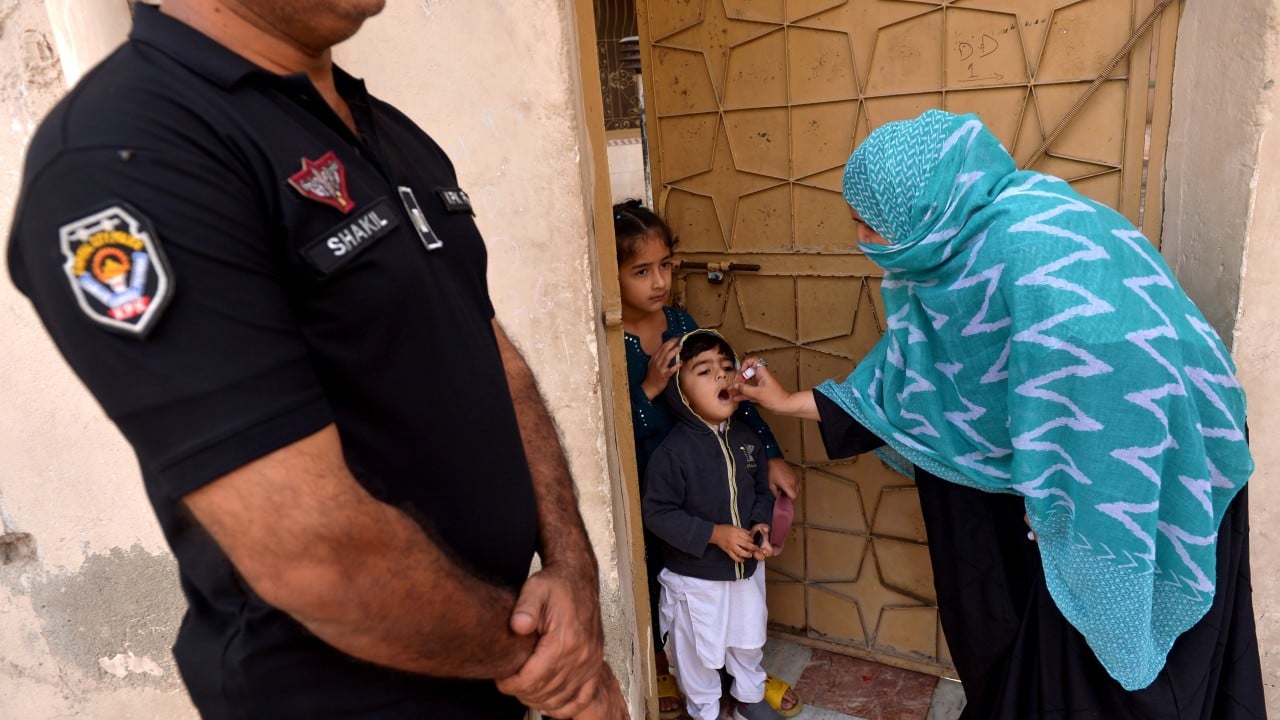
Two Pakistani police officers assigned to protect a polio vaccination team were shot dead by suspected militants, adding two more names to a grim ledger that stretches back well over a decade. While breaking news reports treat these ambushes as isolated flare-ups in an endless border conflict, the reality on the ground is far more calculated. Insurgent groups in Pakistan deliberately target police escorts not because they oppose vaccines on medical grounds, but because disrupting state-sponsored health campaigns is a cheap, high-visibility way to prove the central government cannot control its own territory.
Every time a door-to-door vaccination drive launches in northwestern Khyber Pakhtunkhwa or southwestern Balochistan, local police officers become walking bullseyes. They stand at the absolute front line of a geopolitical and ideological war, armed with aging rifles and minimal tactical support, guarding health workers who carry nothing more than insulated cooler boxes and vials of oral polio drops.
The Anatomy of a Predictable Ambush
To understand why these killings repeat with depressing regularity, look at the operational mechanics of a Pakistani polio drive. Pakistan and neighboring Afghanistan remain the only two countries on Earth where wild poliovirus is still endemic. Eradicating it requires reaching millions of children under the age of five during synchronized, multi-day campaigns. Because the virus spreads rapidly through contaminated water and poor sanitation, missing even a small pocket of children allows the disease to rebound.
Health workers cannot wait in clinics for parents to bring their children in. They must go door to door, knocking on gates in dense urban slums, remote mountain valleys, and sprawling tribal districts along the Afghan border.
That operational necessity creates a massive security vulnerability. You cannot hide a vaccination campaign. Days before the teams deploy, community mobilizers and mosque loudspeakers announce the schedule so parents stay home. Militant scouts hear those exact same announcements. They know the dates, they know the neighborhoods, and they know the teams must move on foot from house to house along predictable alleyways and dirt tracks.
Police escorts are typically assigned in pairs to shadow a two-person vaccination team—usually female health workers, since cultural norms prohibit male strangers from entering private family compounds to speak with mothers. Walking slowly down narrow streets, stopping every few minutes to mark chalk symbols on mud walls indicating whether children were vaccinated or missed, the officers are completely exposed.
Militants on motorcycles—the weapon of choice for targeted assassinations across Pakistan—can scout a team, pull up behind the officers, fire at close range, and vanish into traffic or rugged terrain within seconds. By the time backup arrives from the nearest precinct, the attackers are miles away.
Why Vaccines Became a Proxy War
Foreign observers often assume militants attack polio teams out of pure religious fanaticism or ignorance about modern medicine. That explanation is lazy and incomplete. While extremist clerics have certainly weaponized religious misinformation, the strategic driver behind the violence is political leverage.
The suspicion surrounding vaccination drives in Pakistan has deep, documented roots. In 2011, the Central Intelligence Agency used a fake hepatitis B vaccination campaign in Abbottabad to gather DNA samples and confirm the presence of Osama bin Laden before the U.S. Navy SEAL raid that killed him. That single covert operation shattered trust in public health initiatives across the region overnight.
Militant groups like the Tehreek-e-Taliban Pakistan (TTP) and regional Islamic State affiliates immediately seized on the revelation. They framed every subsequent health worker as a Western spy and every vial of polio drops as a CIA plot to sterilize Muslim children or mark targets for drone strikes.
Even after the CIA formally pledged in 2014 never to use vaccination programs for intelligence gathering again, the damage was permanent. The narrative stuck because it served insurgent interests. For militants fighting Islamabad, the polio eradication program is the single most visible arm of the Pakistani state in remote districts where paved roads, functioning schools, and reliable electricity barely exist.
When militants kill the police officers guarding those teams, they achieve three immediate strategic goals without needing to overrun a heavily fortified military base:
- They humiliate the state. If the government cannot protect two cops handing out medicine, local residents conclude the state cannot protect them either.
- They extract political ransom. During past negotiations and regional standoffs, tribal elders and militant factions have used boycotts of polio drives as bargaining chips to demand infrastructure funds, prisoner releases, or the withdrawal of military checkpoints.
- They paralyze global oversight. Every high-profile killing triggers immediate panic among international donors, the World Health Organization, and UNICEF, forcing temporary suspensions of vaccination drives and buying militants breathing room.
The Human Cost Borne by Rank and File Police
When headlines report that two officers were killed, the casualties are rarely elite counter-terrorism commandos. They are almost always low-ranking constables from local police stations—men earning modest wages, often lacking bulletproof vests, modern communications gear, or armored transport.
In provinces like Khyber Pakhtunkhwa, where the TTP has resurged sharply since the Taliban takeover of neighboring Afghanistan in 2021, police forces have absorbed staggering losses. Militants routinely hit police stations with night-vision sniper attacks, roadside bombs, and targeted ambushes. Assigning thousands of already overstretched officers to babysit door-to-door health workers stretches thin precinct manpower to the breaking point.
Consider a hypothetical scenario based on standard deployment protocols in districts like Bannu or Tank. A local police station responsible for patrolling a volatile sub-district must suddenly pull forty percent of its active duty roster for five consecutive days to escort twenty vaccination teams. During those five days, routine patrols stop, criminal investigations stall, and the officers standing guard outside mud-brick homes know they are stationary targets. Morale erodes quickly when men are ordered into open exposure without tactical backup.
The vaccinators themselves—mostly low-paid female Lady Health Workers—face immense psychological trauma. Many have watched their police escorts bleed out on the pavement right in front of them. Yet they keep showing up because for many, the meager stipend is their household's primary income, and they genuinely want to save neighborhood children from lifelong paralysis.
The Structural Flaws in Current Security Tactics
Pakistan’s security establishment has tried various workarounds to stop the bloodshed, none of which have solved the core dilemma.
One approach has been the hit-and-run campaign—flooding a high-risk district with heavy paramilitary troops for forty-eight hours, vaccinating as many children as possible under massive armed escort, and pulling out before militants can organize an ambush. While this reduces casualties during the blitz, it leaves behind missed children whose families were away or hiding, allowing the virus to survive in silent reservoirs.
Another tactic involves embedding vaccination teams inside regular community health centers rather than sending them door to door. That keeps workers and police safely behind fortified walls, but coverage rates plummet. In impoverished areas where mothers cannot easily travel miles to a clinic with multiple small children, passive vaccination simply does not reach the herd immunity threshold required to kill the virus.
The brutal mathematical reality of polio eradication is unforgiving. Unlike measles or smallpox, where 80 to 85 percent vaccination coverage can halt transmission, wild poliovirus demands upwards of 95 percent coverage across every single district. If militants successfully scare off teams or kill escorts in just five or six volatile districts along the border, the virus continues circulating, eventually spilling back into major cities like Karachi, Lahore, and Peshawar through internal migration.
The Geopolitical Trap Behind the Border
You cannot separate the ambushes on Pakistani police from the geography of the Durand Line—the porous, 1,600-mile border separating Pakistan and Afghanistan. Poliovirus does not recognize border fences or passport controls. Seasonal laborers, nomads, and refugees cross back and forth daily, carrying the virus in their intestines without showing any symptoms.
For every one child paralyzed by polio, roughly two hundred others are infected silently, shedding the virus into local sewage systems for weeks. When Pakistani police die trying to secure a neighborhood in North Waziristan, their sacrifice can be undone if an unvaccinated child crosses the border from Afghanistan's Paktika province a month later.
Following the 2021 regime change in Kabul, international health agencies initially hoped the Afghan Taliban would enforce universal polio vaccination across areas they previously blocked during their insurgency. While vaccination access did improve in parts of Afghanistan, cross-border militant networks like the TTP remain fiercely hostile to Islamabad. For these fighters, shooting Pakistani police officers during a polio drive is just another front in a wider war against the Pakistani state.
What Actually Moves the Needle
Throwing more under-equipped constables onto dusty streets to stand beside health workers is not a sustainable strategy. It treats symptoms while ignoring the structural dynamics feeding the violence.
First, security forces must abandon predictable static escorts in red-zone districts in favor of intelligence-led area denial. Rather than tying two policemen to each walking team like targets on a shooting gallery, tactical units need to seal off entire neighborhood sectors hours before vaccinators enter, sweeping rooftops and controlling vehicle access points until the grid is cleared.
Second, community ownership has to replace top-down enforcement. In districts where local tribal jirgas, respected religious scholars, and neighborhood elders actively negotiate safe passage and take public responsibility for the safety of health workers, attacks drop sharply. People protect what they feel belongs to them; they resent what arrives at the barrel of a gun.
Third, health delivery cannot remain single-issue. Walking into a neglected village where children are dying of preventable diarrhea, malaria, and malnutrition, and offering nothing except polio drops, breeds deep cynicism. Residents rightly ask why the government cares so desperately about one specific virus funded by Western donors while ignoring every other disease killing their families. Bundling polio drops with clean water initiatives, maternal care, and basic antibiotics transforms the health worker from a suspected foreign agent into a genuine lifeline.
Until those deeper operational and political fractures are addressed, Pakistani police officers will keep putting on their uniforms every time a vaccination drive begins, walking out into narrow alleys knowing someone in the shadows is waiting for them to stop and knock on the next door.