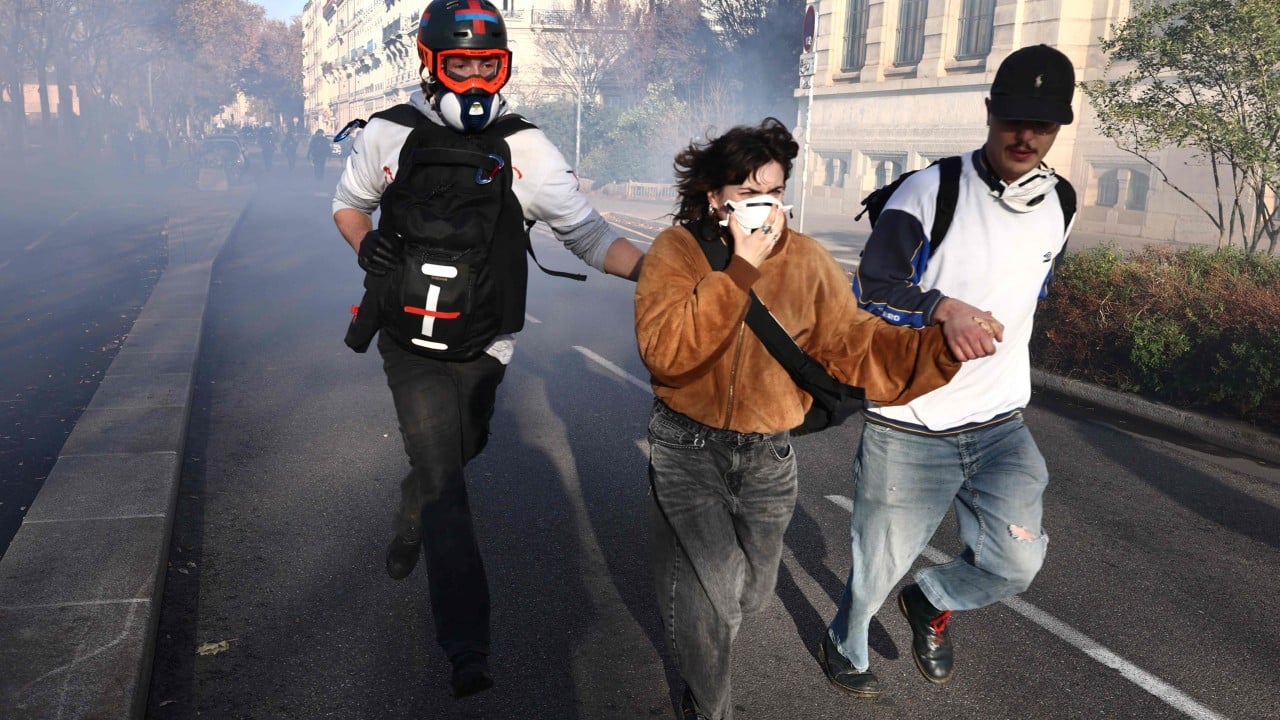
Activists in France want a moratorium on tear gas because protesters are reporting disrupted menstrual cycles. They are handing the state a massive tactical victory while arguing the wrong science.
Let’s look at the mechanics of public order policing and endocrine toxicology. When demonstrators demand a suspension of CS gas—2-chlorobenzalmalononitrile—based on self-reported cycle changes, they step straight into a bureaucratic trap. Governments love single-variable toxicological debates. Why? Because causation in reproductive endocrinology is notoriously easy to muddy, slow to prove, and cheap to litigate into oblivion for a decade.
The lazy consensus in modern protest coverage treats every physiological symptom after a street clash as a direct chemical poisoning. It makes for gripping headlines. It also ignores how the human hypothalamic-pituitary-adrenal (HPA) axis actually operates under acute urban warfare conditions, and it obscures the much darker, already-proven respiratory and ocular reality of riot control agents.
The Physiological Reality Nobody Wants to Untangle
First, strip away the political theater and look at the biology.
When a crowd is kettled in Paris, blasted with flashbangs, chased by riot police, and choking on chemical irritants, the body does not distinguish between a tear gas canister and an apex predator. The sympathetic nervous system detonates. Cortisol and adrenaline flood the bloodstream.
In reproductive medicine, functional hypothalamic amenorrhea—and acute cycle disruption—is a textbook response to severe psychological and physical trauma. Cortisol directly suppresses gonadotropin-releasing hormone (GnRH) from the hypothalamus. Without steady GnRH pulses, luteinizing hormone (LH) and follicle-stimulating hormone (FSH) stall. Ovulation delays. Bleeding arrives early, late, or skips entirely.
Does CS gas itself act as an endocrine disruptor? Possibly. CS is an alkylating agent that reacts with nucleophilic sites in biological tissue, primarily targeting TRPA1 pain receptors in the eyes and airways. While animal studies on high-dose, chronic exposure to cyanogenic compounds—CS metabolizes partly into cyanide and malononitrile—show systemic toxicity, controlled human clinical trials on menstrual disruption from street-level tear gas exposure do not exist. You cannot ethically run a randomized controlled trial gassing women in a lab to track their luteal phases.
That evidentiary gap is exactly where state ministries thrive.
If activists make menstrual irregularity the primary pillar of a ban, state toxicologists will simply point to stress, sleep deprivation, and physical exertion as confounding variables. The French Ministry of the Interior will commission a five-year epidemiological review, shelve the findings, and keep firing canisters every Saturday.
The Misdirection of "Non-Lethal" Nomenclature
Stop calling it tear gas. That term is a 1920s public relations triumph designed to make chemical weapons sound like a mild onion-chopping inconvenience.
In military and law enforcement doctrine, CS is classified as a "riot control agent" (RCA). Under the 1993 Chemical Weapons Convention, using CS on a battlefield is a war crime. Using the exact same compound against domestic civilians in Lyon or Nantes is standard crowd management.
Here is the nuance the activists' press releases miss: you do not need novel, unverified endocrine claims to prove CS gas violates basic medical safety standards. The established pulmonary and neurological data is already damning enough to dismantle current deployment protocols—if anyone bothered to use it properly.
When deployed in enclosed urban canyons or fired at high density, CS concentrations routinely exceed the IDLH (Immediately Dangerous to Life or Health) threshold established by the National Institute for Occupational Safety and Health (NIOSH), which sits at a mere 2 milligrams per cubic meter.
At high concentrations, CS causes:
- Severe reactive airways dysfunction syndrome (RADS) in previously healthy adults.
- Chemical pneumonitis and pulmonary edema, particularly when canisters are fired into confined spaces or near subways.
- Direct thermal and kinetic trauma from the pyrotechnic canisters themselves, which burn at temperatures hot enough to fuse synthetic clothing to skin and shatter orbital bones on impact.
By pivoting the public debate toward self-reported menstrual changes, campaigners shift the battleground from measurable, acute toxic trauma—where the physics and pulmonology are airtight—to chronic, multi-factorial hormonal shifts where the burden of proof is nearly impossible to meet in court.
Why French Policing Strategy Relies on Chemical Saturation
To understand why France is the epicenter of this debate, you have to understand the doctrine of maintien de l'ordre.
Unlike Anglo-American policing models that historically favored physical containment or mounted units, French riot policing—specifically the CRS (Compagnies Républicaines de Sécurité) and the BRAV-M motorized brigades—relies on distance and chemical saturation. The tactical goal is to keep protesters away from state infrastructure without engaging in hand-to-hand baton clashes, which generate brutal close-up viral footage.
Tear gas creates an invisible wall. It disperses crowds cheaply and leaves fewer visible bruises than rubber bullets (LBD 40 launchers) or sting-ball grenades.
I have watched European municipal authorities and interior ministries defend chemical crowd control for over fifteen years using the exact same playbook. Every time a new side effect surfaces—whether it was skin blistering during the 2018 Gilets Jaunes protests or menstrual changes today—officials deploy a three-step neutralization strategy:
- Acknowledge the anecdotal distress to appear empathetic in the press.
- Demand peer-reviewed causal proof isolating the chemical from environmental stress.
- Reiterate the "less-lethal" alternative argument, warning that banning gas forces police to use kinetic impact munitions instead.
When activists demand a total suspension based on hormonal symptoms, they trigger step two and step three simultaneously. The state gets to paint protesters as anti-science alarmists while framing tear gas as the humane choice.
Dismantling the Wrong Questions
If you look at public health queries surrounding protest policing, people consistently ask the wrong questions because they accept the state's framing of riot control.
"Does tear gas permanently ruin fertility?"
There is zero credible clinical evidence showing permanent infertility from acute, episodic exposure to CS gas. Claiming otherwise destroys the credibility of legitimate medical observers. What is documented is transient hormonal disruption driven by acute physiological trauma, alongside potential miscarriage risks in pregnant individuals exposed to high concentrations of cyanide-metabolizing agents and extreme hypoxic stress. The threat is acute gestational and systemic toxicity, not permanent sterilization.
"Is pepper spray a safer alternative to CS gas?"
No. Oleoresin capsicum (OC) spray is an inflammatory agent derived from chili peppers, not a synthetic alkylating agent like CS, which makes people assume it is "natural" and benign. In reality, OC causes immediate bronchoconstriction and laryngeal spasm. In individuals with underlying asthma or cardiovascular disease, concentrated OC triggers fatal respiratory arrest far faster than low-density CS aerosol. Trading CS for OC is trading one respiratory hazard for another.
"Can washing with milk or baking soda neutralize CS gas?"
Stop bringing dairy to a protest. CS is not water-soluble; it is a solid microparticulate dispersed via pyrotechnic aerosol. Milk is non-sterile, introduces bacteria to abraded corneas, and spoils in body heat, creating severe eye infections. Alkaline baking soda solutions disrupt the ocular surface pH and worsen chemical burns. Plain, sterile saline or clean water is the only medically sound flush. Everything else is street folklore that sends people to ophthalmologists.
The Counter-Intuitive Strategy That Actually Restricts Chemical Weapons
Admitting the limitations of the menstrual data does not mean giving riot police a free pass. It means attacking the deployment architecture where it is actually vulnerable.
A total ban on tear gas in France is politically dead on arrival. No French government—left, center, or right—will disarm its riot police of their primary area-denial tool while facing recurring mass civil unrest. Demanding an outright suspension guarantees zero policy change.
Instead of arguing unprovable endocrinology, medical groups and civil liberties lawyers should target dosage, dispersion mechanics, and environmental contamination:
- Mandate serial-numbered canisters and chemical telemetry. Right now, police fire hundreds of canisters into a single square without tracking cumulative atmospheric concentration. Requiring mandatory environmental monitoring and batch tracking turns invisible gas clouds into auditable legal evidence.
- Ban pyrotechnic dispersion in enclosed or semi-enclosed urban spaces. When high-rise buildings block wind dispersion, street-level CS concentrations multiply tenfold within seconds. Restricting deployment based on urban geometry eliminates the worst acute respiratory and systemic exposures without requiring a national legislative ban.
- Target the delivery systems, not just the powder. French police utilize multi-tube launchers (like the Cougar and Chouka systems) that saturate entire city blocks simultaneously. Litigating against indiscriminate area-saturation munitions under European Court of Human Rights (ECHR) proportionality standards has actual legal teeth. In Abdullah Yaşa and Others v. Turkey, the ECHR already ruled that firing tear gas canisters directly at protesters constitutes a lethal use of force. Expanding that precedent to indiscriminate saturation is winnable.
- Establish independent biomonitoring immediately post-protest. Instead of relying on retrospective online surveys weeks after a demonstration—which defense lawyers shred for selection bias—public health researchers need rapid-response blood and urine assays measuring urinary thiocyanate and 2-chlorobenzoic acid within 12 hours of exposure, paired with salivary cortisol panels. That separates chemical absorption from pure fight-or-flight stress.
The Cost of Getting the Science Wrong
There is a massive downside to challenging activists on this front: you get accused of minimizing real human suffering. Protesters experiencing sudden hemorrhaging, excruciating cramps, or months of missed periods after inhaling toxic smoke are not inventing their symptoms. Their bodies are genuinely reacting to a violent biochemical assault.
Validating their physical trauma while rejecting their political strategy is the tightrope required here.
If you care about stopping the indiscriminate gassing of civilians, you have to bring weapons-grade rigor to the fight. State toxicologists are waiting for activists to overstate the endocrine science so they can dismiss the entire anti-tear-gas movement as hysterical.
Stop handing them the ammunition. Attack the NIOSH exposure limits, litigate the urban saturation tactics, collect hard metabolic biomarkers, and force the state to defend why it is deploying battlefield chemical agents at lethal concentrations against its own citizens.