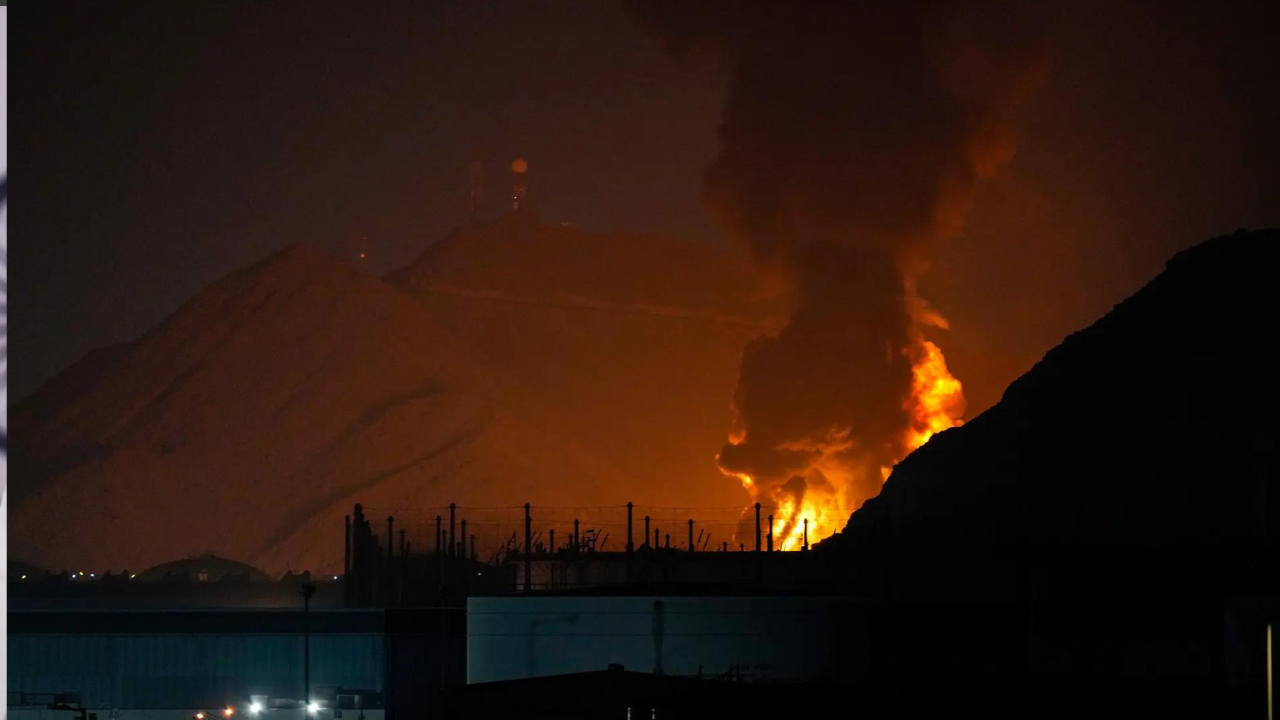
The desert night in the Emirates is rarely truly dark. Between the neon glow of the Burj Khalifa and the amber string of highway lights stretching toward Abu Dhabi, the sky usually hums with the quiet vibration of progress. But when the sirens start, that hum snaps. It is replaced by a primitive, bone-deep silence.
Then comes the flash.
For a young father standing on a balcony in Sharjah or a delivery rider pausing his bike in Dubai, the instinct is no longer to hide. It is to record. We have become a species of witnesses, our thumbs twitching toward the camera app before our brains even process the threat. We want to capture the streak of the interceptor, the orange bloom of a neutralized threat, and the twisted, blackened ribs of a fallen missile resting in the dunes.
But in the United Arab Emirates, that instinct is now a legal and national liability. The government’s recent, stern warnings against filming or sharing footage of missile debris are not merely about aesthetics or "controlling the narrative." They are about the invisible physics of modern warfare and the terrifying speed at which a viral video can become a targeting coordinate.
The Anatomy of a Leak
Consider a hypothetical resident named Omar. Omar isn’t a spy. He’s a real estate agent who likes his morning espresso and his 100,000 TikTok followers. When a piece of an intercepted projectile thuds into the sand near a suburban construction site, Omar sees content. He sees engagement. He films the twisted metal, the serial numbers etched into the casing, and the distant skyline that provides a perfect, unintentional landmark for anyone with a basic understanding of triangulation.
He hits "post."
Within seconds, that video travels across the globe. It lands on the screens of intelligence analysts in Tehran, Tel Aviv, and Washington. To Omar’s followers, it’s a "wow" moment. To a ballistic engineer, it is a diagnostic report.
By looking at the debris, an adversary can determine exactly how effective their missile was. They can see if the warhead detonated or if it was a "dud." They can analyze the scorch marks to see if the UAE’s interceptor hit the "sweet spot" or if it barely grazed the target. Most dangerously, by looking at where the debris landed in relation to the skyline in Omar’s background, they can map the gaps in the air defense umbrella.
They are looking for the holes in the shield. Omar just gave them the map.
The Weight of a Thumb
The UAE Ministry of Interior didn't issue this warning to be spoilsports. They are fighting a war where the front line is a five-inch glass screen. When the state warns of "legal consequences," they are addressing the reality that a single tweet can compromise a billion-dollar defense system.
The UAE operates some of the most sophisticated missile defense hardware on the planet. We are talking about the Terminal High Altitude Area Defense (THAAD) and Patriot systems. These are not simple cannons; they are hyper-complex computers that calculate intercepts at thousands of miles per hour.
$v = \sqrt{v_0^2 + 2ad}$
Even a slight delay in calculation or a shift in the "kill box" can mean the difference between a loud bang in the sky and a catastrophe on the ground. When civilians post footage of these interceptions, they inadvertently reveal the "refresh rate" and the positioning of these batteries.
The silence requested by the authorities is a form of electronic camouflage. In a region where the geopolitical temperature is constantly hovering near a boil, the UAE has positioned itself as a sanctuary of stability. That stability is fragile. It relies on the perception—and the reality—that the sky is closed to intruders. Every video of a charred engine block lying in a parking lot chips away at that shield.
The Psychology of the Share
Why do we do it? Why do we risk jail time or a massive fine to post a blurry video of a metal tube?
It’s the dopamine of the "first." In the digital age, being the first to witness an event provides a fleeting sense of power. It makes the witness feel like a protagonist in a world that often feels like it's spinning out of control. There is a strange, morbid intimacy in touching the debris of a conflict that is supposed to be happening "over there," up in the clouds or across the water.
But the metal is hot. It’s toxic.
Beyond the intelligence risks, there is a visceral, physical danger that many ignore in the rush for views. Missile debris isn't just "junk." It is often coated in highly corrosive fuels like hydrazine or contains unexploded boosters. To stand over a crash site with a smartphone is to breathe in the chemical residue of a machine designed to kill.
The UAE’s warning is as much a public health directive as it is a security one. They are asking their people to step back—not just from the debris, but from the digital impulse to broadcast.
The Invisible Stakes
We live in a world where the "fog of war" has been replaced by the "glare of the internet." In previous decades, a general would have to wait days or weeks for a reconnaissance plane to return with grainy photos of a strike zone. Today, they just have to monitor a hashtag.
This creates a terrifying feedback loop. If an adversary sees via social media that their missile was intercepted 20 kilometers short of its target, they can adjust the coordinates for the next launch in real-time. The civilian with the camera becomes an unintentional spotter for the very weapon aimed at their city.
The UAE is a country built on the "impossible"—cities rising from salt flats, Mars missions, and global hubs of trade. But the most "impossible" task of all might be convincing a hyper-connected population to put their phones away during a crisis.
It requires a shift in how we view our role in society. We are no longer just consumers of news; we are participants in the defense of our own borders. Every time a resident chooses not to post, they are actively participating in the national defense. They are keeping the "holes in the shield" invisible.
The Cost of a Clear Sky
There is a deep, unsettling irony in this. The very technology that allows the UAE to thrive—the high-speed internet, the global connectivity, the status as a "smart city"—is the same technology that threatens its security during a conflict.
The authorities have been clear: the law is not a suggestion. The penalties for sharing footage that "harms the state's reputation" or "endangers security" are severe. But the real penalty isn't a fine. It’s the realization that your desire for a "like" might have given a hostile actor the final piece of a puzzle they needed to bypass a battery of interceptors.
Next time the sirens wail and the sky splits open with the sound of a controlled explosion, the most patriotic thing a resident can do is stay inside. Watch the sky through the glass, but leave the phone on the table.
The desert night is beautiful when it is quiet. The goal of the UAE's new stance is to ensure it stays that way, keeping the machinery of war as a silent, invisible guardian rather than a viral spectacle.
In the high-stakes poker game of Middle Eastern geopolitics, information is the only currency that matters. And sometimes, the most powerful thing you can say is nothing at all. The most powerful image you can share is a black screen.
The shield only works if nobody knows where the cracks are.
Would you like me to look up the specific legal penalties and fines currently being enforced by the UAE Ministry of Interior for these violations?