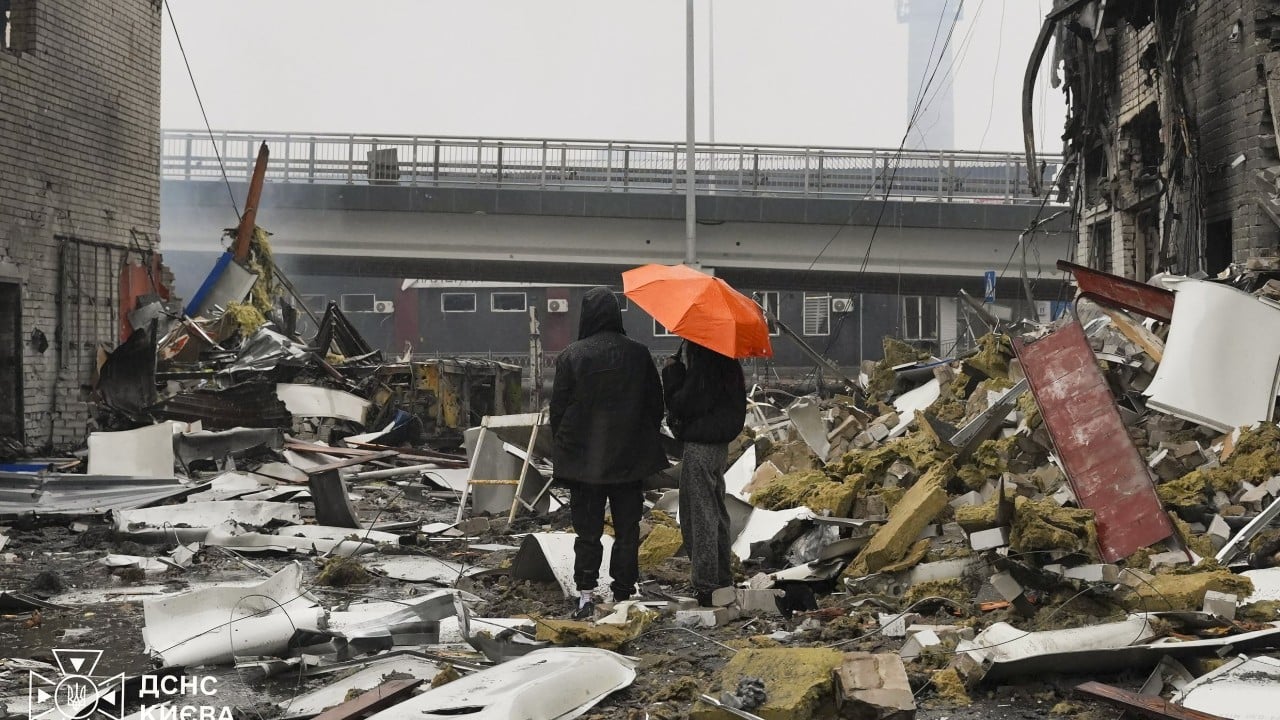
At least eight people are dead across Ukraine following a coordinated wave of Russian missile and drone strikes launched in direct retaliation for attacks on the Kerch Strait Bridge. The strikes hit residential infrastructure, energy grids, and urban transit hubs, turning a strategic logistics battle over occupied Crimea into immediate civilian devastation far behind the front lines. While initial wire reports treat this exchange as another isolated spike in hostilities, the reality on the ground points to a much darker operational pattern. Every major strike against Moscow's prized physical link to the Crimean peninsula triggers a predictable, asymmetric escalation aimed at breaking Ukrainian civilian morale and exhausting air defense stockpiles.
War rarely announces its turning points with formal declarations. Instead, the shifts happen in concrete, steel, and high explosives. When Ukrainian naval drones or long-range missiles damage the Kerch Strait Bridge, they strike at the logistical artery feeding Russia's southern military group and the symbolic centerpiece of Vladimir Putin's 2014 annexation. Moscow's military command cannot absorb that blow quietly without risking domestic political fallout and operational paralysis in southern Ukraine. Their answer is almost always the same. They reach deep into their long-range strike inventory and fire into Ukrainian cities, trading tactical military logic for widespread psychological and infrastructural punishment.
The Anatomy of Asymmetric Retaliation
To understand why eight civilians died in the wake of a bridge attack hundreds of miles away, you have to look at how Russian target selection operates under political pressure. Militaries with precision-guided munitions normally prioritize immediate battlefield threats—ammunition depots, troop concentrations, command bunkers, and radar installations. Yet when the Crimea bridge comes under fire, the Russian Ministry of Defense faces an immediate demand from the Kremlin for visible, televised retribution.
Retaliatory strike packages rely on a mix of ballistic missiles, cruise missiles, and one-way attack drones launched simultaneously from bombers over the Caspian Sea, naval vessels in the Black Sea, and mobile ground launchers. The objective is saturation. By flooding Ukrainian airspace with dozens of slow-moving drones ahead of high-speed ballistic missiles, Russian planners attempt to force Ukrainian air defense crews to expend expensive interceptor missiles on cheap decoys before the heavier warheads arrive.
Even when Ukrainian air defenses intercept the vast majority of incoming threats, the physics of modern air warfare guarantees collateral destruction. A ballistic missile intercepted at high altitude does not vanish into thin air. Tons of burning wreckage, unexploded warheads, and jagged shrapnel plummet onto whatever sits beneath the flight path. When strikes are aimed near dense urban centers or dual-use electrical substations embedded within residential neighborhoods, the margin between a successful interception and a mass-casualty event shrinks to zero.
Why the Crimea Bridge Remains the Ultimate Flashpoint
Built at a cost exceeding three billion dollars and opened personally by Putin in 2018, the nineteen-kilometer span across the Kerch Strait is far more than a highway and rail corridor. For Moscow, it is physical proof that Crimea is permanently welded to the Russian mainland. For Kyiv, it is an illegal structure built on occupied territory and the primary supply line sustaining Russian forces across Kherson and Zaporizhzhia.
The logistical vulnerability of the Russian army in southern Ukraine cannot be overstated. Unlike Western militaries that rely heavily on fleets of logistical trucks, the Russian armed forces are fundamentally a railroad army. Heavy artillery shells, tank replacements, fuel bladders, and armored personnel carriers move overwhelmingly by rail. While Russia has spent months constructing an alternative overland railway through occupied Mariupol and Berdiansk, that coastal route remains dangerously close to Ukrainian artillery and drone range.
The Kerch bridge remains the safest, highest-capacity conduit for heavy military freight entering Crimea. Each time Ukrainian forces strike the bridge—whether through explosive-laden uncrewed surface vessels skimming the Black Sea waves or Western-supplied cruise missiles—they force Russian engineers to halt rail traffic, inspect structural pilings, and reroute convoys onto vulnerable ferries.
The Tactical Equation Behind Bridge Strikes
- Supply Bottlenecks: Even minor structural damage to the rail span forces weight restrictions, slowing the delivery of artillery ammunition to the southern front by days or weeks.
- Air Defense Diversion: Every time the bridge is hit, Russia is forced to strip high-end S-400 air defense batteries and Pantsir systems from active front-line sectors to bolster security around the Kerch Strait.
- Information Warfare: Successfully hitting one of the most heavily defended pieces of infrastructure in the world shatters the Kremlin's narrative of total security over Crimea.
What Wire Reports Miss About Civilian Casualties
Mainstream breaking news coverage inevitably reduces these exchanges to a grim scoreboard. Eight dead here, a damaged bridge span there, a statement of condemnation from European capitals, and a vow of resilience from Kyiv. That framing misses the structural reality of how this conflict has evolved into a war of industrial and societal attrition.
When Russian missiles kill civilians in apartment blocks or destroy regional power transformers in response to a strike on the Crimea bridge, Moscow is pursuing a deliberate coercive strategy. The Kremlin understands that Western allies place strict political and operational guardrails on how Ukraine uses donated long-range weapons. By escalating violently against Ukrainian cities immediately after any high-profile strike on Russian-held prestige targets, Moscow attempts to make Kyiv's international backers hesitate before approving future weapons packages or lifting targeting restrictions.
At the same time, Ukrainian emergency responders and municipal workers operate in an environment of compounding exhaustion. In the cities hit during this latest wave, rescue crews spent hours digging through collapsed concrete panels while air raid sirens continued to wail—a signature Russian tactic known as the double-tap strike, where a second missile is fired at the exact same coordinates twenty to forty minutes after the first impact to kill firefighters, paramedics, and journalists arriving on the scene.
The Air Defense Mathematics Nobody Wants to Discuss
There is an uncomfortable truth sitting beneath every casualty report coming out of Ukraine. Air defense is an asymmetric financial trap, and the numbers favor the attacker.
A single Shahed-style attack drone costs tens of thousands of dollars to manufacture. A single interceptor missile fired from a Western Patriot or NASAMS battery can cost anywhere from one million to four million dollars. When Russia launches a retaliatory barrage after a Crimea bridge attack, Ukraine must decide in seconds which incoming blips on a radar screen represent lethal ballistic threats aimed at a hospital or power plant, and which ones are cheap foam-and-fiberglass decoys designed solely to drain their magazine depth.
Western production lines for high-end air defense interceptors cannot match the pace at which Russia—bolstered by Iranian drone technology and North Korean ballistic missile transfers—can assemble offensive munitions. Every retaliatory strike forces Ukrainian commanders to make agonizing triage decisions. Protecting Kyiv, Kharkiv, Odesa, and Dnipro simultaneously while also shielding front-line brigades from Russian glide bombs is mathematically impossible with current interceptor stockpiles.
The Myth of Proportional Deterrence
Military analysts have spent decades debating deterrence theory, yet the war in Ukraine has exposed how fragile those academic models become when survival and regime legitimacy collide. In theory, proportional deterrence prevents escalation because each side fears unacceptable costs. In practice, Russia and Ukraine are fighting under entirely different political constraints.
Ukraine operates under intense international scrutiny. Its leadership knows that striking purely civilian targets inside Russia would immediately jeopardize vital military and financial aid from Washington, Berlin, and London. Consequently, Ukrainian long-range strikes are overwhelmingly directed at military airfields, oil refineries, ammunition dumps, and dual-use logistics hubs like the Kerch bridge.
Russia faces no such constraints. Having already absorbed sweeping Western economic sanctions and diplomatic isolation, the Kremlin pays almost zero additional diplomatic price for bombing a Ukrainian apartment building or electrical grid. When the Crimea bridge burns, Putin does not need to find an equivalent Ukrainian bridge to hit in order to claim victory on state television. Any burning building in a Ukrainian city serves his domestic political requirement for visible vengeance.
The Infrastructure War Beneath the Headlines
Look closely at the secondary targets struck alongside the residential buildings where the eight victims were killed, and a clearer picture emerges. Russian planners consistently pair terror strikes on urban centers with precision hits on energy distribution nodes—specifically high-voltage autotransformers and thermal generation facilities.
Destroying a large autotransformer is not like knocking down a utility pole. These massive, custom-built pieces of electrical equipment weigh hundreds of tons, require specialized rail transport, and take months or even years to manufacture in European factories. You cannot simply pull a spare off a warehouse shelf. By targeting these choke points during retaliatory waves, Russia systematically degrades Ukraine's ability to keep water pumps running, hospitals powered, and domestic defense factories operating.
The human toll of eight dead is immediate and viscerally tragic, yet the hidden casualty list grows silently in the weeks that follow. Cold apartments, disrupted surgical schedules, contaminated municipal water supplies, and halted industrial production compound the damage long after the rubble is cleared from the streets.
Why Neither Side Can Walk Away From the Kerch Strait
If attacking the Crimea bridge reliably triggers deadly Russian retaliation against Ukrainian cities, an obvious question arises: why does Kyiv keep hitting it?
The answer lies in the brutal geography of southern Ukraine. As long as Russia controls the Crimean peninsula and uses it as an unsinkable aircraft carrier and logistics hub, Ukrainian forces cannot secure their southern coastline or liberate occupied territories along the Sea of Azov. Allowing the Kerch Strait Bridge to operate at full capacity means allowing thousands of tons of shells, mines, and fuel to flow uninterrupted to the very Russian units shelling Ukrainian trenches and cities every single day.
From Kyiv's perspective, leaving the bridge intact does not save Ukrainian lives; it merely shifts the deaths from missile strikes in the rear to artillery barrages at the front. Hitting the bridge forces Moscow onto the defensive, stretches Russian logistics to the breaking point, and proves that no territory held by Russian forces is beyond Ukrainian reach.
The Brutal Reality of Escalation Cycles
Observing this conflict from the outside often breeds a false expectation that diplomatic pressure or tactical breakthroughs will eventually establish a stable front line. History suggests otherwise. Wars of attrition rarely settle into neat, predictable patterns; they lurch forward through violent cycles of action and reprisal.
The eight lives lost in the wake of the latest Crimea bridge attacks are not an anomaly, nor are they the result of a rogue commander exceeding orders. They are the direct, predictable output of a military doctrine that treats civilian terror as a standard tool of operational retaliation. Until Ukraine possesses either the long-range strike capacity to permanently sever Russia's southern logistics network or the air defense density required to close its skies completely, every blow struck against Moscow's prized bridge will continue to be answered in blood across Ukrainian cities.