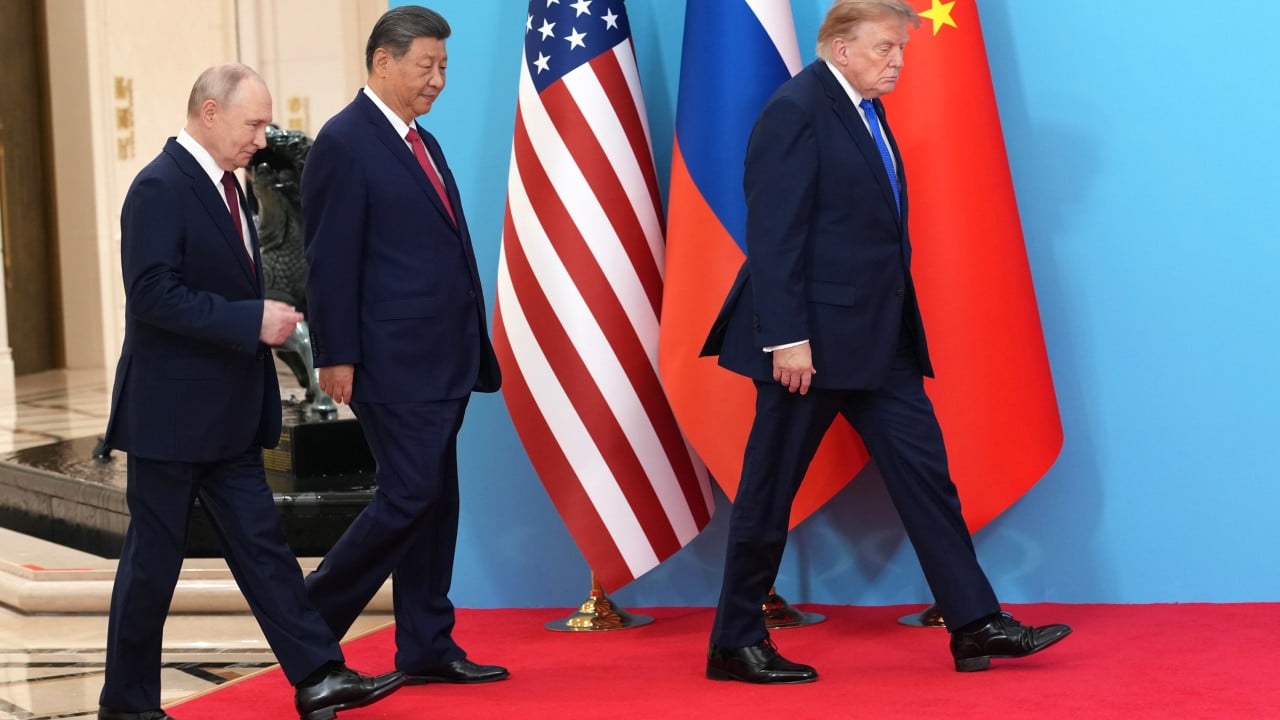
Talks between Donald Trump, Xi Jinping, and Vladimir Putin over nuclear risk reduction are heavy on diplomatic theater and entirely devoid of binding constraints because the Cold War architecture of arms control was built for a two-player game that no longer exists. While Washington, Beijing, and Moscow publicly acknowledge the catastrophic dangers of nuclear escalation, each capital is simultaneously pouring hundreds of billions of dollars into warhead modernization, delivery systems, and dual-use conventional weapons that blur the line between regional conflict and existential exchange. The rhetoric is designed to project statesmanship to domestic audiences and nervous allies, yet the physical hardware rolling off assembly lines points toward an unregulated, three-way sprint for strategic dominance.
Diplomats call it strategic stability. In practice, it means maintaining a delicate balance where no single nuclear-armed state believes it can launch a decapitating first strike and survive the inevitable retaliation. For over half a century, that balance rested on bilateral treaties between the United States and the Soviet Union, and later the Russian Federation. Those agreements relied on strict numerical ceilings, intrusive on-site inspections, and predictable notification protocols. Every single pillar of that system has now collapsed, leaving the world's three most powerful militaries operating without a shared rulebook for the first time since the early 1970s. In other updates, read about: The Concrete Island That Swallows Time And How One Blueprint Dares To Drain It.
The Death of Bilateral Arithmetic
To understand why modern summits produce press releases instead of treaties, look at the basic math of a three-body problem. During the Cold War, parity was simple. If Moscow deployed one thousand warheads, Washington deployed one thousand warheads, and both sides could verify the count using spy satellites and inspection teams.
Enter China. The Guardian has also covered this critical topic in great detail.
For decades, Beijing maintained a posture of minimum deterrence, keeping a relatively small arsenal of a few hundred warheads designed strictly to survive an attack and retaliate against major cities. That restraint is dead. Pentagon assessments and commercial satellite imagery confirm that China is executing the fastest peacetime nuclear expansion in modern history, constructing hundreds of new solid-fuel intercontinental ballistic missile silos across its northwestern deserts and expanding its fleet of ballistic missile submarines. Projections put Beijing on track to field more than a thousand operational warheads by the end of the decade, roughly matching the deployed arsenals of the United States and Russia.
This numeric shift breaks the foundational logic of bilateral arms control. Washington argues that it cannot cap its own arsenal at Cold War parity levels with Russia if doing so leaves the United States outnumbered two-to-one by a combined Russo-Chinese front. Moscow counters that any new treaty must include the independent nuclear forces of the United Kingdom and France, which are treaty allies of the United States. Beijing flatly refuses to join formal reduction talks until Washington and Moscow slash their arsenals down to Chinese levels—a demand neither Western capital will ever entertain.
Every leader has a mathematically sound excuse to walk away from the table while blaming the other two.
Why Verification Has Become Almost Impossible
Even if Trump, Xi, and Putin suddenly agreed on exact warhead limits tomorrow afternoon, nobody could verify the deal. Arms control treaties are worthless without trust, and in nuclear strategy, trust is just a polite word for intrusive physical verification.
Historically, inspectors from rival nations walked right up to ballistic missiles, measured their dimensions, checked the number of reentry vehicles mounted on top, and monitored perimeter gates outside production facilities. Russia suspended its participation in the New START treaty, halting on-site inspections and ending the biannual exchange of telemetry data that allowed Washington to track Russian missile tests. Without boots on the ground, intelligence agencies are forced to rely on orbital reconnaissance and signals intelligence, both of which have glaring blind spots.
Modern weapons technology actively defeats satellite surveillance. Consider the proliferation of dual-capable delivery systems—missiles and aircraft engineered to carry either conventional high explosives or nuclear warheads. When a Russian Iskander brigade or a Chinese DF-26 intermediate-range missile battery deploys to the field, overhead satellites cannot see inside the launch canister to determine whether the payload is conventional or thermonuclear.
This ambiguity creates a nightmare scenario during a crisis. If a military commander detects a volley of incoming hypersonic glide vehicles, they have minutes to decide whether they are facing a conventional strike on an airbase or a nuclear strike on their command bunker. Under the doctrine of launch on warning, waiting to see what kind of explosion occurs upon impact is a risk few nuclear states are willing to take.
The Hypersonic and Space Complication
Traditional treaties counted heavy bombers, land-based silos, and submarine launch tubes because those systems were massive, slow to build, and easy to spot from orbit. Today's strategic competition is migrating into domains that laugh at old counting rules.
- Hypersonic Glide Vehicles: Unlike traditional ballistic missiles that follow a predictable parabolic arc high into space—allowing early-warning radars to calculate their exact target within seconds of launch—hypersonic gliders skim the upper atmosphere at speeds exceeding Mach 5 while maneuvering laterally. They evade ground-based radar horizons and complicate missile defense calculations, shrinking decision windows for political leaders.
- Orbital Bombardment Systems: Intelligence leaks and diplomatic warnings over Russian efforts to develop a space-based nuclear anti-satellite weapon highlight a terrifying new frontier. Detonating a nuclear device in low Earth orbit would not kill anyone on the ground directly, yet the resulting electromagnetic pulse and persistent radiation belt would blind the military reconnaissance, navigation, and communications satellites that keep nuclear command-and-control networks functioning.
- Autonomous Underwater Vehicles: Systems like Russia's Poseidon—a nuclear-powered, nuclear-armed torpedo designed to cross entire oceans undetected and detonate near coastal cities—do not fit neatly into existing treaty categories. They are neither ballistic missiles nor traditional submarines, allowing designers to bypass decades of established diplomatic definitions.
The Domestic Politics of Nuclear Posturing
When leaders meet on the sidelines of international summits and issue joint statements declaring that a nuclear war cannot be won and must never be fought, they are engaging in low-cost diplomatic signaling. It costs nothing to agree on an abstract principle. It costs immense political capital to cancel a multi-billion-dollar defense contract or accept intrusive foreign inspectors onto sovereign military bases.
In Washington, any administration attempting to negotiate binding nuclear limits faces immediate, fierce resistance from defense hawks in Congress. With bipartisan consensus hardened around strategic competition with China, offering concessions on missile defense deployments in the Indo-Pacific or capping warhead uploads is treated as unilateral disarmament. Meanwhile, the United States is locked into a massive, decades-long modernization program to replace every single leg of its nuclear triad—new Sentinel intercontinental ballistic missiles, new Columbia-class submarines, and new B-21 stealth bombers—leaving almost zero bureaucratic appetite for treaties that might restrict deployment flexibility.
In Moscow, nuclear weapons have become the ultimate guarantor of regime survival and great-power status. As conventional military capabilities have been ground down and exposed in Eastern Europe, the Kremlin has leaned ever harder on nuclear coercion, lowering its declaratory threshold for nuclear use and deploying tactical warheads to neighboring Belarus. For Vladimir Putin, giving up nuclear leverage in exchange for Western diplomatic goodwill is a non-starter.
In Beijing, secrecy is the core currency of deterrence. China's rocket force operates under layers of opacity, utilizing vast underground tunnel networks—sometimes referred to as the Underground Great Wall—to hide mobile launchers and warhead stockpiles. Agreeing to American-style transparency measures would strip away the very ambiguity that protects China's smaller arsenal from a preemptive strike. For Xi Jinping, signing a verification protocol isn't arms control; it is espionage legalized by treaty.
The Quiet Danger of Tactical Nuclear Weapons
Public debates usually fixate on civilization-ending intercontinental ballistic missiles, yet military planners lose far more sleep over non-strategic nuclear weapons, commonly called tactical nukes. These are lower-yield warheads designed for battlefield use against troop concentrations, naval carrier groups, or hardened command posts.
No treaty has ever successfully regulated tactical nuclear weapons. Russia holds a massive asymmetric advantage in this category, possessing an estimated one to two thousand non-strategic warheads compared to roughly two hundred maintained by the United States, many of which are stored in underground vaults across Europe.
The danger lies in the illusion of controllability. Military theorists in several capitals have toyed with the concept of escalate to de-escalate—the idea that if a nation is losing a conventional war, firing a single low-yield nuclear weapon will shock the adversary into backing down without triggering a full-scale strategic exchange.
Most veteran defense analysts view this theory as pure fantasy. Once the nuclear taboo is broken on a battlefield, neither side has a reliable mechanism to control the escalation ladder. A commander on the receiving end of a tactical nuclear strike does not know if it is a localized warning shot or the opening salvo of a broader campaign, creating overwhelming pressure to retaliate with overwhelming force before remaining assets are destroyed.
Artificial Intelligence in the Kill Chain
Beneath the public posturing over warhead counts, a silent revolution is unfolding inside nuclear command centers: the integration of artificial intelligence and automated decision-support tools.
Modern warfare moves too fast for human staffs to process raw data manually. When early-warning satellites, over-the-horizon radars, cyber-defense sensors, and signals intelligence feeds are all screaming simultaneously during a high-intensity crisis, militaries rely on machine-learning algorithms to filter noise, identify incoming threats, and recommend response options.
During talks on nuclear risk, diplomats routinely float pledges to keep "humans in the loop" regarding any decision to launch nuclear weapons. On paper, every nuclear power agrees that an algorithm should never independently authorize a nuclear strike.
In practice, that promise is thinner than tissue paper. If an AI-driven sensor network flashes an alert that an enemy hypersonic strike is seven minutes away from obliterating a nation's leadership, a human president technically makes the final call. Yet that human is making a world-ending decision based entirely on compressed data curated by a machine, under extreme psychological stress, with zero time to independently verify whether the sensors are experiencing a technical glitch, a cyberattack, or an actual launch.
History already shows how close human operators have come to accidental Armageddon due to faulty early-warning systems. In 1983, Soviet officer Stanislav Petrov famously defied protocol when an orbital satellite system falsely reported incoming American missiles, correctly deducing it was a malfunction because a real first strike would involve hundreds of launches, not five. Adding opaque machine-learning models and hypersonic flight times to that equation strips away the precious minutes human judgment needs to catch a fatal error.
Why Confidence-Building Measures Are Failing
When formal treaties stall, diplomats traditionally pivot to smaller, non-binding confidence-building measures. These include bilateral hotlines, pre-launch notifications for missile tests, and military-to-military crisis communication channels.
Even these basic guardrails are rusting shut. Crisis hotlines only work if leaders pick up the phone and believe the person on the other end is telling the truth. Over the past several years, military communication channels between Washington and Beijing have been repeatedly severed during diplomatic disputes, only to be painstakingly restored with limited operational mandate. Meanwhile, routine diplomatic contact between Washington and Moscow has shriveled to historic lows.
Without active military-to-military working groups, minor incidents carry catastrophic potential. A mid-air collision between a surveillance aircraft and a fighter jet over contested waters, a cyber intrusion into a satellite ground station, or a misread military exercise can rapidly spiral when neither side has an established backchannel to clarify intentions in real time.
The Illusion of Risk Reduction Without Restraint
Summit photo-ops and joint communiqués serve a clear political purpose. They allow leaders to tell anxious voters and nervous markets that responsible adults are managing the ultimate existential threat.
Reality on the ground tells a completely different story. Budgets are expanding, warhead production lines are reopening, missile silos are being poured, and the legal frameworks that kept nuclear competition predictable for fifty years are dead and buried. Calling for nuclear risk reduction while simultaneously dismantling verification regimes and deploying ambiguous dual-use weapons is like installing smoke detectors while pouring gasoline on the floorboards.
Until Washington, Beijing, and Moscow are willing to trade concrete military capabilities for verifiable transparency—accepting hard caps on warheads, banning orbital weapons, and opening their bases to foreign inspectors—every summit declaration on nuclear safety remains nothing more than diplomatic ink on an empty page.