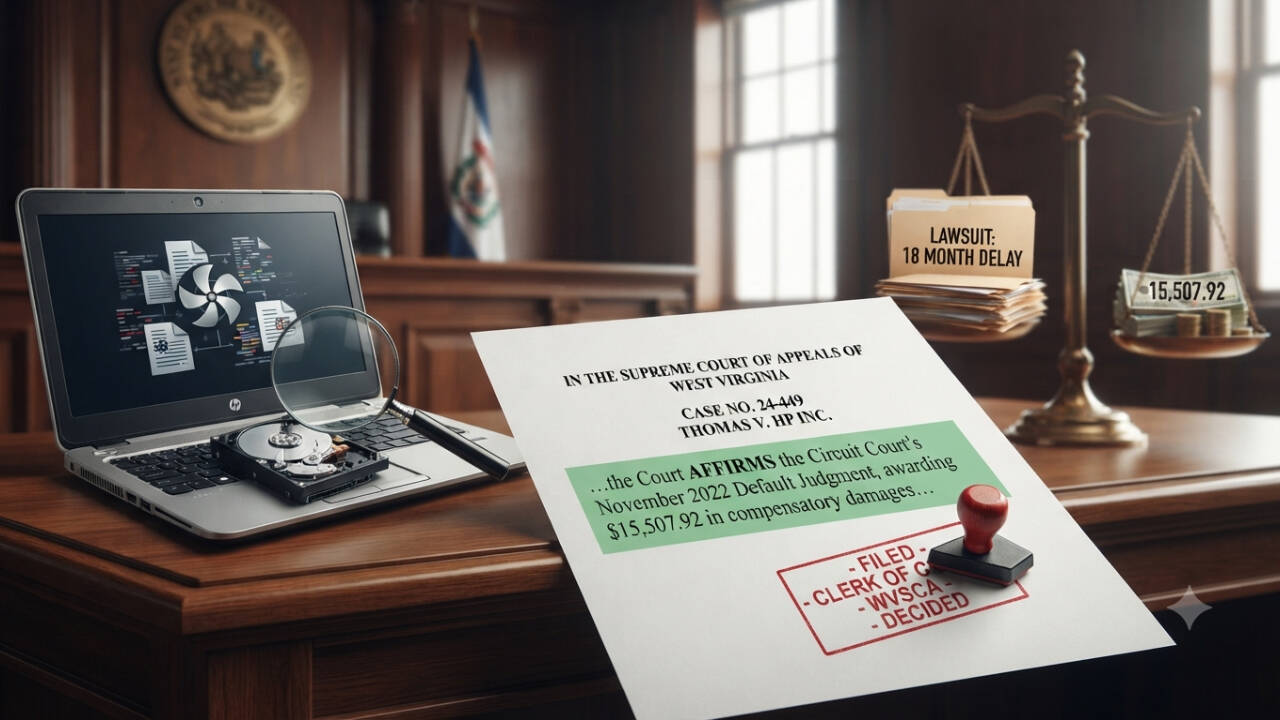
The hum of a dying hard drive sounds a lot like a mosquito trapped inside a glass jar. It is a thin, frantic clicking—a mechanical stutter that signals the end of something you didn't realize was fragile until the exact second it broke.
For most of us, a laptop is just an appliance, no more romantic than a toaster or a radiator. We tap the keys, close the lid, and trust that the invisible architecture beneath the plastic will hold our lives steady. We store our tax returns next to our grandmother’s scanned recipes, our unfinished novels beside our children’s first blurry steps, assuming that silicon is somehow permanent.
Until the screen goes black.
In West Virginia, one woman’s routine brush with hardware failure turned into an eighteen-month war of attrition—a legal and emotional odyssey that recently ended with a court awarding her damages after a repair company destroyed her data and simply vanished from the conversation. On paper, it is a dry local news item about consumer protection, default judgments, and liability waivers. In reality, it is a story about what happens when modern corporate indifference collides with the irreplaceable artifacts of a human life.
The Anatomy of a Digital Ghost
To understand why a woman in West Virginia fought for a year and a half over a broken computer, you have to strip away the cold legal jargon of "negligence" and "breach of contract." Think instead about what lives inside a personal laptop.
Imagine, for a moment, a hypothetical archivist named Clara—a composite of every person who has ever stood across a counter from a technician in a branded polo shirt, sliding a machine across the laminate with a mixture of dread and hope. Clara isn't a billionaire guarding proprietary trade secrets. She is an ordinary person whose machine holds six years of family photographs, the rough draft of a local history project, medical records for an aging parent, and the quiet, unbacked-up digital footprint of her daily existence.
When you hand that device over for repair, you are not merely commissioning a mechanical fix. You are handing over a vault.
In the West Virginia case, the transaction began like millions of others. A malfunctioning laptop needed professional attention. The expectation was simple: diagnose the fault, replace the failing component, and preserve the drive. Instead, the data was wiped—erased not by a malicious hacker in a dark room, but by the far more common banality of carelessness.
Gone.
There is a specific kind of nausea that accompanies permanent data loss. I remember the first time a external drive failed on me a decade ago; I sat on my kitchen floor for three hours staring at a blinking error light, convinced that if I just held my breath and rebooted it one more time, the last four years of my writing would magically reappear. You bargain with the machine. You refresh the directory as if sheer willpower could magnetize the platters back into alignment. When the realization finally settles in—that the bits have been overwritten by zeros, that no software utility can resurrect what has been scrubbed—the grief is strangely disorienting. You haven't lost a physical object you can hold or mourn. You have lost time itself.
The Wall of Corporate Silence
If the erasure of the data was the initial wound, what followed in West Virginia was salt rubbed into it with bureaucratic precision.
When a consumer suffers a catastrophic loss at the hands of a service provider, they rarely want a courtroom battle. They want an apology. They want accountability. They want someone on the other end of the line to say, We messed up, and here is how we are going to make it right.
Instead, the West Virginia plaintiff encountered a phenomenon familiar to anyone who has ever tried to dispute an erroneous charge or track down a lost package: the weaponized delay.
Companies today are built like fortresses with no front doors. You are routed through automated phone trees that loop back onto themselves, handed off to third-party support centers where agents read from scripts designed to soothe rather than solve, and eventually met with total radio silence. When the woman took legal action to hold the company accountable for her destroyed data, the business did not mount a vigorous defense. They did not argue the fine print of their liability waiver in open court.
They simply failed to show up.
For eighteen months, the case sat in the slow-grinding machinery of the civil justice system while the company defaulted. Eighteen months is five hundred and forty-seven days. It is two summers, two winters, dozens of trips to the mailbox, legal fees paid out of pocket, and the constant, low-grade hum of frustration that comes from shouting into an empty canyon.
In legal terms, a default happens when a defendant fails to respond to a summons or appear in court within the required timeframe. To a corporation, ignoring a small-claims or circuit court filing from an individual in West Virginia can look like a calculated business decision. Why pay outside counsel three hundred dollars an hour to fight a consumer claim when you can simply ignore the paperwork and hope the plaintiff runs out of money, patience, or both?
It is an asymmetry of endurance. A corporation does not lose sleep over a pending docket number. An individual does.
The Myth of the Indestructible Cloud
We live in an era that sells us the illusion of effortless permanence. Tech giants assure us that everything is synced, mirrored, and backed up in the ether. Yet the reality on the ground—especially in rural states like West Virginia, where broadband access can still be patchy and expensive—is far messier.
Many people still rely on local storage. They save files to their desktop because the upload speeds to a cloud server crawl at a snail’s pace, or because they refuse to pay yet another monthly subscription just to rent space for their own memories. To understand how fragile local storage truly is, picture a traditional spinning hard drive not as a solid block of memory, but as a microscopic turntable. A tiny mechanical arm floats nanometers above a magnetic platter spinning at thousands of revolutions per minute. A speck of dust, a sudden jolt, or a technician who formats a drive without checking for a partition is the equivalent of dragging a steel needle across a vinyl record.
Once the groove is scratched, the music is over.
Even modern solid-state drives, which have no moving parts, carry their own silent perils. When a technician performs a factory reset or swaps out a motherboard tied to hardware encryption, the data isn't just misplaced—it is mathematically obliterated. Without the specific cryptographic key tied to the original hardware, the files become an indecipherable soup of random characters.
Repair shops know this. Every work order you sign at a tech counter contains dense blocks of microscopic text designed to absolve the business of responsibility for data loss. Those waivers are the armor businesses wear to protect themselves from the high stakes of handling people’s digital lives.
But a liability waiver is not a license for gross negligence. Courts across the country have increasingly recognized that when a customer explicitly entrusts a device to professionals—especially when data preservation is part of the expected standard of care—a company cannot hide behind fine print after carelessly destroying someone's property, even if that property weighs nothing at all.
How Much Is a Memory Worth?
This brings us to the hardest question the West Virginia court had to answer: How do you put a dollar figure on something that cannot be replaced at a retail store?
If a dry cleaner ruins your winter coat, the math is straightforward. You look at the receipt, factor in depreciation, and write a check for two hundred dollars. The market sets the price.
Data defies market logic. A laptop itself might be worth eight hundred dollars on the secondhand market, its aluminum chassis and battery easily valued by an insurance adjuster. Inside that chassis, however, might sit a folder of photographs of a parent who passed away three years ago, or years of genealogical research that took a decade of weekends to compile. To a stranger, those files have zero commercial value. To their owner, they are priceless.
In legal history, courts have struggled with this exact paradox. Under traditional property law, damages for destroyed personal items are usually capped at their fair market value. You cannot easily sue for sentimental value when a moving company drops a box of family heirlooms. Yet as our lives have migrated almost entirely onto silicon, the law has been forced to evolve.
When a judge calculates damages in a case involving data loss and an eighteen-month corporate default, the award isn't just a reimbursement for a piece of hardware. It is a recognition of the real, tangible labor required to recreate what was lost, the disruption to a person's life, and the sheer, inexcusable waste of eighteen months spent forcing a citizen to beg for basic accountability.
Winning a judgment, of course, is only half the battle. Anyone who has navigated the civil courts knows that a piece of paper signed by a judge does not automatically turn into money in a bank account. When a company defaults, collecting those damages often requires another round of persistence—tracking down corporate registered agents, filing liens, or garnishing accounts. It takes grit to see that process through to the end when every institutional incentive is designed to make you quit.
What We Owe Each Other in a Digital Age
Look closely at why this story resonates far beyond the borders of West Virginia. It taps into a quiet anxiety shared by anyone who has ever felt small in the face of a massive, faceless enterprise.
We have automated away almost every point of human friction in modern commerce, right up until the moment something goes wrong. You can buy a laptop in thirty seconds with a thumbprint. You can schedule a repair with three taps on a screen. The system is frictionless when it is taking your money. The moment you need someone to take responsibility, however, the friction becomes insurmountable.
The West Virginia woman’s victory is a rare, satisfying crack in that armor. By refusing to let the eighteen-month silence wear her down, she forced a system built on convenience to pause and reckon with human consequence. She proved that persistence still carries weight, even when the opponent refuses to step into the ring.
Still, relying on the courts after a disaster is a brutal way to protect the things we love. If there is a practical lesson buried beneath the legal triumph, it is that we cannot outsource the safety of our own histories to third parties—not to repair technicians, not to cloud providers, and certainly not to corporate customer service departments.
Treat your digital life the way you would treat a box of irreplaceable letters in a house built on a floodplain. Keep one copy on your desk, another copy on an external drive tucked into a drawer, and a third copy somewhere far away from your zip code. Never hand a device over to a stranger without assuming that everything on it could vanish before you get it back.
Because in the end, a hard drive is just a thin sheet of metal spinning in the dark, and a corporation is just a collection of legal filings. Neither one has a heart. Neither one remembers the sound of a laugh caught on a phone video in 2019, or the late-night paragraphs written when nobody else was awake. Only you know what those files mean—and when the screen finally goes dark, you are the only one who will ever fight to bring them back.