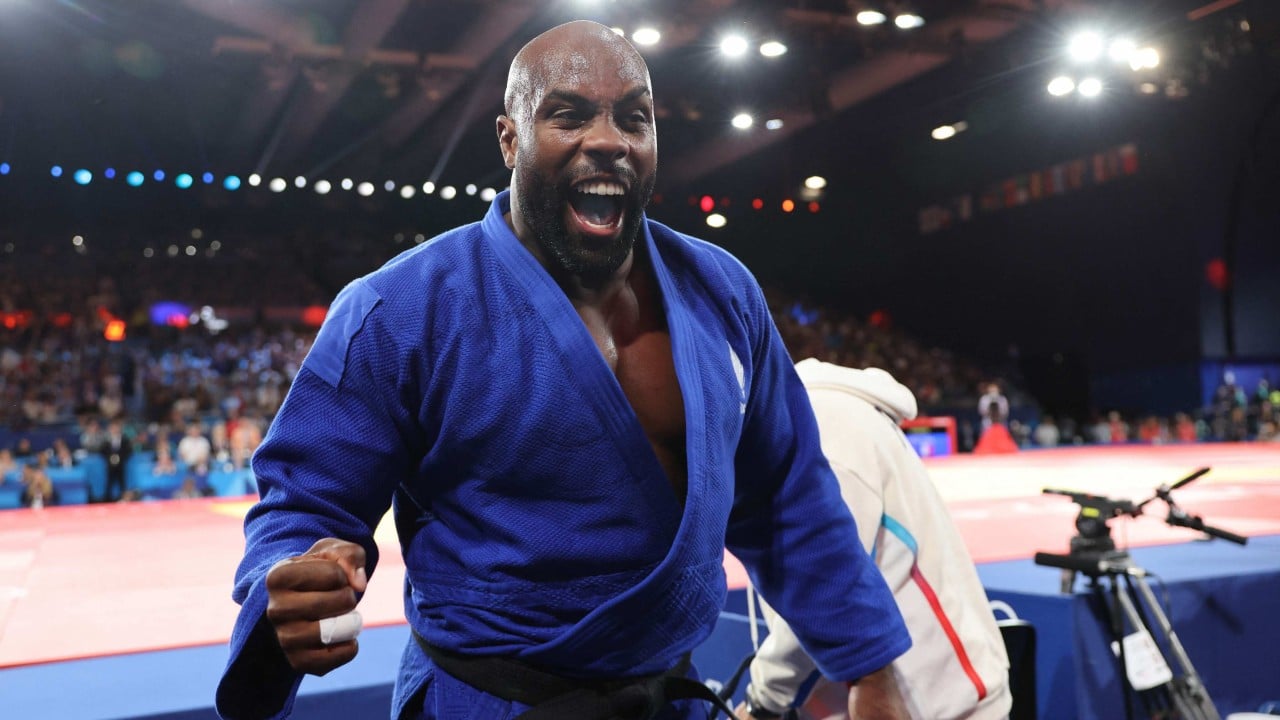
French President Emmanuel Macron’s public welcome of Olympic judo heavyweight champion Teddy Riner into the 2027 presidential conversation is a calculated political maneuver rather than a casual endorsement. Term-limited and watching his centrist coalition fracture under sustained pressure from both the nationalist right and the consolidated left, Macron stands to gain immediately from a high-profile outsider entering the field. Riner brings massive cross-demographic popularity, a unifying national brand forged on the Olympic tatami, and zero political baggage. By encouraging Riner’s political ambitions, the Élysée Palace introduces a disruptive variable capable of scrambling opposition polling and reshaping the race to succeed Macron.
Politics in the Fifth Republic rarely rewards subtlety when a sitting president faces a lame-duck twilight. Macron cannot run again in 2027 due to constitutional term limits, leaving his centrist movement without an obvious standard-bearer capable of matching his original 2017 electoral shockwave. Traditional party apparatuses in France have weakened considerably over the past decade, creating a structural vacuum that favors celebrity outsiders and independent movements over seasoned parliamentarians. For a deeper dive into similar topics, we suggest: this related article.
The Anatomy of a Calculated Endorsement
When a sitting French president publicly validates a potential candidate, nothing about the phrasing is accidental. Every syllable is weighed against internal polling, coalition stability, and the strategic headaches it creates for rivals in the National Assembly.
Macron’s posture toward Riner operates on two distinct levels. On the surface, it projects magnanimity and a commitment to democratic renewal, reinforcing the original ethos of Macron’s own rise to power. Beneath that surface lies cold electoral arithmetic. A fragmented first round in the French two-round presidential system favors candidates who can consolidate a specific ideological base while peeling away undecided moderates. For further details on this development, comprehensive analysis can be read on Al Jazeera.
If Riner runs—or even if he merely spends months testing the waters—he immediately commands media oxygen that would otherwise go to established figures like Marine Le Pen, Jordan Bardella, Édouard Philippe, or Jean-Luc Mélenchon. Television panels, radio debates, and front pages pivot toward the novelty of an athletic titan contemplating the nuclear codes. For an outgoing administration bruised by pension protests, budgetary battles, and parliamentary deadlocks, changing the national conversation is a victory in itself.
Consider the demographic math. Riner, born in Guadeloupe and raised in Paris, holds a unique place in French public life. He is one of the most decorated judokas in Olympic history, a towering physical presence who carried the Olympic flame at the 2024 Paris Games. His appeal cuts cleanly across urban and rural divides, resonates deeply in France’s overseas territories, and avoids the elitist stigma that has haunted Macron throughout his two terms.
Why Celebrities Struggle in the Fifth Republic
History offers a sobering reality check for any public figure attempting to translate cultural fame into residence at the Élysée Palace. The institutional mechanics of French presidential elections are unforgiving to novices.
Unlike parliamentary systems where a charismatic newcomer can ride a party wave into office, the French presidency demands a brutal, multi-stage endurance test. Before a candidate even appears on the ballot, they must secure the parrainages—500 official signatures from elected officials across at least 30 different departments, with no more than a tenth coming from any single department.
For an outsider without a nationwide network of mayors, regional councilors, and senators, gathering those 500 signatures is a logistical nightmare. Mayors in small rural communes are notoriously protective of their local independence and skeptical of Parisian media phenomena. Without the quiet backing of an established political machine—or an explicit green light from Macron’s own networks to lend their signatures—a celebrity campaign can stall before the official race even begins.
Even if the signature threshold is cleared, the campaign itself strips away curated public images with ruthless speed. In sports, Riner’s message is universally digestible: discipline, excellence, national pride, and respect for the opponent. In presidential politics, every issue fractures the electorate. A candidate must take concrete, defensible positions on:
- Fiscal policy and debt reduction, navigating European Union deficit rules while addressing the cost of living.
- Immigration and border security, the defining wedge issue driving voters toward the National Rally.
- Pension reform and labor markets, topics capable of bringing millions of protesters into the streets within days.
- Foreign policy and defense, including France’s role in NATO, European strategic autonomy, and nuclear deterrence.
Vague calls for national unity work well during an Olympic opening ceremony. They collapse within ten minutes of a prime-time political debate against seasoned operators who have spent twenty years memorizing budget line items.
The Succession Crisis Inside Macron’s Camp
To understand why Macron would welcome Riner, one must look closely at the fractures inside the presidential majority. Macron built his movement around his own persona, leaving little room for a natural heir to flourish without appearing disloyal.
Several heavyweights from the center and center-right have already positioned themselves for 2027, creating an internal traffic jam. Former Prime Minister Édouard Philippe has spent years building his own party, Horizons, carefully distancing himself from the Élysée’s most unpopular decisions while maintaining high approval ratings. Gabriel Attal, another former prime minister, commands strong loyalty among younger centrists and party loyalists. Gérald Darmanin and Bruno Le Maire have similarly harbored long-term ambitions, each appealing to different wings of the fragile coalition.
This crowded field presents a severe risk for the center. If three or four Macron-adjacent candidates split the moderate vote in the first round of 2027, none of them may advance to the second-round runoff. France could easily face a final choice between the far right and the hard left, effectively erasing the political center from executive power.
Introducing Riner into this mix serves as a deliberate stress test. By welcoming Riner, Macron reminds his ambitious lieutenants that none of them owns a monopoly on the centrist electorate. It keeps internal rivals off balance, forces them to compete harder for the president’s favor, and signals that the Élysée is open to unconventional alliances if traditional politicians fail to gain traction against the far right.
The Olympic Afterglow and Its Shelf Life
The timing of Riner’s political flirtation is directly tied to the lingering aura of the 2024 Paris Olympics. For two weeks, France experienced a rare pause in its chronic political cynicism. Riner stood at the absolute center of that moment, delivering gold medals and serving as the emotional anchor of the host nation.
Politicians have always sought to bottle athletic triumph for electoral gain. Yet political history demonstrates that Olympic goodwill has a remarkably short shelf life. Voters admire athletes precisely because they operate outside the compromises and mudslinging of partisan politics. The moment an athlete steps onto a campaign stage and endorses a tax bracket or a foreign policy doctrine, that protective shield evaporates.
In a hypothetical campaign scenario, Riner’s greatest asset—his status as a figure above political division—would become his primary vulnerability. Opponents on the right would frame him as a naive proxy for Macron’s third term, attempting to paint him as a celebrity puppet designed to save an unpopular establishment. Opponents on the left would scrutinize his corporate sponsorships, business ventures, and personal wealth, questioning his connection to working-class struggles.
Furthermore, Riner’s athletic career has required absolute focus on physical preparation and competition. Transitioning from elite sport to full-time politics requires building a policy team, raising millions of euros under strict campaign finance laws, and enduring daily media scrutiny into personal finances and past statements. Many public figures enjoy the speculation of a presidential run far more than the grueling reality of executing one.
How the Opposition Reads the Move
Neither the National Rally on the right nor France Unbowed on the left views Riner’s potential candidacy as a joke. Both camps understand that traditional ideological alignments in France have broken down, replaced by a contest between anti-system populism and institutional stability.
For Marine Le Pen and Jordan Bardella, the primary threat in 2027 is not a conventional technocrat reciting economic statistics. Technocrats are predictable targets; populist movements know exactly how to dismantle them on television. A charismatic, wildly popular national hero presents a far trickier target. Attacking Riner too aggressively risks alienating working-class voters who admire his athletic achievements and humble roots.
At the same time, the far right benefits if Riner merely fragments the anti-Le Pen vote. If Riner pulls 8 to 10 percent of the electorate—drawing mainly from moderate centrists, young voters, and the left—he could inadvertently guarantee that a centrist candidate misses the second-round cutoff. That mathematical tension explains why opposition leaders have largely avoided direct attacks on Riner, opting instead to dismiss his candidacy as a distraction engineered by an out-of-touch Élysée.
The Reality of the 2027 Battlefield
Ultimately, the distance between expressing political interest and standing on the steps of the Élysée Palace is vast. France’s institutional framework, economic pressures, and polarized electorate leave almost no margin for error.
Whether Riner commits to a full-scale presidential campaign, settles for a ministerial role in a future government, or uses his platform to advocate for sports and youth initiatives without running, Macron has already extracted value from the moment. By opening the door to Riner, the French president demonstrated that even in the final stretch of his mandate, he retains the ability to disrupt the political board and force every rival to recalculate their path to power.
Voters watching the 2027 race unfold should ignore the early poll numbers surrounding celebrity entrants and watch one concrete metric instead: how many local mayors quietly pledge their official signatures when the filing window opens.