Forty-four.
Say the number out loud, slowly, letting the consonants catch in your throat before you allow your eyes to skim past it like a stock ticker or a sports score. In the sterile language of wire dispatches—the kind of copy designed to be read over morning coffee and forgotten before the commute—forty-four is merely a baseline metric. "At least 44 people killed in air strike near Yemeni capital, Houthi rebels say." Thirteen words. Clean. Contained. Easily digestible.
But a number is a liar when it pretends to be an ending.
To understand what actually happened outside Sanaa, you have to strip away the insulation of distance and look at the geometry of a blast radius. You have to stop thinking like an analyst tracking a geopolitical chess match and start thinking like a baker checking his ovens at four in the morning, or a mother deciding whether the corrugated tin roof over her children’s heads will hold against the night wind.
The Architecture of a Second
Imagine, for a moment, a hypothetical household on the outskirts of the Yemeni capital—let us call the father Tariq, a composite drawn from the thousands of civil servants and day laborers who have spent a decade surviving on fractured salaries and stubborn grace. Tariq does not own a missile battery. He does not draft maritime blockades in Red Sea war rooms, nor does he sit at mahogany tables in Riyadh, Washington, or Tehran calculating deterrence ratios.
Tariq owns a rusted Peugeot with a cracked windshield and three crates of tomatoes he needs to reach the market before the sun crests the surrounding mountains.
When an air strike lands near a densely populated perimeter, physics does not negotiate with innocence. First comes the pressure wave, moving faster than sound, turning ordinary glass into thousands of spinning needles. Then comes the heat—a sudden, unnatural noon that erases shadows. Finally, the sound arrives, a physical blow that rattles the fillings in your teeth and collapses the lungs before the brain even registers that the sky has fallen.
In that single, compressed second, forty-four distinct universes wink out.
Each of those forty-four lives carried a specific gravity. One of them knew the exact ratio of cardamom to coffee beans that made his neighbors smile. Another had spent three years saving copper wire to fix a broken water pump. A third was perhaps a child who had never once known a Tuesday without the low, mosquito-like hum of reconnaissance drones stitching circles above the clouds. When we compress them into a two-digit headline, we perform a quiet violence of our own. We turn biographies into bookkeeping.
Why the Fog of War Is Never an Accident
If you have ever tried to verify a casualty figure from a conflict zone in real time, you know the vertigo that sets in. You sit before glowing monitors, watching competing claims collide like tectonic plates. On one side, Houthi authorities—the de facto rulers of Sanaa since their 2014 takeover—release immediate, stark numbers: forty-four dead, dozens more pulled from concrete dust. On the other, coalition spokespeople or foreign defense ministries speak in the clinical dialect of "precision munitions," "military infrastructure," and "ongoing assessments."
Who do you believe when both sides treat truth as ammunition?
Think of war reporting like trying to reconstruct a shattered stained-glass window during an earthquake. Independent journalists are largely barred from the ground or trapped behind labyrinthine permit systems. Hospital morgues in Yemen, starved of electricity and formal record-keeping software after years of economic blockade and civil collapse, count bodies with clipboards and flashlights. Meanwhile, militant movements have every strategic incentive to amplify civilian suffering to rally domestic outrage, just as those firing from the sky have every incentive to minimize collateral damage to preserve international legitimacy.
Yet beneath the propaganda tug-of-war lies an immovable physical reality. Sanaa sits in a high mountain basin, hemmed in by ridges where military installations, storage depots, and residential neighborhoods have bled into one another over decades of chaotic urban sprawl. There is no neat line drawn in the dirt separating a barracks from a wedding hall, or a radar outpost from a mechanics' alley. When high-explosive ordnance drops into that tight geography, precision becomes a comforting myth told by people who have never swept plaster out of their children's hair.
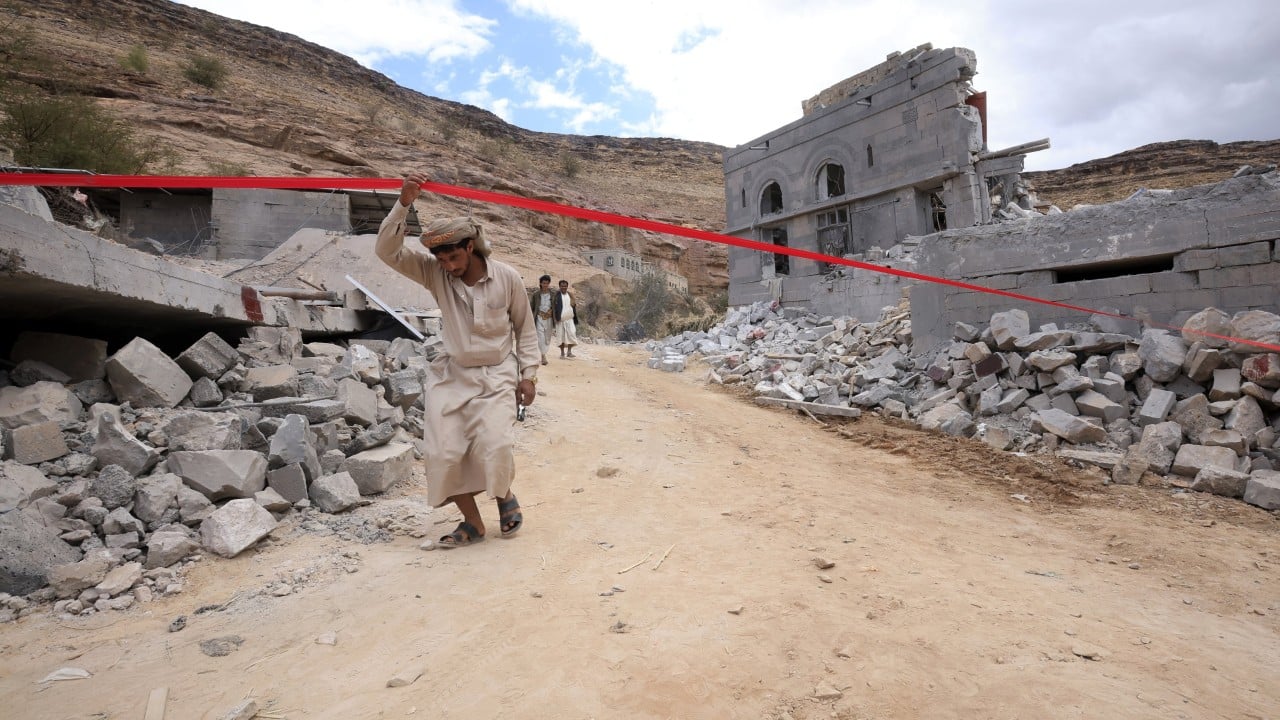
I remember standing once in the aftermath of a similar strike in the region—not as a soldier, not as a diplomat, just a witness trying to keep my boots steady on loose rubble. What stays with you is not the dramatic roar you see in films. It is the smell. Crushed limestone smells remarkably like chalk dust from an elementary school blackboard, mixed with the metallic tang of burst pipes and burning plastic. And it is the silence afterward—a thick, stunned quiet broken only by someone tapping a piece of rebar against a collapsed slab, listening for a tap back.
The Invisible Ledger of Survival
To grasp why an air strike near Sanaa carries stakes far beyond the immediate crater, you have to understand the fragility of the ecosystem it disrupts. Yemen was already the poorest nation in the Arab world before the current cycle of war began in 2014. Over a decade of grinding conflict—a brutal proxy struggle pitting the Iran-aligned Houthi movement against a Saudi-led coalition, later entangled with broader Red Sea escalations involving American and British forces—has hollowed out the country's basic organs.
Consider what happens when a single arterial road or electrical substation near the capital takes a hit.
It is never just the concrete that breaks. It is the cold chain keeping insulin viable in a clinic three miles away. It is the diesel truck carrying flour from the port of Hodeidah that now has to detour across bombed-out mountain passes, doubling the price of bread for families already skipping dinner so their toddlers can eat lunch. According to United Nations humanitarian assessments, more than half of Yemen's population—over eighteen million people—relies on some form of aid simply to stay alive.
In a country balanced on a razor's edge, every explosion triggers a slow-motion second wave of casualties that never makes the breaking news banner. Nobody writes a wire dispatch about the diabetic grandmother who dies six weeks later because a bridge was cratered. Nobody tallies the cholera cases sparked when a water main fractures beneath a bombed intersection.
The Trap of Numbness
Why do we let our eyes slide past forty-four deaths in Sanaa while a single tragedy closer to home stops us cold?
Psychologists call it psychic numbing—the documented quirk of human empathy where our compassion actually decreases as the scale and repetition of suffering grow larger. One person trapped in a well commands the world's breathless attention; forty-four people buried under concrete near a city most Westerners couldn't locate on an unlabeled map trigger a momentary sigh and a thumb-flick down the screen.
Worse still is the fatalism that creeps in around long wars. Because Yemen has been bleeding in the headlines intermittently for more than ten years, outsiders begin to treat violence there like weather—an inevitable, seasonal storm rather than the result of deliberate human choices. We tell ourselves the region is "complicated," using complexity as a sedative to excuse our indifference.
Yes, the politics are labyrinthine. The grievances stretch back through revolutions, unifying wars, tribal realignments, and foreign interventions. The Houthi movement's rise from a northern revivalist insurgency to a heavily armed de facto state has reshaped the security architecture of the entire Arabian Peninsula and global shipping lanes. None of that is simple.
Nothing about forty-four dead human beings, however, is abstract.
What Remains in the Dust
Return, for one last breath, to the outskirts of Sanaa as evening settles over the plateau.
The dust eventually drops out of the air, coating the wild acacia trees and the flat roofs of mud-brick houses in a pale, ghostly flour. Neighbors will gather with shovels, crowbars, and bare hands, because heavy excavation machinery is scarce and fuel is precious. They will pull out survivors covered in gray powder so thick you can only tell they are alive by the wet tracks of tears cutting down their cheeks. And they will lay the dead in neat rows wrapped in wool blankets, waiting for morning prayers.
Somewhere far away, in climate-controlled briefing rooms, analysts will update their maps. A colored pin will move. A press release will be drafted, parsed for legal liability, and filed away.
Tomorrow, another headline will push this one off the page, reducing forty-four lifetimes of laughter, stubbornness, bad jokes, and unfinished plans into an archive footnote. Unless we refuse the sedative of the summary. Unless we remember that every time a missile falls from a dark sky, the true wreckage isn't measured in crater depth or strategic deterrence—it is measured in forty-four empty chairs at forty-four dinner tables, waiting for people who are never coming home.