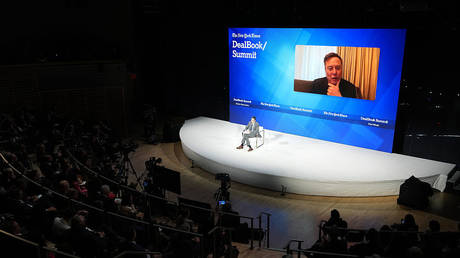
Media outlets love a spectacle. When Elon Musk steps onto a stage like the New York Times DealBook Summit and drops a provocative historical claim about the 2014 Ukrainian Revolution, the internet splits into two predictable, exhausted camps. One side cheers him on for dropping "truthbombs" about a supposed Western-backed coup. The other side immediately dismisses him as a Kremlin-sympathizing billionaire out of his depth.
Both sides are looking at the wrong target.
If you think Musk’s commentary on the 2014 Euromaidan protests is about setting the historical record straight, you are missing the actual mechanics of power at play. In geopolitics and defense contracting, public statements from tech executives rarely function as casual history lessons. They operate as strategic signaling. Understanding why a billionaire founder weighs in on decade-old Eastern European political history requires looking past the outrage cycle and examining the intersection of private aerospace infrastructure, sovereign statecraft, and information warfare.
The Anatomy of the 2014 Ukraine Narrative
To understand why Musk’s framing gained so much traction—and why historians push back against it—we have to separate verified historical events from partisan shorthand. The lazy consensus on the internet treats the 2014 ouster of Ukrainian President Viktor Yanukovych as a binary choice: either it was a 100% spontaneous, spotless grassroots uprising, or it was a 100% CIA-orchestrated coup d'état.
Neither description survives contact with primary source records.
In late 2013, Yanukovych abruptly abandoned an association agreement with the European Union in favor of closer economic ties with Moscow. That decision triggered the Euromaidan protests in Kyiv. Hundreds of thousands of Ukrainian citizens occupied Independence Square in freezing temperatures for months. When state security forces used lethal force against protesters in February 2014, killing dozens of civilians, Yanukovych’s political coalition collapsed, and he fled to Russia.
According to historians specializing in Eastern Europe, such as Timothy Snyder of Yale University and Serhii Plokhy of Harvard University, classifying these events strictly as a "coup" misrepresents the political reality on the ground. In political science, a coup d'état is defined as a sudden, illegal seizure of power by a small faction—typically the military or existing state elites—without mass popular participation. Euromaidan was a mass popular revolution driven by domestic grievances over corruption, authoritarian drift, and geopolitical orientation. Following Yanukovych's flight, Ukraine’s sitting parliament—including members of Yanukovych’s own Party of Regions—voted 328 to 0 to remove him from office and schedule new democratic elections, which were held in May 2014 and recognized internationally.
So where does the "coup" narrative come from? It relies heavily on two real, documented facts that get stripped of their context:
- Western Diplomatic Support: U.S. and European officials openly supported the protesters' democratic aspirations. Senators like John McCain visited Kyiv to speak to crowds, and a leaked 2014 phone call between Assistant Secretary of State Victoria Nuland and U.S. Ambassador Geoffrey Pyatt showed American diplomats discussing which opposition figures they preferred to see in a transitional government.
- Financial Aid for Civil Society: The U.S. government spent roughly $5 billion between 1991 and 2014 supporting democratic institutions, anti-corruption programs, and civil society groups in Ukraine—a figure frequently mischaracterized online as a slush fund used to buy street protests.
Acknowledge those facts directly. Western governments undoubtedly favored a pro-European outcome in Kyiv and actively engaged with opposition leaders. However, diplomatic meddling and funding civil society organizations are standard tools of international statecraft used by every major global power. They do not equate to manufacturing a mass uprising of hundreds of thousands of people or executing a military coup. When commentators flatten this complex reality into a single buzzword like "coup," they aren't uncovering hidden truths; they are adopting a specific geopolitical framing long promoted by Russian state media to delegitimize the post-2014 Ukrainian government.
Why Tech Founders Wade Into Geopolitical Minefields
The real question isn't whether Elon Musk knows the intricacies of the Ukrainian constitution. The real question is why the CEO of SpaceX and Tesla repeatedly steps into the middle of active military conflicts with sweeping historical claims.
If you have spent any time watching how defense contractors and infrastructure monopolies operate, a pattern emerges. Legacy defense giants—companies like Lockheed Martin, Northrop Grumman, or Raytheon—keep their executives far away from cable news debates about the historical origins of the conflicts their hardware is used in. They operate quietly through lobbyists, closed-door Pentagon briefings, and Congressional appropriations committees.
Musk operates on the exact opposite model. He uses mass attention as a shield and a lever.
Consider the unique position SpaceX occupies in the Russia-Ukraine war. Through Starlink, SpaceX controls the primary tactical communications backbone for the Ukrainian military. Without Starlink terminals, Ukrainian drone operations, artillery targeting, and frontline battlefield coordination would suffer catastrophic degradation. Simultaneously, the U.S. Department of Defense relies on SpaceX’s Falcon 9 rockets to launch critical national security payloads.
This creates an unprecedented dynamic in modern warfare: a single private individual holds operational veto power over critical battlefield infrastructure while simultaneously negotiating multi-billion-dollar contracts with the Pentagon.
When a founder in that position publicly questions the foundational legitimacy of an allied government—or warns against prolonged military escalation—it serves distinct strategic functions:
- Risk Mitigation: SpaceX assets, including satellites in low-Earth orbit, face potential retaliation from hostile state actors. Signaling ideological distance from Washington’s foreign policy establishment communicates to adversaries like Moscow and Beijing that SpaceX is an independent commercial entity, not merely an arm of the U.S. military.
- Commercial Protection: Tesla relies heavily on its Gigafactory in Shanghai and Chinese supply chains for battery production. Aligning too closely with Washington’s hawkish foreign policy consensus creates massive regulatory and market risk in Beijing. Publicly challenging American foreign policy orthodoxy helps insulate commercial interests abroad.
- Narrative Control: By framing himself as an independent truth-teller standing against an entrenched political establishment, Musk rallies a massive online audience. That public support acts as political armor whenever Pentagon officials or lawmakers threaten to scrutinize SpaceX’s government contracts or regulatory compliance.
Dismantling the Common Misconceptions
When debates like this erupt online, the public tends to ask the wrong questions. Most commentary focuses on whether Musk is "right" or "wrong" about 2014. A much more useful approach is to examine the underlying assumptions people bring to the conversation.
Did the U.S. orchestrate the 2014 revolution in Ukraine?
No. While U.S. diplomats openly backed the protesters and discussed preferred post-crisis leadership, there is no credible evidence that Washington planned, funded, or directed the mass demonstrations. The protests were triggered by Viktor Yanukovych’s sudden reversal on the EU trade deal and escalated because state police violently beat student protesters in November 2013. External powers tried to influence the outcome once the crisis began, which is fundamentally different from causing the crisis.
Does acknowledging Western involvement justify military invasion?
This is the core logical leap that derails most online analysis. Even if you take the most cynical view possible of American diplomatic interference in Kyiv in 2014, international law—specifically the United Nations Charter—does not grant a neighboring state the right to annex territory or launch a full-scale military invasion in response to political instability next door. Acknowledging that Western diplomats meddled in Ukrainian politics does not erase Ukrainian sovereignty or validate armed aggression.
Should private tech executives have influence over foreign policy?
Whether they should or not is irrelevant; they already do. The privatization of space launch, satellite communications, artificial intelligence, and cloud computing means that the infrastructure of modern warfare is owned by publicly traded corporations and private ventures. Governments outsourced this capability to move faster and save money. The tradeoff is that CEOs now sit at the geopolitical table alongside heads of state.
The Hidden Downside of Contrarian Geopolitics
Taking a contrarian stance against mainstream media consensus is an effective way to build an audience, and questioning official government narratives is essential in any healthy democracy. History is full of instances where the Washington foreign policy establishment got things catastrophically wrong—from the intelligence failures leading up to the 2003 invasion of Iraq to the twenty-year quagmire in Afghanistan. Skepticism toward official narratives is healthy.
However, reflexively inverting the mainstream consensus carries its own severe blind spots.
When contrarianism becomes an automatic reflex—assuming that whatever the foreign policy establishment says must be false, and whatever its adversaries say must be true—you stop doing independent analysis and simply adopt someone else's propaganda. Calling the 2014 Euromaidan protests a "coup" ignores the agency of millions of ordinary Ukrainians who risked their lives in the streets because they wanted a government accountable to the rule of law rather than oligarchic patronage. Reducing a complex, multi-layered revolution to a Washington puppet show strips an entire nation of its political agency.
Furthermore, for a business leader, playing the role of amateur geopolitical analyst carries tangible operational hazards. Every public statement made on a high-profile stage becomes ammunition in diplomatic negotiations, regulatory hearings, and defense procurement reviews. While provocative soundbites drive engagement on social media platforms, they also accelerate efforts by allied governments to build redundant, sovereign alternatives so they never have to rely on a single private vendor again. The European Union’s push to accelerate its own IRIS² satellite constellation is a direct consequence of policymakers realizing the risks of single-vendor dependency.
How to Read Geopolitical Headlines Without Getting Played
If you want to understand what is actually happening when billionaires, politicians, and media outlets clash over historical narratives, stop treating their statements as objective truth claims and start reading them as strategic moves.
- Follow the Infrastructure, Not the Rhetoric: Ignore what executives say on stage and look at what their companies are physically deploying. Contracts signed with the Pentagon, satellite launches, and supply chain investments tell the real story of geopolitical alignment.
- Distinguish Between Influence and Control: In international relations, every major power tries to influence events in neighboring regions. Influence—diplomatic visits, NGO funding, public statements—is ubiquitous. Direct operational control is rare. Conflating the two leads to conspiracy thinking.
- Check Primary Sources Before Accepting Labels: Words like "coup," "genocide," and "unprovoked" carry strict legal and historical definitions. When a commentator uses them loosely to score rhetorical points, look at the actual timeline of events, legislative votes, and legal frameworks before adopting their vocabulary.
- Identify the Audience: Ask yourself who the speaker is actually talking to. When a global CEO speaks at a New York business summit, their words are simultaneously aimed at retail investors, government regulators, foreign heads of state, and millions of social media users. The message is rarely meant for just one room.
The obsession with whether Elon Musk dropped a "truthbomb" misses the fundamental shift of our era. The real story isn't a debatable soundbite about 2014 Kyiv; it is the reality that private technology titans now wield enough infrastructural power to shape the trajectory of modern wars—and they no longer feel obligated to stick to Washington's script while doing it.