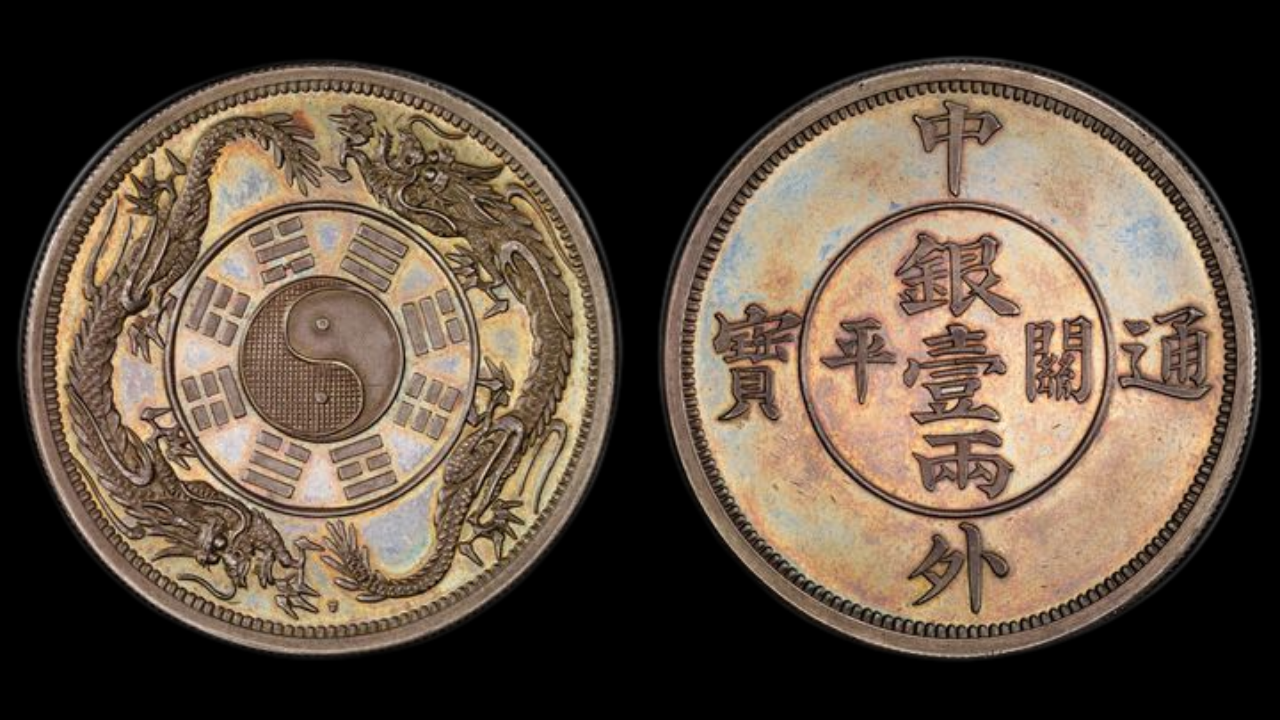
An uncirculated 1867 silver pattern coin minted in Hong Kong for the Chinese trade just sold at auction for $4.75 million, anchoring a single-owner numismatic sale that cleared nearly $32 million. The record-shattering hammer price for the 1867 Shanghai Tael proves that ultra-high-net-worth collectors are treating museum-grade Asian historical artifacts as premier alternative assets. While mainstream financial press treats the sale as a quirky headline about rich hobbyists, the real story sits at the intersection of 19th-century colonial monetary failure, modern capital flight, and the institutionalization of rare tangible collectibles.
Money talks. In Hong Kong auction rooms, it whispers in Mandarin and settles in seven-figure wire transfers.
When a single disc of silver weighing roughly one troy ounce commands nearly five million dollars, the valuation has nothing to do with precious metal spot prices. You are looking at an extreme supply-and-demand bottleneck colliding with a shift in how Asian wealth preserves capital across generations. To understand why buyers fought over a rejected currency prototype from the Qing Dynasty era, you have to look past the auction catalog and examine the mechanics of both colonial trade politics and modern private wealth management.
The Colonial Monetary Experiment That Failed
The 1867 Shanghai Tael was never meant to be a rare collectible. It was designed to be an everyday workhorse of international commerce, born out of sheer frustration among British merchants operating in China's treaty ports during the mid-nineteenth century.
At the time, China did not have a standardized national silver coinage. Commerce relied on sycee, which were hand-cast silver ingots of varying shapes, weights, and purities, alongside foreign silver dollars imported from Mexico, Spain, and Peru. Every transaction required local money changers to weigh and assay the silver, taking a cut at every step. For British trading houses in Shanghai and Hong Kong, this friction was an expensive nightmare.
The Royal Mint in Hong Kong, which had opened in 1866, saw an opportunity to solve the problem and extend British monetary influence into the mainland. Under the direction of Master of the Mint Thomas Graham and designer Leonard Charles Wyon, the Hong Kong facility struck a series of experimental pattern coins in 1867 denominated in taels, the traditional Chinese unit of weight.
They got the technical execution right and the politics entirely wrong.
The obverse featured the British royal coat of arms and English lettering, while the reverse displayed a traditional Chinese dragon surrounded by Chinese characters denoting the weight and the Hong Kong mint origin. British officials assumed Chinese merchants would welcome a uniform, machine-struck silver coin backed by British assay standards. Instead, the Qing imperial court viewed the coin as a direct infringement on Chinese monetary sovereignty. Placing the British royal crest alongside imperial Chinese dragon iconography on a unit of Chinese currency was a diplomatic non-starter.
Local merchants rejected the coin, the Qing government refused to sanction it, and the Hong Kong Mint itself proved financially unsustainable, shutting down permanently in 1868 after less than two years of operation. Only a tiny handful of the 1867 Shanghai Tael patterns were ever struck before the dies were retired and the machinery was eventually sold off to Japan to establish the Osaka Mint.
Scarcity Meets Sovereign Pride
In the world of high-end numismatics, failure is often more profitable than success. Coins that circulate widely get worn down, melted during silver price spikes, or lost over centuries. Coins that fail at the prototype stage get locked away in archival cabinets by mint officials, diplomats, and wealthy Victorian collectors.
Fewer than a dozen examples of the 1867 Shanghai Tael with rays are known to exist across both private hands and public institutions. When one surfaces at a major Hong Kong sale, you are not watching a standard market transaction. You are watching a trophy hunt where the supply curve is completely vertical.
What separates the Chinese numismatic market from Western coin collecting is the emotional and cultural weight attached to these objects. For decades, American and European buyers dominated the market for rare Chinese coins, treating them as exotic curiosities from the colonial era. Over the past twenty years, that dynamic has inverted completely. Mainland Chinese and Hong Kong collectors have aggressively repatriated their monetary heritage, viewing late-Qing and early-Republican rarities not merely as investments, but as reclaimed historical artifacts.
An American billionaire might buy a 1933 Double Eagle because it represents the pinnacle of US minting history. A Chinese industrialist buys the 1867 Shanghai Tael because it sits at the exact pivot point where traditional imperial China collided with Western industrial capitalism. That cultural premium adds millions to the final bid, pushing prices far beyond what Western valuation models would ever predict.
Anatomy of a $32 Million Collection
A single record-breaking coin grabs the headlines, yet the broader financial signal lies in the total realization of the entire sale. Clearing nearly $32 million across a single collection indicates deep liquidity across multiple tiers of the market, not just a bidding war between two isolated billionaires at the very top.
Auction houses achieve these totals through careful curation and psychological pacing. When an estate or longtime private collector brings a generational assemblage to market in Hong Kong, the catalog acts as a temporary monopoly on top-tier material. Institutional buyers, private wealth advisors, and veteran dealers know that if they pass on a lot, they might wait fifteen years to see another comparable specimen.
Consider how high-end numismatic collections generate compounding returns over multi-decade holding periods:
- Condition Rarity: A coin graded Mint State 64 or higher by third-party authentication services like PCGS or NGC often sells for five to ten times the price of an identical coin graded just two points lower. At the $4.75 million level, buyers are paying for microscopic surface preservation that has survived over 150 years without cleaning or environmental damage.
- Pedigree Premium: Provenance matters immensely in Asian art and numismatics. A coin traced back to famous early-twentieth-century collections carries an invisible certificate of authenticity that insulates the buyer from forgery risks and boosts future resale value.
- Cross-Border Portability: Unlike real estate, fine art canvases, or classic cars, a $4.75 million coin fits inside a shirt pocket. For wealthy families operating across jurisdictions with strict capital controls or geopolitical friction, high-value numismatics offer unmatched density of wealth.
The Structural Shift in Tangible Assets
The $32 million Hong Kong auction did not happen in a vacuum. Over the last decade, ultra-high-net-worth portfolios have steadily reallocated capital away from traditional financial instruments during periods of currency volatility and inflation uncertainty.
Real estate in Hong Kong and mainland China has faced severe headwinds, regulatory tightening, and compressed yields. Equities across the region have experienced prolonged periods of erratic performance. Against that backdrop, passion assets—rare coins, vintage watches, classic wines, and imperial ceramics—have matured into an institutionalized asset class with dedicated lending desks, specialized insurance underwriters, and transparent auction databases.
Private banks in Geneva, Singapore, and Hong Kong routinely accept graded, top-pop coins as collateral for liquidity facilities. When a collector spends $4.75 million on an 1867 pattern tael, that capital is not necessarily locked up permanently. The buyer can borrow against the asset at favorable rates while retaining ownership and upside appreciation.
Still, treating rare coins as pure financial instruments carries real risks that auction house press releases conveniently omit.
The Blind Spots Buyers Ignore
Veteran dealers know that auction records can distort reality. A $4.75 million hammer price creates a halo effect that lifts the prices of mid-tier coins temporarily, often drawing unsophisticated speculators into the market at the exact wrong moment.
Liquidity in numismatics is asymmetric. Selling a top-five global rarity at a major Hong Kong auction is easy because the world's wealthiest collectors will fly in to compete for it. Selling twenty mid-tier coins worth $15,000 each during a market downturn can take months and require steep discounts. Transaction costs are also brutal. Buyer's premiums at major auction houses routinely add 20% to the hammer price, meaning a coin must appreciate substantially just for the buyer to break even on a resale.
Authentication remains another persistent vulnerability. While third-party grading slabs have standardized condition assessments and eliminated basic counterfeits, high-end fakes produced with modern laser-scanning and precision die-cutting technology continue to test the limits of numismatic forensics. Buyers relying solely on plastic holders without deep personal expertise or trusted advisor representation expose themselves to catastrophic loss.
Even macroeconomic shifts can cool the room quickly. The Chinese numismatic market experienced a sharp correction between 2012 and 2015 during Beijing's anti-corruption crackdown, when gifting luxury collectibles fell out of favor overnight and auction volumes contracted sharply. While today's buyers are largely legitimate private collectors and family offices rather than political operatives, the market remains sensitive to regional credit conditions and currency fluctuations.
What the Hammer Price Actually Measures
Look closely at the 1867 Shanghai Tael and you see a paradox. British engineers minted it to impose order on chaotic Asian trade, and Chinese merchants rejected it because they refused to surrender control over their own money. More than a century and a half later, that exact symbol of Western colonial ambition has been reclaimed by Asian capital at a price that dwarfs the entire operating budget of the mint that produced it.
The auction result is not an aberration. It is a clear price discovery mechanism showing where global private wealth feels safest right now. When sovereign debt levels climb and traditional asset classes wobble, tangible historical scarcity wins every time. You cannot print more 1867 pattern coins, you cannot dilute their supply through secondary offerings, and you cannot replicate a century and a half of provenance in a laboratory.