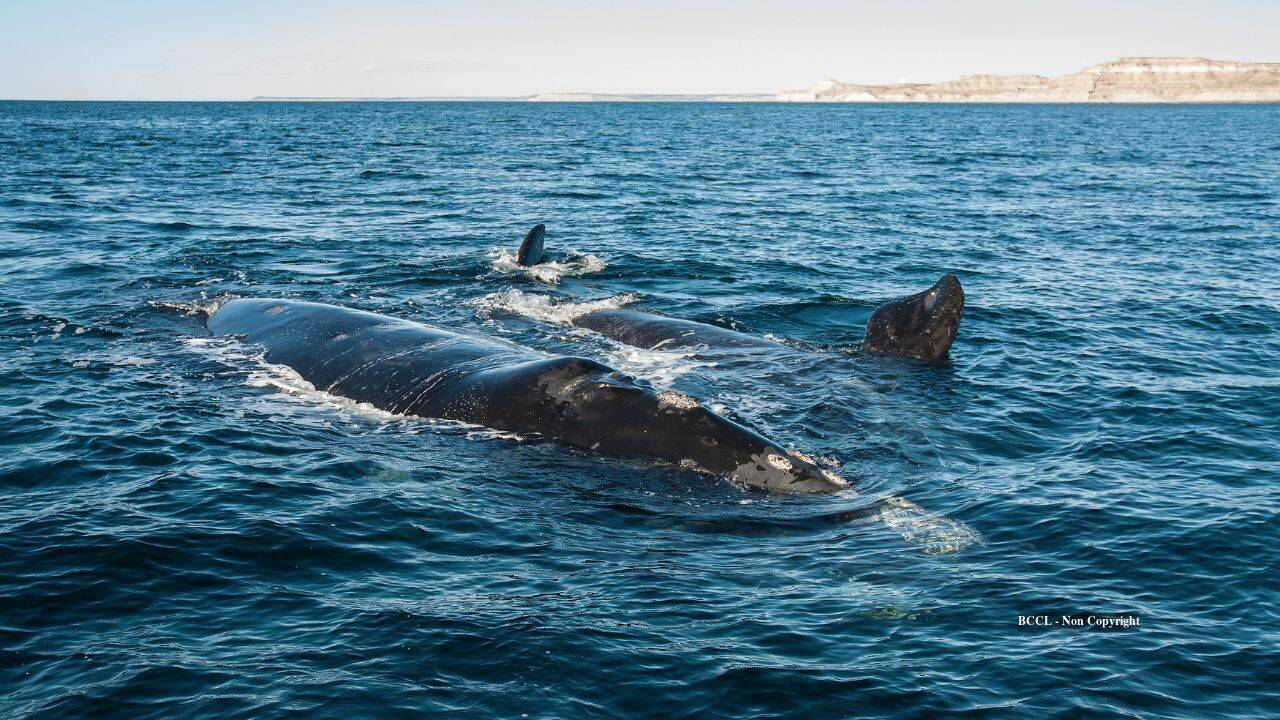
Marine biologists spotting an uncounted North Atlantic right whale calf in Canadian waters sounds like pure good news, pushing the season's total to 24 amid a critically endangered population of roughly 380 individuals. Yet the discovery exposes a troubling blind spot in how we track the world's rarest marine mammals. If a 15-foot newborn and its 45-foot mother can slip past billions of dollars in satellite tracking, aerial surveys, and acoustic buoys during their migration north, the exact same detection gaps are leaving them completely exposed to fatal ship strikes and commercial fishing gear.
For decades, conservation agencies have treated the North Atlantic right whale as the most closely monitored whale population on Earth. Every known individual has a catalog number, a photographic file of the white callosity patterns on its head, and a mapped migration corridor stretching from the warm calving grounds off Florida and Georgia to the cold feeding waters of the Gulf of St. Lawrence. When an unrecorded mother-calf pair suddenly appears off the Canadian coast, it forces a hard look at the limits of our surveillance infrastructure.
The Illusion of Total Surveillance
We like to believe that modern oceanography has mapped every corner of the continental shelf. The reality is far messier. The Atlantic Ocean is vast, turbulent, and optically opaque, making consistent visual confirmation nearly impossible even for well-funded research teams.
Aerial surveys remain the gold standard for counting right whale calves. Spotter planes fly tight grid patterns over known calving zones between November and April, relying on trained human eyes to spot dark backs breaking the surface. A single week of coastal storms, low cloud ceilings, or rough sea states can ground those flights entirely. During those blind windows, a pregnant female can give birth, nurse her calf for weeks, and begin the thousand-mile trek north without ever crossing the flight path of a survey aircraft.
Passive acoustic monitoring fills some of those gaps, though it carries its own structural flaws. Underwater hydrophones listen for the distinct "upcalls" right whales use to communicate. While these listening stations detect presence, they cannot count heads. An acoustic buoy hears a vocalizing adult, not a silent newborn, and it cannot distinguish between a cataloged whale and an unrecorded calf swimming in its mother's slipstream.
Climate Shifts Are Breaking Old Migration Maps
The appearance of an uncounted calf in Canadian waters points directly to a broader ecological disruption. Right whales do not follow calendar dates; they follow food. Specifically, they follow dense blooms of Calanus finmarchicus, a tiny, lipid-rich copepod that fuels their massive bodies and sustains nursing mothers.
As ocean temperatures rise in the Gulf of Maine and the Bay of Fundy, those copepod populations have shifted north and east into the Gulf of St. Lawrence. The whales followed their food supply into waters that, until roughly a decade ago, lacked comprehensive speed restrictions and seasonal fishing closures. Because pregnant females are burning enormous caloric reserves to gestate and nurse, they are taking unconventional routes and lingering in unmonitored offshore pockets where prey still concentrates.
Consider a hypothetical scenario involving a mother-calf pair migrating north in late spring. Rather than hugging the traditional coastal corridor monitored by inshore spotter planes, the mother tracks a warm-core eddy 60 miles offshore where shifting currents have trapped a dense patch of zooplankton. Because standard aerial grids prioritize nearshore shipping lanes and historic aggregation zones, that pair moves north completely invisible to regulators. Dynamic management zones—temporary speed limits triggered only when a whale is visually or acoustically confirmed—never activate because no one knew the whales were there.
Why 24 Calves Is Both a Milestone and a Warning
Context matters when evaluating reproductive numbers. A tally of 24 calves in a single season represents a noticeable uptick compared to the dismal years between 2018 and 2020, when annual births plummeted into the single digits and even hit zero in 2018. Marine biologists estimate the species needs at least 50 calves per year just to offset human-caused mortality and achieve modest recovery.
Twenty-four births is half of what the population requires to stabilize.
Even more concerning is the demographic bottleneck inside that 380-whale estimate. Fewer than 70 breeding-age females remain alive today. The physical toll of modern ocean survival has dramatically slowed their reproductive cycles. Historically, a healthy female North Atlantic right whale gave birth once every three years. Today, the average calving interval has stretched to between seven and ten years.
Chronic sub-lethal trauma drives that delay. Over 85 percent of cataloged right whales bear scars from fishing rope entanglements, and many carry heavy plastic lines wrapped around their jaws, flippers, or tails for months or years. Dragging hundreds of pounds of commercial trap gear burns through the fat reserves a female needs to ovulate and carry a fetus to term. When an uncounted calf surfaces in Canada, it proves one of those precious few breeding females managed to avoid severe entanglement long enough to reproduce—a statistical triumph tempered by the sheer fragility of the remaining breeding pool.
The Deadly Cost of Uncounted Whales
Missing a calf during a winter count is not merely a bookkeeping error for wildlife biologists. Management protocols in both the United States and Canada rely directly on real-time detection to protect whales from their two primary killers: vessel strikes and fixed-gear fisheries.
Dynamic Speed Zones Have a Fatal Lag Time
In high-traffic shipping lanes approaching major ports from Savannah to Halifax, vessels over 65 feet face mandatory 10-knot speed restrictions inside seasonal management areas. Outside those fixed boxes, regulators rely on dynamic zones that take effect only after a verified sighting. If a mother and calf travel undetected, cargo ships and tankers continue barreling through their path at 18 to 22 knots. A collision at those speeds almost always proves fatal to a calf, whose soft bones and thin blubber layer offer zero protection against a bulbous bow.
Static Fishing Gear Remains an Invisible Minefield
Lobster and snow crab fisheries deploy hundreds of thousands of vertical buoy lines connecting seabed traps to surface floats. To a migrating whale, the water column looks like a dense forest of tensioned synthetic rope. Regulators implement temporary fishery closures when right whales aggregate in a specific grid square. An uncounted pair swimming through an unmonitored sector enters waters packed with active vertical lines, turning a routine feeding dive into a potentially lethal entanglement event.
Fixing the Detection Blind Spot
Relying on fair-weather spotter planes and reactive closures will not save a species hovering below 400 individuals. Closing the gap requires shifting from reactive sighting models to continuous, automated, and preventative ocean management.
- Autonomous Acoustic Gliders: Unlike fixed buoys, wave-powered and buoyancy-driven underwater gliders patrol offshore corridors continuously through storms and winter darkness, transmitting near-real-time acoustic detections via satellite to alert mariners immediately.
- High-Resolution Satellite Imagery: Commercial synthetic aperture radar and sub-meter optical satellites can now identify whale-sized targets from orbit, allowing analysts to scan massive swaths of offshore ocean without risking pilots in low-altitude aircraft.
- On-Demand Ropeless Fishing Gear: Removing vertical lines from the water column altogether eliminates entanglement risk even when whales go uncounted. Acoustic-release traps sit on the ocean floor until a fishing vessel triggers a submerged buoy to surface for retrieval, letting fisheries operate safely alongside undetected whales.
- Mandatory Broad-Scale Speed Caps: Replacing patchwork dynamic zones with continuous, coast-wide 10-knot speed limits for large vessels during peak migration windows removes human detection error from the equation entirely.
Spotting a 24th calf in Canadian waters gives conservationists a fleeting reason to exhale, proving that nature still finds ways to reproduce against steep odds. Yet until shipping lanes slow down automatically and vertical ropes leave the water column, every hidden whale we celebrate discovering remains one unseen encounter away from becoming another mortality statistic.