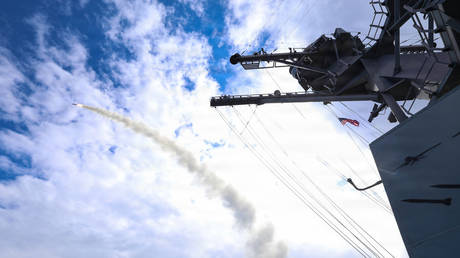
Mainstream defense reporters love a good scandal. Tell a journalist that the U.S. Navy fired "expired" missiles during naval engagements in the Red Sea and Persian Gulf, and you get breathless headlines implying Pentagon incompetence, supply chain collapse, and sailors gambling their lives on spoiled hardware.
That narrative is completely backwards.
Firing munitions past their initial shelf-life stamp isn't a sign of a broken military. It is a sign of smart logistics, fiscal discipline, and engineering reality. The panic around "expired" weapons stems from a fundamental misunderstanding of how military hardware is built, tested, and managed—confusing a carton of warm milk with a multi-million-dollar solid-fuel rocket motor.
If you want to understand modern naval warfare and defense economics, stop reading sensationalist headlines about expiration dates and start looking at how ordnance lifecycle engineering actually works.
The Milk Carton Fallacy in Defense Reporting
When a headline screams that a warship launched an "expired" Standard Missile-2 (SM-2) or Evolved SeaSparrow Missile (ESSM), the average reader pictures a rusty tube fizzling out on the deck or blowing up inside the Vertical Launching System (VLS).
That is fiction.
In military procurement, an "expiration date" is not a drop-dead date where the weapon turns into a pumpkin. It is a conservative, bureaucratic warranty window established during initial acquisition—often decades before the missile ever sees combat. When defense contractors like RTX (formerly Raytheon) or Lockheed Martin deliver a missile, they certify its components for a baseline period, usually 10 to 15 years. That baseline reflects the statistical predictability of chemical propellants, thermal batteries, O-rings, and pyrotechnic initiators under average storage conditions.
Once a missile crosses that arbitrary calendar line, it doesn't get thrown in a dumpster. It enters a rigorous surveillance and recertification pipeline.
The U.S. Navy, working alongside the Naval Surface Warfare Center (NSWC) at Indian Head and Corona, constantly pulls aging missiles out of fleet magazines for destructive and non-destructive testing. Technicians x-ray solid rocket motors for micro-cracks in the propellant grain. They test guidance electronics in thermal chambers. They strip down warhead fuses and measure chemical degradation in high-explosive fills.
If a batch passes inspection, the Navy issues a Service Life Extension—a formal engineering waiver that pushes the operational date out by another three, five, or ten years. To a lazy reporter looking at a leaked inventory spreadsheet, a missile with a 2018 original manufacture expiration date sitting in a destroyer's VLS cell in 2024 looks "expired." To a weapons officer, it is a recertified, fully functional interceptor with a fresh engineering sign-off.
The Economics of Shooting Old Inventory First
There is a massive financial reality behind firing older missiles in active combat zones, and any logistics officer worth their salt will defend it to the death: First In, First Out (FIFO) saves taxpayers hundreds of millions of dollars.
Consider the lifecycle cost of a modern surface-to-air missile. An SM-2 Block IIIA costs roughly $2 million. An SM-6 runs closer to $4.3 million. If a missile sits in a climate-controlled bunker or a shipboard canister until its propellant genuinely degrades beyond safe tolerances, the Navy doesn't just lose the weapon. They have to pay a second time to destroy it.
Demilitarization—the safe disassembly, chemical neutralization, and disposal of aging ordnance—is expensive, hazardous, and slow. The Pentagon spends billions maintaining massive stockpiles of aging munitions waiting in line for demil facilities in places like Hawthorne, Nevada, or McAlester, Oklahoma.
Now, put a warship in the Red Sea facing inbound one-way attack drones or anti-ship ballistic missiles launched by Iranian-backed forces. The destroyer has a mixed loadout in its VLS cells: brand-new Block IV variants fresh off the assembly line, and older Block IIIA variants that have already had their service lives extended twice.
Which button do you want the Tactical Action Officer to press?
You shoot the older round every single time.
Shooting an extended-life missile at an incoming threat accomplishes three critical objectives simultaneously:
- It destroys the target. An older SM-2 flying at Mach 3.5 with a blast-fragmentation warhead kills an incoming drone or cruise missile just as dead as a missile built last Tuesday.
- It preserves deep magazine depth. You keep your newest, longest-shelf-life interceptors in reserve for a potential high-end conflict in the Indo-Pacific, where logistics chains are longer and threats are more sophisticated.
- It eliminates disposal costs. Instead of paying a contractor half a million dollars to safely burn out an aging rocket motor in the Nevada desert three years from now, you expend that chemical energy defending a multi-billion-dollar warship today.
Calling that a failure is like mocking a restaurant chef for using yesterday's fresh catch before opening today's delivery. It isn't desperation; it is basic inventory management.
What Actually Degrades Inside a Missile?
To understand why extended-life missiles remain lethal, you have to look under the skin of the airframe. Having spent years analyzing defense supply chains and watching how procurement bureaucracy clashes with engineering reality, I can tell you that most observers look at the wrong failure points.
A guided missile is essentially four subsystems bolted together:
- The Airframe and Control Surfaces: Aluminum, titanium, and composite skins do not expire. Stored inside sealed, nitrogen-purged canisters, a missile body can sit for forty years without meaningful structural degradation.
- The Guidance and Electronics: Solid-state circuit boards, radar seekers, and inertial measurement units age remarkably well when kept dry and power-cycled during depot maintenance. While obsolescence of replacement parts is a headache for factories, the components already soldered inside an existing missile rarely fail just because a calendar page turned.
- The Warhead: High explosives like PBXN-109 or Composition B are exceptionally stable. Barring extreme temperature cycling that causes explosive fills to sweat or crack, a warhead from 2005 detonates with the exact same brisance as one from 2025.
- The Energetics (Propellant and Batteries): This is the real clock. Solid rocket propellant—typically a rubbery binder like HTPB mixed with ammonium perchlorate oxidizer and aluminum powder—slowly oxidizes over decades. As the binder hardens and shrinks, microscopic fissures can form. If a rocket motor ignites with cracks in the grain, the surface area of the burn spikes instantaneously, causing over-pressurization—a catastrophic failure known in the industry as a "CATO" (Catastrophic Take-Off). Similarly, thermal batteries rely on pyrotechnic heat pellets to melt solid electrolytes upon launch; moisture ingress over decades can ruin their shelf life.
Because propellant and thermal batteries are the true limiting factors, defense engineers monitor them obsessively. They don't guess. They use accelerated aging models, chemical stabilizer depletion tests, and ultrasonic scans. When the Navy clears an "expired" missile for deployment, it means the energetic chemistry has been verified safe for ignition.
The Real Scandal Nobody Talks About
If defense critics want to get angry about missile stockpiles, they are aiming at the wrong target. The scandal isn't that the Navy fired old missiles in the Middle East. The scandal is why the U.S. defense industrial base takes years to replace them, and why the Pentagon routinely fires $2 million interceptors at $20,000 drones.
Look at the cost-exchange ratio in recent Red Sea engagements. When a destroyer launches an SM-2 or SM-6 to splash an Iranian-designed Shahed-style drone, the math is brutal. The attacker spends the price of a compact sedan; the defender spends the price of a luxury beachfront house. Even if that SM-2 was an older, service-extended unit that was nearing the end of its depot life, you cannot sustain a multi-year campaign on that economic curve.
Furthermore, the production rates for critical energetics—specifically solid rocket motors—have been strangled by decades of industry consolidation. In the 1990s, the U.S. had half a dozen major solid rocket motor suppliers. Today, the market has collapsed down to essentially two giants: Northrop Grumman (which absorbed Orbital ATK) and L3Harris (which bought Aerojet Rocketdyne).
When you shrink an industrial base down to a duopoly, lead times balloon. If the Navy fires 100 interceptors in a month of intense naval operations, replacing those rocket motors takes 18 to 24 months. That bottleneck is the real reason older, extended-life munitions are on the front lines. The Navy is intelligently rationing its newest production runs while burning through legacy stock because the factories back home cannot stamp out replacements fast enough.
The Trade-Offs of Pushing Shelf Life
To be completely candid, running munitions past their original certification window isn't without risk. Pretending otherwise would be dishonest.
Every time you extend the service life of a solid-fuel rocket motor, you accept a slightly higher statistical probability of a dud—a "hangfire" where the booster fails to ignite in the launcher, or a motor burnout mid-flight. In a VLS cell on a cruiser or destroyer, a failed ignition is a serious headache: the cell has to be flooded or locked out, taking that specific tube offline until the ship pulls into a port with a crane capable of unloading a live, damaged canister.
There is also the software gap. An older SM-2 Block IIIA doesn't have the upgraded seeker processing power or networking capabilities of an SM-6 Block IA. Against low-end threats like subsonic cruise missiles and propeller-driven drones, that older software is more than enough. Against maneuvering hypersonic glide vehicles or complex electronic warfare jamming, older hardware hits its ceiling fast.
That is why doctrine dictates salvo shooting and layered defense. Naval tacticians don't fire one 20-year-old missile at a high-value target and cross their fingers. They pair older interceptors with modern fire-control radars like the AN/SPY-6 or upgraded SPY-1D(V), using superior shipboard sensors to guide legacy airframes onto targets they could never have tracked on their own thirty years ago. You put the brains on the ship and use the old missile as pure kinetic muscle.
Stop Reading Labels, Start Reading Logistics
The next time a defense leak claims the military is using "expired" gear, ignore the outrage bait and ask three questions instead:
- Was the lot recertified under a formal Service Life Extension Program? If yes, the weapon isn't expired; the reporter just doesn't understand military engineering waivers.
- What was the target profile? Using legacy inventory against low-tier threats is textbook resource optimization, freeing up modern production runs for peer adversaries.
- What is the alternative? Paying billions to safely dismantle working missiles in a desert facility while ships deploy with half-empty magazines is bureaucratic insanity.
Warfare isn't won by keeping pristine, factory-fresh weapons wrapped in plastic until their warranties run out. It is won by matching the right chemical energy to the right threat at the lowest possible lifecycle cost. Firing older missiles in combat isn't a failure of readiness—it is the entire point of building them in the first place.