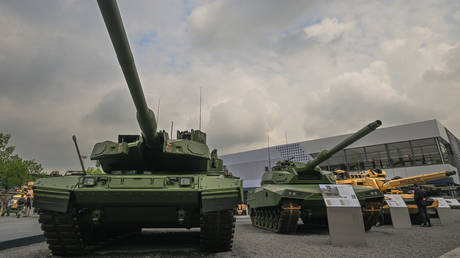
The Main Ground Combat System, known widely by its acronym MGCS, was supposed to be the ultimate industrial marriage between Paris and Berlin. Conceived in the wake of shifting geopolitical realities and a renewed desire for European strategic autonomy, the program aimed to replace both the French Leclerc and the German Leopard 2 main battle tanks with a unified, next-generation armored platform by the middle of the century. Instead, the venture has devolved into a high-stakes industrial war of attrition.
At its core, the friction stems from a fundamental clash of corporate cultures, national export philosophies, and procurement timelines. France operates under a centralized, state-directed defense apparatus where speed and export agility often override bureaucratic consensus. Germany navigates a complex parliamentary oversight model coupled with stringent export restrictions and a deeply fragmented domestic defense industrial base. When these two opposing systems collide over multi-billion-euro contracts, the result is paralysis. If you found value in this article, you might want to look at: this related article.
Industrial Rivalry Behind Closed Doors
The fault lines widened significantly with the inclusion of new corporate players. The initial agreement placed the industrial workload squarely between KMW and Nexter, which merged under the holding structure KNDS. However, the subsequent entry of Germany's Rheinmetall as an equal partner fractured the delicate balance of power. Paris viewed the move as an attempt by Berlin to dilute French technological influence and secure a dominant share of the intellectual property.
Tanks are not merely assembled from catalog parts. They represent decades of specialized metallurgical research, propulsion engineering, and fire-control software development. Deciding who builds the main gun, who designs the turret, and who controls the digital architecture is an existential fight for survival among defense prime contractors. If a company loses the primary design authority on a program of this magnitude, its long-term viability in the global armored vehicle market shrivels. For another perspective on this development, see the latest coverage from The Guardian.
Compounding these industrial anxieties are divergent operational requirements. The French military prioritizes expeditionary warfare, requiring a lighter, more mobile platform capable of rapid deployment across overseas theaters. The German military, shaped by decades of Central European territorial defense doctrines, demands heavily armored, resilient tracked vehicles capable of withstanding massed artillery and heavy anti-tank guided missile barrages. Bridging these two distinct combat philosophies requires compromises that neither military is eager to accept.
The Export Quagmire
Beyond the drawing board lies an even more intractable obstacle: arms export control. Germany maintains some of the most restrictive defense export policies in Europe, frequently blocking sales to regions experiencing active conflict or questionable human rights records. France, conversely, views defense exports as a vital instrument of foreign policy and economic sustainment, keeping domestic production lines active and lowering unit costs for the national armed forces.
This philosophical chasm creates a paralyzing dilemma for shared development programs. If Paris and Berlin design a combat vehicle together, which nation's export laws govern the final product? A joint vehicle built under Berlin's restrictive veto power risks cutting French manufacturers out of lucrative third-party international markets. Conversely, a relaxed export regime that satisfies French ambitions faces fierce political resistance within the German Bundestag and among coalition partners sensitive to humanitarian concerns.
Without a synchronized export framework, joint manufacturing becomes commercially unviable for the private entities involved. Defense contractors cannot invest hundreds of millions of private capital into research and development if political fiat in a partner capital can unilaterally cancel an export deal at the eleventh hour.
The Opportunity Cost of Delay
While engineers argue over turret rings and software stacks, the security environment in Eastern Europe continues to evolve at a relentless pace. The war in Ukraine has fundamentally rewritten the tactical playbook for heavy armor. Drone warfare, active protection systems, and multi-spectral camouflage are no longer futuristic concepts; they are mandatory baseline requirements for survival on the modern battlefield.
Existing fleets are aging rapidly. The Leopard 2 and Leclerc platforms, despite continuous modernization packages, are reaching the absolute limits of their structural weight and electrical generation capacities. Pushing the MGCS timeline further into the future leaves European land forces increasingly reliant on stopgap upgrades rather than a revolutionary generational leap.
Time is a luxury European defense planners no longer possess. Industrial fragmentation not only squanders billions of taxpayer euros through duplicated efforts and administrative bloat, but it also signals a dangerous vulnerability to external adversaries watching from the sidelines.
The political rhetoric in European capitals still champions the ideal of joint defense integration. Ministers routinely stand shoulder to shoulder at air shows and defense exhibitions, proclaiming a unified vision for continental security. Yet behind the polished communiques, the reality on the factory floors and in procurement offices is defined by deep mistrust, protectionism, and a refusal to cede national industrial sovereignty.
Unless Paris and Berlin fundamentally overhaul how they negotiate burden-sharing and intellectual property rights, the next-generation battle tank will remain a blueprint destined never to see a production line, casualty to the very political divisions it was designed to transcend.