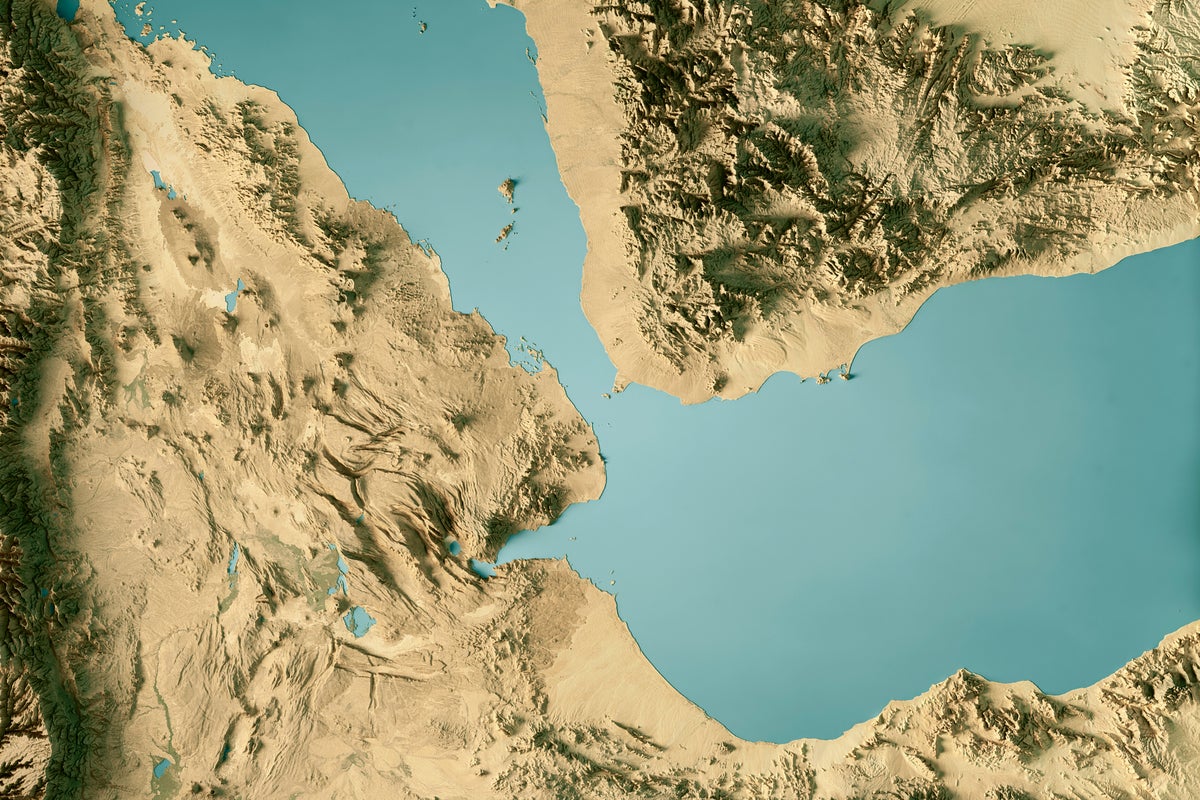
You’ve probably never thought about the Bab el-Mandeb strait while sipping your morning coffee. But if that coffee traveled from Ethiopia or the beans came through the Suez Canal, it likely passed through a narrow chokepoint known for centuries as the Gate of Tears. This strip of water separates Djibouti in Africa from Yemen on the Arabian Peninsula. At its narrowest, it’s just 18 miles wide.
Right now, that tiny stretch of water is the biggest headache for global trade.
When Houthi rebels in Yemen start launching drones and missiles at commercial tankers, they aren't just making a local political statement. They’re effectively putting a chokehold on 12% of all global trade. If the Gate of Tears closes, the world feels it in the form of higher gas prices, delayed electronics, and empty shelves. It’s the ultimate geographic vulnerability.
The Brutal Geography of the Bab el-Mandeb
The name "Gate of Tears" isn't just poetic flair. Historically, the strait was notorious for shipwrecks and dangerous currents that claimed countless lives. Today, the danger is strictly man-made.
To understand why this spot matters, you have to look at a map. To get from the Indian Ocean to the Mediterranean Sea via the Suez Canal, you must pass through the Bab el-Mandeb. There is no shortcut. There is no easy "Plan B." If a ship can't get through this gate, it has to turn around and sail all the way around the southern tip of Africa—the Cape of Good Hope.
That detour adds about 3,500 nautical miles to the trip. It tacks on 10 to 14 days of travel time. It burns thousands of tons of extra fuel. For a massive container ship, we're talking about nearly $1 million in additional costs per voyage. You pay for that. I pay for that. Every company from Amazon to Walmart pays for that.
Why the Houthi Threat Changed Everything
For years, the main worry in these waters was Somali pirates. They were a nuisance, but they were manageable with armed guards and navy escorts. The Houthi threat is different. We're talking about a group with state-level technology.
The Houthis use anti-ship ballistic missiles, suicide drone boats, and sophisticated aerial drones. These aren't guys in skiffs with AK-47s. They have intelligence and surveillance capabilities that allow them to pick targets with precision.
When they began attacking ships in late 2023 and throughout 2024, they claimed they were only targeting vessels linked to Israel. In reality, the targeting has been erratic. They’ve hit ships with no clear ties to the conflict, forcing major shipping giants like Maersk and Hapag-Lloyd to make a hard choice: risk a missile strike or pay for the long way around. Most chose the long way.
The Economic Domino Effect
When trade slows down at the Gate of Tears, the math gets ugly fast. Logistics isn't just about moving boxes; it's about timing. Most modern manufacturing relies on "just-in-time" supply chains. If a shipment of car parts is two weeks late because it had to go around Africa, the entire assembly line in Germany or the US might have to shut down.
- Energy markets: Roughly 8 million barrels of oil and petroleum products pass through this strait every single day. Even a slight disruption causes oil traders to panic, which sends prices at the pump higher within days.
- Insurance spikes: The cost to insure a vessel traveling through a "war zone" can jump by 1,000% in a week. Sometimes, insurers refuse to cover the trip at all.
- Container shortages: Because ships are spending more time at sea going around Africa, they aren't back at the ports to pick up the next load. This creates a backlog that can take months to clear.
The Djibouti Factor
Interestingly, while Yemen is the source of the chaos, the country across the water—Djibouti—has become a massive military parking lot.
Because the Bab el-Mandeb is so critical, everyone wants a presence there. Djibouti hosts military bases for the United States, China, France, Japan, and Italy. It’s one of the few places on earth where you'll see American and Chinese troops stationed just a few miles apart. They are all there for one reason: to keep the Gate of Tears open.
But even with all that military hardware, stopping a $2,000 drone with a $2 million interceptor missile is a losing game for the West. The cost-to-kill ratio is completely skewed in favor of the rebels.
What Happens if the Route Stays Blocked
If the Gate of Tears remains a high-risk zone for the long term, we're looking at a fundamental shift in how things are made.
Companies are already talking about "near-shoring"—moving factories closer to home so they don't have to rely on these fragile maritime chokepoints. We might see more production moving to Mexico for the US market, or to Eastern Europe for the EU.
The era of cheap, reliable shipping through the Suez is under its greatest threat since the canal was closed during the Six-Day War in 1967. Back then, the canal stayed shut for eight years. The world adapted, but it was expensive and painful.
How to Track the Impact Yourself
If you want to see how this affects your own wallet, don't just watch the news. Watch the "Shanghai Containerized Freight Index" (SCFI). This index tracks the cost of shipping containers from China to various parts of the world.
When the Gate of Tears gets messy, the SCFI for routes to Europe and the US East Coast goes vertical. Another tool is "MarineTraffic," a live map where you can actually see the "conga line" of ships diverting around Africa in real-time.
Practical Steps for Navigating the Chaos
If you're running a business that relies on imported goods, stop assuming the Suez route is the default.
Check your contracts for "Force Majeure" clauses. Many shipping lines are using these to pass on "War Risk Surcharges" that can add thousands of dollars to a single container. You should also be diversifying your ports. If you usually bring everything into the East Coast through the Suez, start looking at West Coast ports via the Pacific. It might be more expensive upfront, but it's more predictable than a missile-prone strait.
The Gate of Tears earned its name centuries ago. Today, it's living up to it by making the global economy cry. Don't wait for a total shutdown to build some slack into your own supply chain. This isn't a temporary glitch; it's the new reality of a fractured world.
Start looking at your inventory levels now. Increase your safety stock for critical items that originate in Asia or the Middle East. If your business depends on "just-in-time" delivery, it's time to switch to "just-in-case" planning.