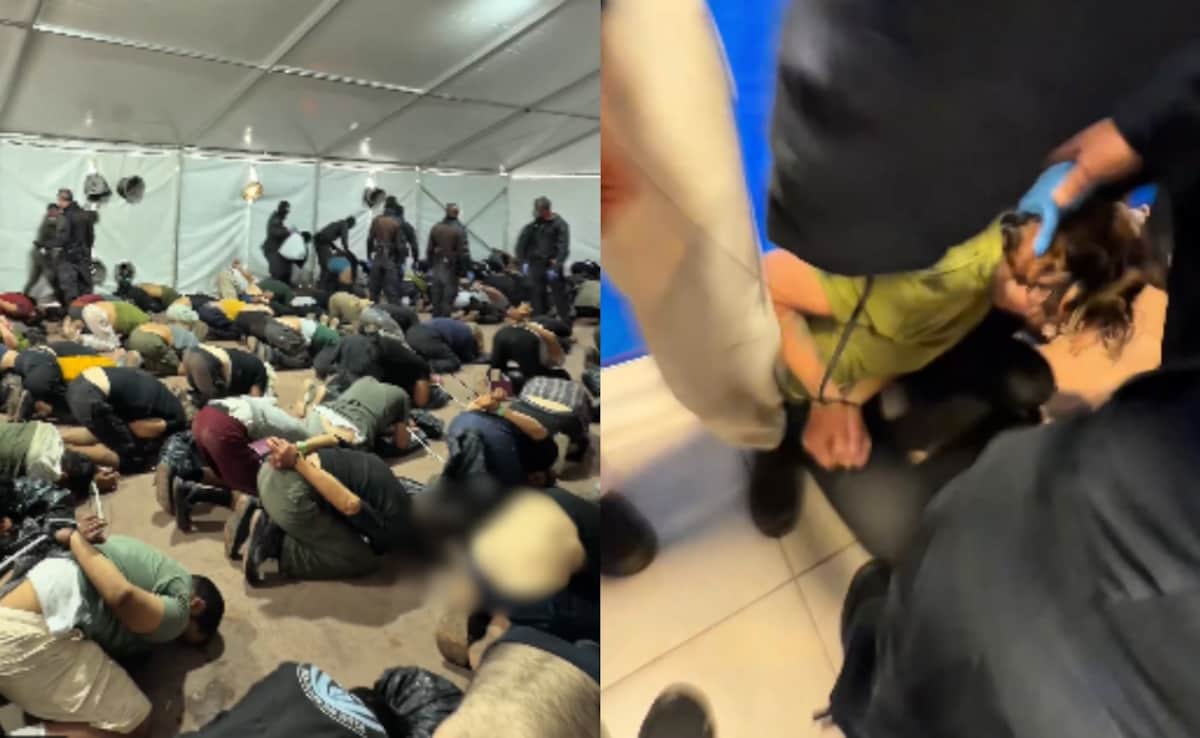
Italian Prime Minister Giorgia Meloni’s public condemnation of Israeli actions in Gaza—specifically sparked by footage of detentions and protests—marks a calculated departure from standard Western diplomatic solidarity. This shift cannot be understood merely as an emotional reaction to a video; it represents a deliberate realignment within a complex geopolitical matrix. By evaluating this event through the lens of strategic statecraft, international relations theory, and domestic electoral math, we can decode the underlying mechanisms driving Italy’s foreign policy recalibration.
Foreign policy decisions by middle powers like Italy operate under strict structural constraints. When a head of state shifts from quiet diplomacy to overt, sharp criticism of a close ally, it signals that the internal cost of silence has surpassed the external cost of friction.
The Strategic Trilemma of Middle-Power Foreign Policy
Middle powers in the Euro-Mediterranean theater must constantly balance three competing vectors: domestic coalition stability, supranational alignment (EU and NATO), and regional sphere-of-influence security. Meloni’s recent rhetorical escalation reveals a acute bottleneck where these three vectors collided.
1. Domestic Legitimacy and Coalition Equilibrium
The Italian governing coalition relies on a delicate balance between nationalist-conservative elements and technocratic pragmatists. Public sentiment regarding the humanitarian crisis in Gaza has grown increasingly volatile.
- The Risk of Inaction: Remaining silent during highly publicized, controversial events risks ceding the humanitarian narrative entirely to left-wing opposition parties like the Democratic Party (PD) and the Five Star Movement.
- The Fragmentation Risk: Within the ruling coalition, divergent views on foreign intervention require the Prime Minister to assert a dominant, unifying narrative that satisfies the nationalist emphasis on sovereignty and moral authority without alienating moderate voters.
2. The European Union Leadership Calculus
Italy continuously vies for structural leadership within the EU alongside France and Germany. As France adopts a more independent stance on Middle Eastern policy and Germany maintains its historical alignment with Israel, Italy views a rhetorical shift as an opening to anchor the Mediterranean bloc's perspective. Asserting a position grounded in the "defense of human dignity" allows Rome to claim the moral center of gravity within the European Council, strengthening its leverage in unrelated economic and budgetary negotiations.
3. The Mattei Plan and Mediterranean Influence
The cornerstone of Meloni’s foreign policy is the "Mattei Plan" for Africa, a strategic initiative aimed at positioning Italy as the primary energy and economic bridge between the Global South and Europe.
- The North African Footprint: Success depends entirely on deep bilateral trust with Arab nations, particularly Tunis, Tripoli, and Cairo.
- The Contradiction Penalty: Unconditional support for Israeli military strategies directly undermines Italy's credibility in North Africa, creating a reputational penalty that threatens multi-billion-euro energy and migration management treaties.
Deconstructing the Rhetoric: The Mechanics of "Dignity" as a Political Currency
The specific deployment of the term "violates dignity" serves a precise functional purpose in diplomatic discourse. It shifts the argument away from complex international humanitarian law (IHL) definitions—where legal experts can debate proportionality for months—and repositions it into the realm of universal values.
[Diplomatic Friction Input] -> [Universal Value Appeal (Dignity)] -> [Bypasses Legalistic Red Tape] -> [Immediate Domestic/Regional Alignment]
By framing the critique around dignity rather than explicitly accusing a state of war crimes, the Italian administration achieves a dual-track objective:
- De-escalation Mitigation: It offers the targeted state an exit ramp. A violation of "dignity" can be blamed on rogue battlefield actors or systemic operational errors, rather than being interpreted as a systemic indictment of the state's sovereign right to self-defense.
- Audience Segmentation: To the domestic audience and Global South partners, the rhetoric sounds unyielding and principled. To Washington and Brussels, it signals a manageable tactical divergence rather than a strategic rupture.
The Cost-Benefit Architecture of Diplomatic Re-alignment
Every diplomatic critique carries an implicit financial and strategic cost function. The decision to execute a public rebuke involves a calculated trade-off across three primary dimensions.
| Variable | Immediate Strategic Cost | Long-Term Mitigating Factor |
|---|---|---|
| Intelligence Sharing | Potential slowdown in bilateral counter-terrorism data pipelines. | Shared Mediterranean security threats force a baseline level of structural cooperation that politics cannot entirely disrupt. |
| Trade and Commerce | Friction in defense procurement contracts and joint technological ventures. | Italian-Israeli bilateral trade, while significant in tech, is dwarfed by Italy's macroeconomic dependence on broader Euro-Med stability. |
| Alliance Trust | Reduced access to inner-circle diplomatic coordinates in Washington. | Italy’s critical geographic position on NATO's southern flank ensures its fundamental value to the alliance remains non-negotiable. |
The primary risk in this cost-benefit matrix is the escalation spiral. If the targeted nation responds with economic retaliatory measures or severe diplomatic downgrades, the middle power faces a secondary bottleneck: double down on the critique and risk deeper economic fallout, or walk back the statements and suffer catastrophic domestic credibility loss.
Structural Vulnerabilities in the Italian Strategy
While the rhetorical shift provides immediate political breathing room, it exposes several long-term structural vulnerabilities that the Italian administration must manage.
The first limitation is the reliance on asymmetric media dependencies. When foreign policy shifts are triggered by viral video footage, the state essentially cedes the timing of its diplomatic maneuvers to the algorithms of information warfare. This creates an unpredictable operating environment where the state must constantly react to external information shocks rather than executing a proactive, linear strategy.
The second vulnerability is the institutional divergence within Italy’s own foreign policy apparatus. The Ministry of Foreign Affairs (Farnesina) historically favors institutional continuity and quiet, back-channel diplomacy. Sudden, top-down rhetorical interventions from the Prime Minister's office create coordination friction, leaving career diplomats to smooth over institutional relationships behind the scenes while the public narrative shifts rapidly.
The Strategic Playbook For Middle-Power Realignment
To prevent tactical rhetorical shifts from degenerating into permanent strategic liabilities, middle powers must execute a highly coordinated rebalancing sequence. The following structural playbooks outline the necessary operational steps to stabilize foreign policy output when navigating high-stakes international friction.
Structural Playbook A: Kinetic Rebalancing via Multilateral Forums
- Step 1: Immediately follow up one-on-one public critiques with parallel actions within multilateral frameworks like the United Nations or the G7. This diffuses the bilateral tension by embedding the critique within a broader, multi-state consensus.
- Step 2: Shift the focus from political condemnation to logistical execution. Pivot resources toward maritime humanitarian corridors or field hospital deployments. This re-establishes the state as an active, constructive stakeholder in crisis resolution rather than a passive critic.
- Step 3: Deploy technocratic envoys to conduct low-profile bilateral reviews of economic and security agreements, ensuring that operational-level cooperation remains insulated from executive-level political rhetoric.
Structural Playbook B: Hegemonic De-escalation and Alignment
- Step 1: Conduct proactive briefings with the primary systemic hegemon (the United States) to explicitly define the boundaries of the rhetorical shift, reassuring allies that core security commitments remain unchanged.
- Step 2: Utilize targeted economic statecraft, such as stabilizing trade agreements in non-sensitive sectors, to signal that bilateral commercial pathways remain open despite political friction.