The smell of a winter rink at six in the morning is a specific kind of cold. It is sharp, metallic, and slightly sweet from the Zamboni water freezing into a fresh, glassy skin. If you have ever laced up skates in a damp concrete dressing room while the fluorescent lights hummed overhead, you know the weight of a jersey before it even touches your shoulders. It is not just polyester and stitched twill. It is a ledger of every ghost who wore the crest before you.
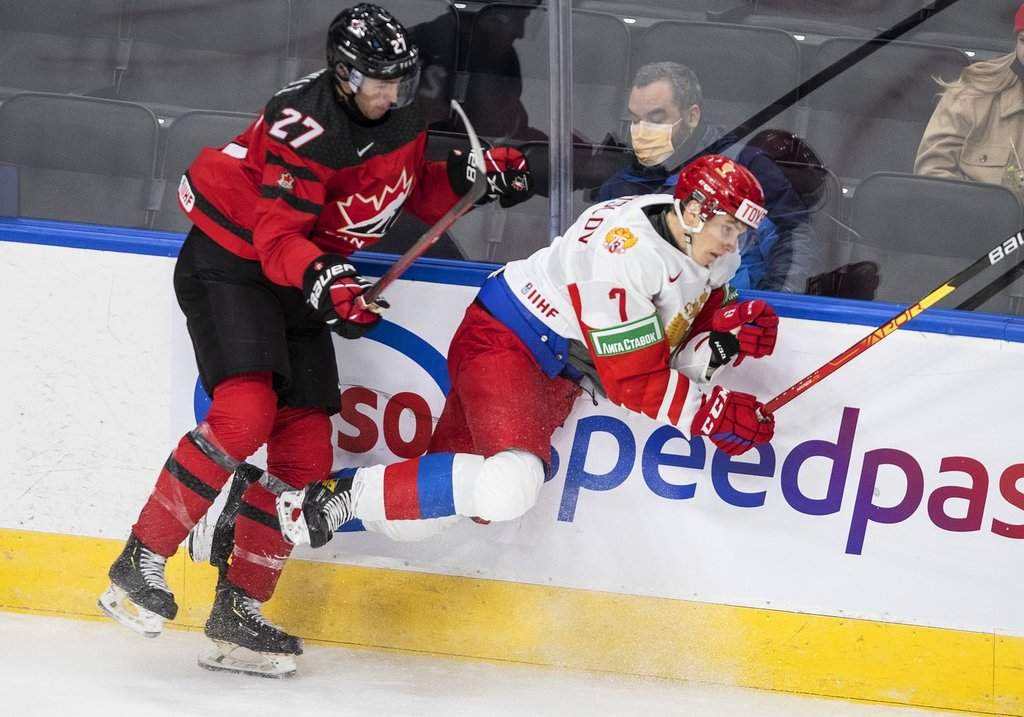
In Canada, that crest is a maple leaf. In Russia, for decades, it was four Cyrillic letters—CCCP—and later a double-headed eagle. For half a century, the entire emotional architecture of international hockey depended on the collision between those two sweaters. Without one, the other felt strangely weightless, like a boxer shadow-sparring in an empty gym.
Then, in February 2022, the ice cracked. Following the full-scale invasion of Ukraine, the International Ice Hockey Federation (IIHF) suspended Russia and Belarus from all international competition. Overnight, one of the sport's twin pillars vanished from the tournament brackets.
Now, years later, the silence surrounding their absence has grown louder than the roar of any gold-medal game. Hockey Canada is publicly asking the IIHF for clarity on when, how, and under what conditions Russia might return to the international stage. On paper, it sounds like routine administrative housekeeping. Bureaucrats asking other bureaucrats for a timeline.
Look closer, though. Behind the polite press releases and executive boardroom inquiries lies a messy, deeply human collision of morality, economics, athlete grief, and the existential survival of international hockey itself.
The Empty Chair at the Dinner Table
To understand why Hockey Canada is pressing the issue now, you have to step out of the executive suites in Toronto and Zurich and walk into a hypothetical locker room in rural Saskatchewan or outside Moscow.
Consider Leo, a nineteen-year-old Canadian defenseman who has spent his entire adolescence waking up before dawn, sacrificing proms, bruised ribs, and teenage normalcy for one singular shot at the World Junior Championship. Now, across an invisible ocean, picture Anton, a nineteen-year-old Russian center who has made the exact same blood-and-sweat bargain. Neither boy started a war. Neither boy sits on a security council or draws lines on military maps. Yet Anton has spent his prime developmental years playing exhibition matches against second-tier clubs in empty arenas, while Leo wins gold medals that carry a quiet, unspoken asterisk.
As someone who has spent years watching international hockey tournaments from press boxes and cramped rink-side bleachers, I can tell you the atmosphere has changed. There is a phantom limb sensation at every major IIHF event. You watch Canada dismantle an overmatched opponent 9–0 in a preliminary round, and the crowd barely stirs from its popcorn. The tension that used to make your knuckles turn white during a third-period power play has evaporated.
Hockey Canada feels this every single day. Their business model, their broadcast rights, and their cultural currency are built on high-stakes drama. When the tournament loses its primary antagonist, the ratings dip, sponsors ask harder questions, and the emotional oxygen gets sucked right out of the building.
What Clarity Actually Means
When Hockey Canada executives ask the IIHF for "clarity," they are not necessarily lobbying for Russia to skate onto the ice tomorrow morning. That is a crucial distinction that often gets lost in heated social media debates.
Clarity means a roadmap. It means knowing the rules of the game before the puck drops.
Right now, the IIHF council reviews Russia and Belarus’s eligibility on a rolling, annual basis, largely citing "safety and security" concerns for participants, fans, and host nations. That phrase—safety and security—is doing an enormous amount of heavy lifting. It is an umbrella term that shields the federation from making a purely political declaration while achieving the exact same outcome.
Think of the IIHF’s current policy like a referee refusing to tell the coaches how much time is left on the clock. You are trying to manage your roster, plan your budget, and prepare your athletes for the 2026 Winter Olympics in Milan-Cortina and the World Championships beyond, yet nobody will tell you who is actually allowed in the building.
For Hockey Canada, this ambiguity creates three immediate headaches:
- Competitive Preparation: Building a national program requires multi-year scouting and tactical planning. Preparing for a tournament field that includes a powerhouse like Russia requires a completely different roster construction than preparing for a field without them.
- Financial Forecasting: Broadcast deals and ticket sales for major tournaments hosted in North America—like the World Juniors—depend heavily on marquee matchups. A Canada–Russia final sells out an NHL arena in twelve minutes; a blow-out quarterfinal against a developing hockey nation does not.
- Institutional Credibility: Hockey Canada has spent the last few years fighting tooth and nail to rebuild public trust after devastating domestic scandals surrounding governance and accountability. Demanding transparent criteria from the international body is part of a broader push to prove that decisions are being made by rules, not backroom improvisation.
The Ghosts of 1972 and the Weight of History
We have been here before, even if the uniforms looked different.
In September 1972, during the height of the Cold War, Canada and the Soviet Union met for the Summit Series. The political tension was suffocating. Canadian players walked into Moscow convinced their hotel rooms were bugged, their food was tampered with, and their entire way of life was on trial. Soviet players faced immense state pressure, knowing that failure meant disgrace.
Yet they played. Through eight grueling, violent, transcendent games, hockey became a pressure valve for two superpowers that refused to speak to each other anywhere else. Paul Henderson’s goal in Game 8 didn't end the Cold War, of course. Nuclear warheads stayed in their silos, and the Berlin Wall stood for another seventeen years. But for three weeks, millions of people saw the humanity—and the sheer, terrifying brilliance—of the people on the other side of the Iron Curtain.
Today’s world is different, and pretending otherwise would be dishonest. In 1972, the Soviet Union was not actively invading a European neighbor while the tournament took place. When Ukrainian ice rinks are being reduced to rubble by missile strikes, asking Ukrainian athletes—or their European allies in Finland, Sweden, Latvia, and Czechia—to simply "stick to sports" is not just naive; it is cruel.
This is the moral quicksand that makes the issue so paralyzing. I admit, even after years of covering international sports, I find myself torn in half whenever I think about it. Part of me aches for the purity of best-on-best competition, knowing that a generation of generational talents—players like Connor McDavid, Nathan MacKinnon, Kirill Kaprizov, and Igor Shesterkin—are being robbed of the chance to test themselves against one another in their primes. Another part of me looks at the geopolitical reality and realizes that sport does not exist in a vacuum. When a state uses athletic triumph as a weapon of propaganda to legitimize violence, putting that state’s flag back on the ice is never a neutral act.
The European Wall
Hockey Canada does not operate in isolation, and its push for clarity runs straight into a brick wall built by its European counterparts.
If you travel to Helsinki, Stockholm, Riga, or Prague, the appetite for Russia’s return is nonexistent. For countries sharing a border or a painful history with Moscow, the invasion of Ukraine is not an abstract news headline happening an ocean away. It is a daily existential threat.
The Finnish Ice Hockey Association and the Swedish Ice Hockey Association have made their positions unmistakably clear: as long as the war continues, their teams will not share the ice with Russian national squads. Even if the IIHF were to lift the ban tomorrow, a tournament without Finland, Sweden, and Czechia would collapse instantly. You cannot save the house by burning down the neighborhood.
This creates a quiet geographical fault line within the hockey world. North American stakeholders, insulated by the Atlantic Ocean and heavily focused on the commercial health of NHL-driven best-on-best events—like the 2025 4 Nations Face-Off, which notably excluded Russia—view the problem through a prism of competitive completeness and market viability. European federations view it through a prism of national security and moral solidarity.
Hockey Canada’s request for clarity sits right on that fault line. By asking the IIHF to define the exact conditions for reintegration, Canada is essentially forcing the global governing body to stop kicking the can down the road and admit whether "safety and security" is a temporary logistical hurdle or a permanent political veto.
What Happens to a Generation in Exile?
While executives trade memos and diplomats argue over sanctions, time keeps ticking on an athlete’s biological clock. Unlike politicians, who can remain in power well into their seventies, a hockey player’s prime lasts roughly eight to ten years.
Think about what has already been lost. Since 2022, multiple classes of Russian junior players have aged out of the Under-18 and World Junior brackets without ever playing a single meaningful international game. For scouts, general managers, and fans, those players exist almost entirely as grainier video clips from domestic leagues rather than tested performers under the white-hot spotlight of a global tournament.
And the ripple effects hit Canadian players, too. Iron sharpens iron. For fifty years, Canadian hockey development was forced to evolve because the Soviet—and later Russian—system kept exposing Canadian flaws. When Soviet teams passed the puck with mesmerizing, geometric precision in the 1970s and 1980s, Canada had to abandon pure dump-and-chase brute force and learn skill, speed, and puck possession. When Russia produced wave after wave of acrobatic, butterfly-style goaltenders in the 2000s and 2010s, Canadian goalie coaches had to reinvent their entire curriculum.
Without that rival pushing from the opposite end of the rink, complacency creeps in. Victory becomes cheaper. Standards soften.
The Path Through the Fog
So where does the game go from here? The International Olympic Committee (IOC) has already floated frameworks allowing individual Russian athletes to compete as "Individual Neutral Athletes" (AINs) under strict vetting conditions—no flags, no anthems, no active military ties.
In individual sports like tennis, swimming, or gymnastics, neutrality is clunky, imperfect, and controversial, yet logistically possible. You can put a neutral tennis player on Court 1 without raising a flag.
Team sports are an entirely different beast. You cannot field a twenty-five-man ice hockey roster, complete with coaches, trainers, medical staff, and equipment managers, slap a plain gray jersey on their chests, and pretend they do not represent a nation. Everyone watching knows who they are. Every goal they score becomes a political broadcast back home, regardless of what patch is sewn onto the collar.
That is why the IIHF has resisted the IOC’s neutral-athlete model so fiercely. A gray jersey does not stop a riot in the concourse, nor does it convince a European government to issue visas to thirty Russian nationals when diplomatic relations are frozen.
Yet silence is no longer a viable strategy either. Hockey Canada knows this. By demanding clarity, they are asking the IIHF to establish transparent, objective benchmarks. What does "safe" actually look like? Is a ceasefire required? A full withdrawal? A change in sports governance?
Without clear answers, the suspension stops looking like a principled stand and starts looking like indefinite drift.
The Last Shift
Late at night, long after the arena lights are dimmed to half-power and the last beer cup has been swept from the concrete steps, an empty hockey rink is one of the quietest places on earth. You can hear the faint hiss of the refrigeration pipes beneath the ice, working tirelessly in the dark to keep the surface frozen until morning.
International hockey is sitting in that darkened arena right now. The ice is still there. The boards are freshly painted. The players—in Toronto, in Stockholm, in Moscow, in Prague—are still lacing up their skates in the cold morning air, chasing a black disc of vulcanized rubber with everything they have.
Hockey Canada’s question to the world is simple, even if the answer is agonizing: tell us what it takes to turn the lights back on. Until someone has the courage to draw a clear line on the ice, the greatest rivalry in winter sports will remain trapped in the dark, waiting for a whistle that never blows.