The mall smelled of roasted almonds and rain. Or at least, it used to.
If you grew up in Houston during the late eighties, the North Mall—later rebranded as Greenspoint Mall, though everyone who mattered still called it by its original name—wasn't just a collection of anchor stores and food court kiosks. It was a cathedral of consumer optimism. It was where teenagers in oversized flannel and bleached denim spent Saturday afternoons dodging security guards, pretending to look at cassette tapes they couldn't afford, while neon lights buzzed overhead like giant, happy insects.
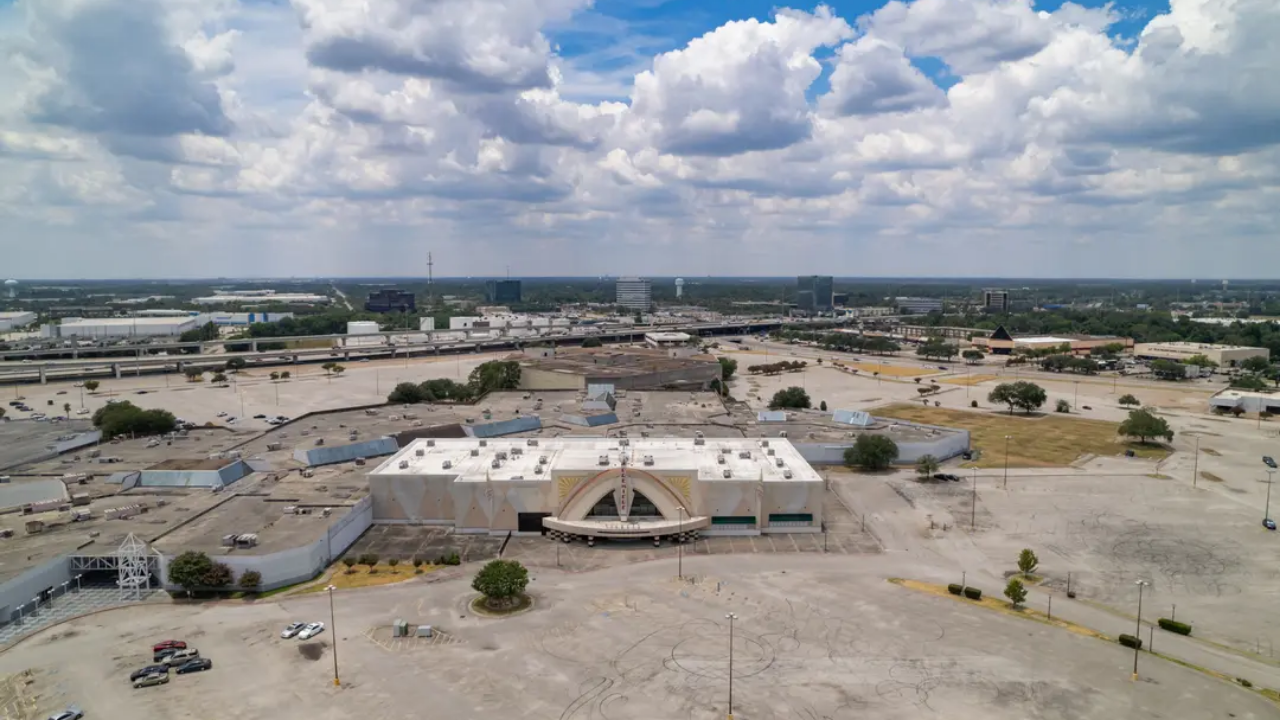
Today, that same footprint is quiet. The fountain is dry. The glass skylights are caked with the stubborn dust of an industrial neighborhood in transition. And soon, the wrecking ball will finish what decades of economic shifts began.
Greenspoint Mall is coming down. In its place, an 80-acre industrial park backed by a $150 million investment will rise.
Steel beams instead of storefronts. Logistics hubs instead of Santa’s winter wonderland.
It is easy to mourn the architecture of our youth, to write elegies for the dead temples of American retail. But to view this demolition merely as a tragedy is to miss the fierce, unyielding engine of a city that refuses to stay still. Houston does not preserve its ghosts; it paves over them. And in the case of Greenspoint, that asphalt-and-steel future might just be the most honest thing to happen to the area in thirty years.
The Anatomy Of A Slow Decline
To understand why an 80-acre shopping center is being leveled for a warehouse and distribution complex, you have to look at the anatomy of the neighborhood surrounding it, an area once optimistically dubbed "Gunspoint" by local cynics during the turbulent crime waves of the nineties.
The mall didn't die overnight. Retail death is rarely a sudden cardiac arrest; it is a long, slow bleed.
Consider a hypothetical retailer named Marcus, who opened a shoe kiosk near the center court in 1994. Marcus remembers when Saturday foot traffic was a roaring river of cash. He remembers the hum of the crowd, the low roar of competing bass from the record store and the arcade, the sheer kinetic energy of a Saturday afternoon when air conditioning was a luxury commodity and the mall was the coolest place in town, literally and figuratively.
By 2005, the river had turned into a creek. By 2015, it was a puddle.
The anchors began to peel away like scabs. First Macy’s. Then Dillard’s. Then Sears. Each departure felt like a small eviction notice served to the community’s sense of identity. When online shopping shifted the tectonic plates of global commerce, enclosed suburban malls built in the twentieth century found themselves stranded on the wrong side of history. They were too big to maintain, too expensive to heat and cool, and entirely mismatched with modern consumer habits that prized doorstep delivery over a Sunday afternoon stroll past the food court.
Greenspoint tried to adapt. It rebranded. It tried community events, discounted lease rates for local vendors, security overhauls. Nothing worked. The math simply stopped making sense. A massive concrete box sitting on prime real estate near Interstate 45 and the Sam Houston Tollway was no longer an economic asset. It was a tax liability wrapped in corrugated metal.
The Pivot To Concrete And Commerce
Enter the developers with their hard hats, blueprints, and cold, hard calculations.
An 80-acre plot of land sitting at the intersection of major transit arteries in the fourth-largest city in America is too valuable to spend its life as a parking lot for tumbleweeds. The decision by NorthPoint Development to demolish the structure and pour $150 million into a state-of-the-art industrial and logistics park is a glaring symptom of the modern American economy.
We do not need more places to buy cheap plastic shoes. We need places to store, sort, and ship the things we buy on our phones at two in the morning.
This is not romantic. There are no poems to be written about a distribution center. You cannot take your first date to a loading dock. But you can employ hundreds of people. You can generate property tax revenue for local schools and emergency services. You can transform a dead zone of urban decay into a functional nexus of the supply chain.
The industrial park model is ruthlessly efficient. In the wake of global supply chain disruptions over the past decade, proximity to major population centers has become the holy grail of corporate real estate. Companies no longer want their inventory sitting in a container ship off the coast or in a warehouse three states away. They want it ten minutes from downtown Houston, ready to be loaded onto a semi-truck and delivered by sunrise.
The Greenspoint site is tailor-made for this new reality. It sits like a spider in the center of a logistical web.
What We Leave Behind
Standing at the edge of the perimeter fence, watching a solitary hawk circle above the empty asphalt of the north parking lot, it is worth asking what gets lost when we trade commerce for logistics.
A mall is a social space, for better or worse. It was where teenagers learned how to interact with the world outside their parents' living rooms. It was where elderly couples walked laps in the morning to beat the Texas heat. It was a secular town square in a country that is rapidly running out of places where you don't have to buy something just to sit down.
When you replace a mall with an industrial park, you remove the human friction. You replace the shopper with the forklift. You replace the window-shopper with the logistics coordinator.
Yet, to romanticize the dying mall is to ignore the reality of what Greenspoint had become in its final years: half-empty corridors, flickering fluorescent lights, and an oppressive silence that felt less like peace and more like abandonment. A community cannot subsist on nostalgia alone. Economic stagnation is a slow poison, and a blighted property casts a long shadow over surrounding neighborhoods, depressing home values and choking off municipal investment.
The bulldozers are not destroying a community center; they are performing surgery.
The Next Horizon
When the dust finally settles over the 80-acre expanse, the trucks will roll in. The concrete will be poured thick enough to support twenty-ton rigs. The steel skeleton of the new industrial park will rise against the Houston sky, clean, gray, and unapologetically functional.
The teenagers who once hung out near the fountain are now middle-aged, mortgage-paying adults living out in the suburbs of Spring or Kingwood, driving past the exit on I-45 without turning their heads. They don't need the mall anymore. And the city doesn't, either.
Cities are living organisms. They shed their skin, scar over, and grow new muscle where the old bone broke. Greenspoint Mall had its season. It gave a generation a place to be young, loud, and together.
Now, the age of the warehouse begins. The trucks are waiting at the off-ramp, engines idling, ready to write the next chapter of a city that never stops building itself from the ground up.