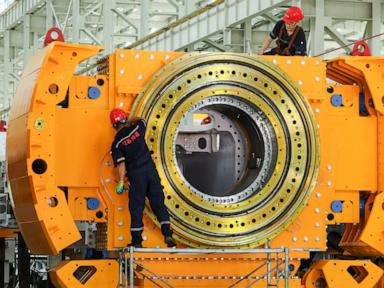
The air inside the stamping plant tastes of hot oil and ambition. At four in the morning, the shift change sounds like a collapsing wave: hundreds of boots hitting the concrete, zippers hissing up heavy canvas coats, the low, rhythmic murmur of men and women who have spent decades folding themselves into the machinery of global trade.
Meet Chen. He is not a statistic, though economists treat him like one. He is a fifty-two-year-old floor manager in Guangdong whose hands are mapped with tiny, pale scars from thirty years of feeding sheet metal into presses that roar like low-flying jets. When Chen looks out across the cavernous floor of his factory, he does not see Gross Domestic Product. He sees empty pallets. He sees the quiet, creeping dread of a loading dock that used to be choked with crates bound for Los Angeles and Rotterdam, now sitting wide open to the gray dawn.
The official bulletins tell a dry story. China’s factory activity contracted again in August, sliding further beneath the crucial fifty-point threshold that separates growth from decay. The Purchasing Managers Index ticked down, painting a picture of stagnation on a macro-sheet. But numbers do not sweat. Numbers do not stare at a ledger at midnight wondering how to make payroll for two hundred families when the phone has stopped ringing.
Look closer at the machinery. For thirty years, the world operated on a simple, comforting assumption: whenever you needed something built, packaged, and shipped at a scale that defied imagination, you sent an order east. The factories hummed twenty-four hours a day. They burned coal, they swallowed raw steel, and they spat out everything from smartphones to diesel generators. It was an unstoppable engine.
Until it started to stutter.
There is a strange paradox unfolding in these industrial corridors right now. Step outside Chen’s plant, down to the ports where colossal container ships stack against the skyline like children’s blocks, and you will hear a different tale. Export demand actually ticked up. Somewhere across the ocean, consumer appetites remain stubborn. People are still buying televisions, still ordering clothes, still needing the endless stream of manufactured goods that grease the wheels of modern life.
So why are the factories contracting? Why is the machine slowing down even as a trickle of foreign orders keeps coming in?
To understand, you have to look past the ports and deep into the domestic heartland of the world’s second-largest economy. You have to look at the living rooms of families who are tightening their belts so hard the air is leaving the room.
Property markets have wobbled like a spinning top losing its momentum. For generations, the average urban family parked their life savings not in stocks, not in bonds, but in concrete and rebar. An apartment bought off-plan was a retirement fund, a dowry, a legacy. When that foundation shook, the psychological shift was absolute. People stopped spending. They stopped remodeling. They stopped buying the new car, the better mattress, the extra appliances that keep domestic assembly lines working at full tilt.
Imagine a giant restaurant kitchen. Half the burners are fueled by hungry local diners who eat there every single night. The other half of the kitchen fills takeout orders for people living miles away. If the local diners suddenly decide to stay home and eat rice out of a pot, the kitchen hurts. Even if the takeout window remains busy, the sheer volume isn't enough to keep all twenty chefs employed.
That is the Chinese manufacturing sector today. The export window is cracked open, letting in a draft of foreign cash, but the domestic hearth has gone cold.
Chen feels this daily. Last week, his primary supplier of high-grade aluminum hiked their prices while cutting their delivery windows. Why? Because the supplier is running their furnaces at half-capacity to save on energy costs, spreading their fixed overhead across fewer tons of metal. The math turns brutal very quickly. When output drops, unit costs rise. When unit costs rise, margins evaporate.
Economists call this a contractionary feedback loop. Chen calls it the quiet time.
It is a strange, unsettling kind of quiet. Not the peace of a country lane, but the silence of a clockwork toy as its mainspring uncoils for the last time. The lights stay on. The computers hum. The robotic arms still sweep through the air in programmed arcs, welding seams on frames that nobody has yet claimed. But the frantic energy is gone. The sense of an inevitable, roaring future has been replaced by a heavy, cautious hesitation.
What happens when the workshop of the world stops working at full capacity? The ripple effects do not stay contained within borders. They wash out across the Pacific and wash up on shores thousands of miles away. Retailers in Chicago and Hamburg rely on the exact timing of these assembly lines to stock their shelves for the holiday rush. Shipping lines adjust their routes, pulling vessels from service, driving up freight volatility in a domino effect that turns supply chains into a game of financial roulette.
We are watching the end of an era defined by brute-force expansion. For decades, the recipe was simple: pour more concrete, build more plants, hire more hands. The sheer velocity of production solved every structural flaw. But velocity has hit a wall.
Back in Guangdong, the shift whistle blows. Chen wipes his grease-stained hands on a rag, looking down the long, dimming aisle between the presses. The machines are cooling down, ticking softly as the heavy iron contracts in the night air. Outside, the container trucks idle at the gate, waiting for cargo that is taking longer and longer to materialize. The world outside keeps turning, hungry for goods, but the hands that make them are waiting for a signal that hasn't yet arrived.