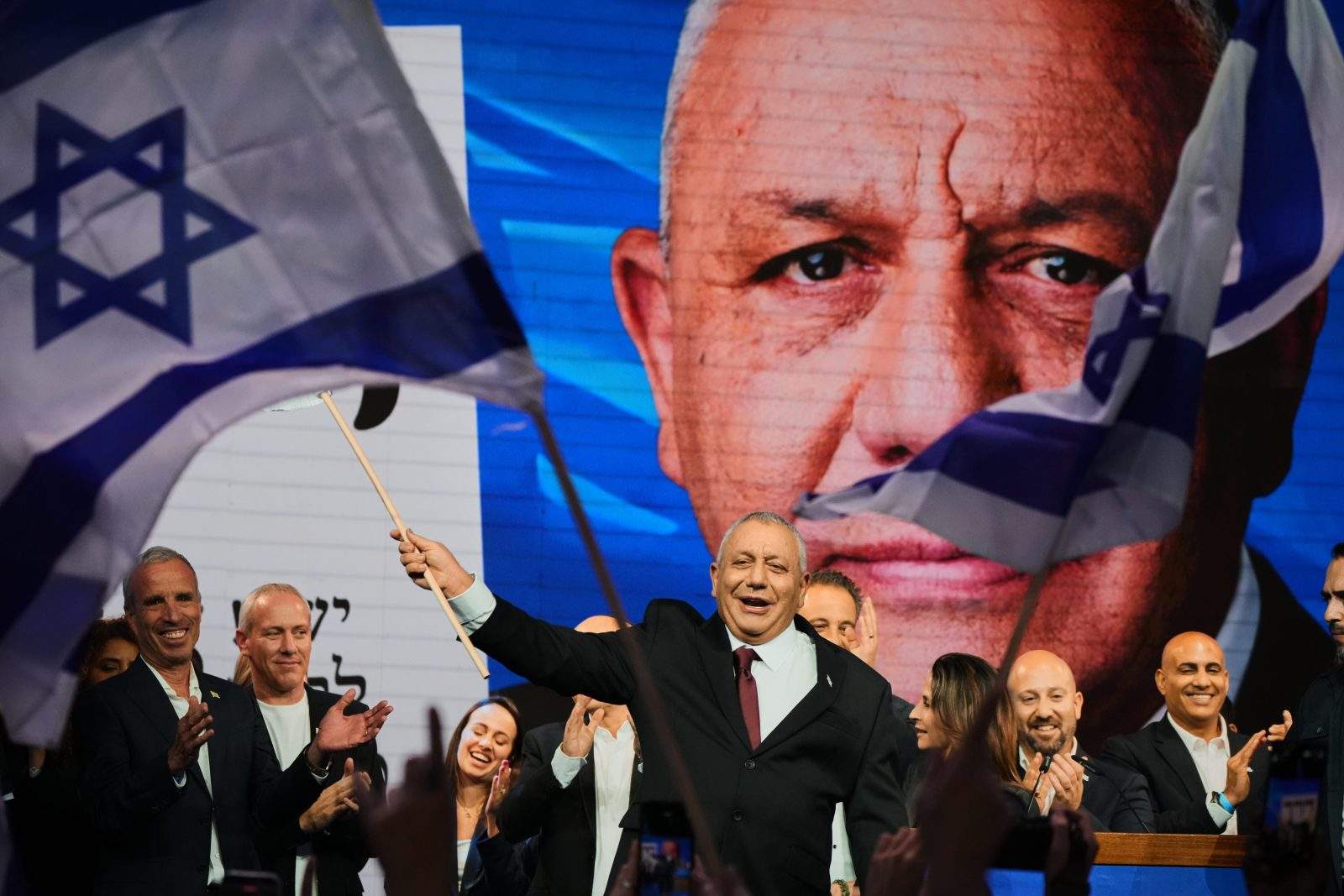
The mandate to form a government in Israel is rarely just a constitutional formality. According to parliamentary analysts and political observers tracking the Knesset's shifting alliances, tapping former Israel Defense Forces Chief of Staff and opposition figure Gadi Eisenkot to assemble a ruling coalition represents a calculated maneuver to break a prolonged political deadlock and challenge Prime Minister Benjamin Netanyahu's hold on power.
It is a high-wire act with razor-thin margins. In Israel's proportional representation system, securing the presidential nod to form a government is only the opening bell of a grueling, multi-week negotiation process that has broken far more seasoned politicians than a retired general. Meanwhile, you can find other events here: Why Giving Eisenkot the Mandate Is a Trap Designed to Save Netanyahu.
To understand why Eisenkot's name sits at the center of this political storm, one has to look past the surface-level headlines of opposition unity and examine the brutal arithmetic of the 120-seat Knesset, the institutional mechanics of Basic Law: The Government, and the deep ideological fissures dividing the anti-Netanyahu bloc.
The Constitutional Mechanics of the Mandate
In Israel, voters do not cast ballots directly for a prime minister. They vote for party lists, and the 120 seats in the Knesset are distributed proportionally among those that clear the electoral threshold. Under the provisions of Basic Law: The Government, the President of Israel is tasked with consulting the leaders of every faction elected to the parliament before deciding which Knesset member has the highest probability of assembling a viable majority coalition of at least 61 seats. To see the complete picture, we recommend the detailed article by TIME.
Receiving the mandate does not make someone prime minister. It merely grants a 28-day window—extendable by up to 14 additional days at the president's discretion—to draft coalition agreements, distribute ministerial portfolios, and present a fully formed government to the Knesset for a vote of confidence.
Political scientists at the Israel Democracy Institute have long noted that the mandate process often rewards tactical leverage over raw vote totals. A candidate does not necessarily need to lead the largest single faction in parliament to receive the nod; they only need to demonstrate that a critical mass of party leaders will recommend them to the president, or at the very least, refuse to recommend their primary rival.
For Eisenkot, whose public profile was forged over four decades in uniform rather than in the backrooms of party politics, the transition from military strategist to coalition architect tests a completely different set of muscles. In the military, orders flow down a clear chain of command. In the Knesset, every minor faction leader operates as an independent power broker capable of collapsing a nascent government before it is even sworn in.
Why Gadi Eisenkot Became the Consensus Vehicle
The emergence of Gadi Eisenkot as a prospective coalition builder did not happen in a vacuum. Following the events of October 7, 2023, and the subsequent multi-front war, public trust in traditional political leadership suffered historic lows across Israeli polling data. Eisenkot, who joined the emergency war cabinet alongside Benny Gantz before resigning in mid-2024 over disagreements regarding post-war strategy and hostage negotiations, carved out a distinct reputation among centrist and soft-right voters.
His personal credibility was underscored by immense personal sacrifice, having lost his son, Gal Eisenkot, and his nephew in combat in Gaza. In the eyes of many Israeli commentators, this gave his critiques of Prime Minister Netanyahu's decision-making a moral weight that career opposition figures struggled to match.
Yet moral weight does not automatically translate into 61 Knesset seats.
The primary reason opposition strategists have looked toward Eisenkot as a potential mandate holder is his unique positioning as a bridge figure. Within the anti-Netanyahu camp, ideological compatibility is notoriously elusive. The bloc spans secular centrists like Yair Lapid's Yesh Atid, right-wing nationalists led by figures such as Avigdor Liberman and Gideon Sa'ar, left-wing democrats, and predominantly Arab factions.
Bridging the Center-Right Divide
Historically, attempts to unseat Netanyahu have stalled because right-leaning voters uncomfortable with Likud's leadership refused to back a government headed by a center-left politician. Conversely, centrist and left-leaning voters have been wary of handing the premiership to hardline nationalists.
Eisenkot's security credentials—as the 21st Chief of the General Staff of the IDF from 2015 to 2019—provide political cover for right-of-center lawmakers considering a break from the traditional right-wing bloc. At the same time, his advocacy for a state commission of inquiry, his emphasis on democratic norms, and his pragmatic approach to diplomatic agreements keep him acceptable to the liberal center.
As political analysts in Jerusalem frequently point out, Eisenkot is viewed by many opposition planners not necessarily as an ideological firebrand, but as the lowest common denominator capable of holding together a fragile, single-purpose coalition.
The 61-Seat Arithmetic Problem
Even with a broadly acceptable figure at the helm, the math required to form a government in Israel remains unforgiving. To understand the obstacles facing Eisenkot, consider a hypothetical coalition-building scenario based on typical Knesset seat distributions.
Suppose an opposition bloc secures 56 seats across its core Zionist parties—combining centrist, center-right, and left-wing factions. That leaves the mandate holder five seats short of the 61-seat threshold required to pass a confidence vote.
To close that five-seat gap, the prospective prime minister faces three distinct, and equally treacherous, pathways:
- Courting the Ultra-Orthodox Parties: Shas and United Torah Judaism (UTJ) have historically aligned with Netanyahu's right-wing bloc, largely due to shared positions on religious status quo issues and military draft exemptions for yeshiva students. Breaking their alliance with Likud would require massive concessions on draft legislation—a move that would immediately alienate secularist allies like Avigdor Liberman and Yair Lapid, who have made universal military service a non-negotiable demand.
- Relying on Arab Factions: Securing either direct participation or external confidence-and-supply backing from parties like Ra'am (the United Arab List) or Hadash-Ta'al was the mechanism used by the short-lived Bennett-Lapid government in 2021. However, in the post-October 7 political climate, right-wing members of any prospective opposition coalition have publicly stated they will not rely on Arab parties to form a government, making this arithmetic virtually impossible to execute without triggering immediate defections.
- Peeling Off Likud Moderates: The third option involves convincing a handful of sitting Likud lawmakers to defect and join an Eisenkot-led unity government. While critics of Netanyahu within Likud exist, the party's internal primary system heavily punishes perceived disloyalty, making mass defections an extreme rarity unless Netanyahu's political standing collapses entirely.
This trilemma illustrates why winning the mandate is only half the battle. Without a pre-agreed formula to bridge these irreconcilable demands, the 28-day clock ticks down rapidly while rival factions leak demands to the press to maximize their leverage.
The Counter-Argument From Netanyahu's Camp
While opposition supporters frame an Eisenkot mandate as a necessary course correction for national unity and institutional stability, Prime Minister Netanyahu and his allies present a starkly different interpretation.
From the perspective of Likud strategists and right-wing commentators, an opposition coalition stitched together solely by a desire to remove Netanyahu lacks a coherent governing ideology. They argue that a government spanning hawks and doves cannot make decisive strategic choices on critical issues such as the future of the West Bank, the trajectory of regional normalization agreements, or long-term security arrangements in Gaza and southern Lebanon.
Netanyahu's defenders also point to the precedent of the 2021–2022 "change government" led by Naftali Bennett and Yair Lapid. That coalition, composed of eight ideologically diverse parties, collapsed after just over a year when internal disagreements over legislation in the West Bank caused backbenchers to defect, stripping the government of its majority.
Critics of Eisenkot further contend that his career as a military commander does not guarantee success in the rough-and-tumble world of legislative politics. Israeli history is filled with celebrated generals—including Ehud Barak, Shaul Mofaz, and Benny Gantz—who struggled to translate battlefield prestige into durable parliamentary control. Opponents argue that Netanyahu's decades of experience in diplomatic negotiations, economic policy, and coalition management make him far better equipped to navigate international pressure and domestic crises than a relative newcomer to electoral politics.
Overlooked Factors in the Coalition Battle
Beyond the headline-grabbing rivalries between party leaders, several structural realities quietly dictate whether an Eisenkot-led government could survive its first hundred days.
The Battle Over Ministerial Portfolios
In Israeli coalition politics, policy guidelines often take a back seat to the distribution of key ministries. Every faction joining a government demands high-profile portfolios to reward its base and secure budgetary control.
For Eisenkot, the most contentious negotiations will center on three positions: the Ministry of Defense, the Ministry of Finance, and the Ministry of Justice. Centrist and right-leaning partners both view the Defense and Justice portfolios as existential priorities—the former for security policy, the latter for defining the relationship between the Knesset and the Supreme Court. Meanwhile, whoever controls the Finance Ministry holds the power to approve or freeze coalition funds earmarked for specific voter demographics, from West Bank settlements to secular municipal programs.
Satisfying four or five distinct party leaders with only three top-tier ministries requires creative structural compromises, such as rotating premierships or creating parallel ministerial authorities—mechanisms that historically breed friction and administrative paralysis.
The Shadow of the State Budget
Under Israeli law, failing to pass a state budget by the statutory deadline automatically triggers the dissolution of the Knesset and forces new elections. This rule is the single most potent weapon in the hands of minor coalition partners.
Even if Eisenkot successfully assembles a 61-seat majority and passes the initial confidence vote, his government would immediately face the hurdle of passing a comprehensive budget. In an economy strained by prolonged military expenditures, elevated deficit targets, and debates over tax increases versus spending cuts, every faction will threaten to withhold its budget vote unless its specific financial demands are met.
Judicial Reform and Institutional Guardrails
Before the war, Israeli society was deeply polarized by the Netanyahu government's push to overhaul the judiciary and limit the powers of the Supreme Court. While the conflict temporarily pushed judicial legislation off the front pages, the underlying constitutional disputes remain unresolved.
An opposition government led by Eisenkot would face immediate pressure from its liberal base to reverse previous legislative changes and enshrine stronger checks and balances into Basic Laws. Yet pushing aggressively on constitutional reform risks alienating more conservative coalition partners who share some of Likud's skepticism toward judicial activism. Navigating this divide without fracturing the coalition requires meticulous legislative sequencing—focusing first on consensus issues like a formal state commission of inquiry and ultra-Orthodox conscription frameworks before touching broader judicial questions.
What Happens If the Mandate Fails
The presidential mandate process is designed with built-in contingencies if the first nominee cannot secure a majority within the allotted timeframe.
If Eisenkot's 28-day period—and any potential 14-day extension—expires without a signed coalition agreement, the mandate returns to the President of Israel. At that stage, the president has two primary options under Basic Law: The Government.
First, the president can assign the mandate to a different Knesset member—potentially Netanyahu himself, or another opposition leader—for a second 28-day attempt. Second, if the president concludes that no single lawmaker has a realistic path to 61 seats, the mandate can be handed directly to the Knesset as a whole.
During this 21-day parliamentary phase, any group of 61 Knesset members can sign a formal request asking the president to assign the task of forming a government to a specific lawmaker, including someone who already failed in an earlier round. If those 21 days pass without 61 signatures, the Knesset automatically dissolves, sending Israeli voters back to the polls for yet another round of national elections.
Every party leader in Jerusalem understands this timeline. For Netanyahu, dragging out negotiations and encouraging minor factions to hold firm increases the likelihood that Eisenkot runs out the clock, opening the door for Likud to reclaim the mandate or force a fresh election on favorable terms. For Eisenkot and his allies, the pressure is absolute: either lock down 61 signatures before the statutory deadline expires, or watch the opposition's best opportunity to reshape Israel's leadership evaporate on the Knesset floor.