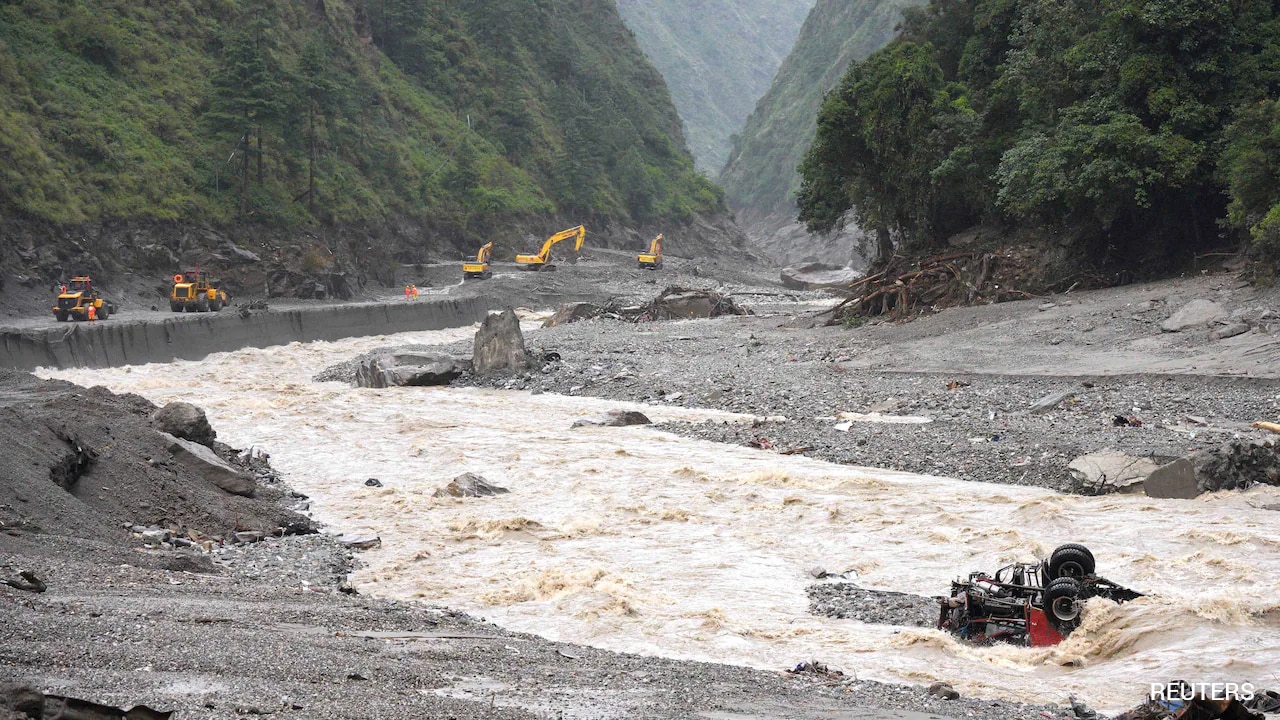
The death toll from the catastrophic flash floods triggered by a massive glacial collapse along the Nepal-Tibet border has climbed to 626, with nearly 2,500 people still unaccounted for. Entering its fourth day, the rescue effort has transitioned from a desperate search for survivors into a grim logistical nightmare. Entire villages along the Bhote Koshi and Trishuli river corridors have been erased, transformed into gray expanses of mud and pulverized stone.
Initial reports pinned the disaster on heavy monsoon downpours, but satellite telemetry and seismic data compiled by the United States Geological Survey confirmed a different catalyst. A magnitude 5.2 glacial collapse near Gyirong dumped an estimated 50,000 cubic meters of ice and rock debris into the watershed. The resulting wall of water and slurry tore down the valley with terrifying speed, giving villagers, construction crews, and pilgrims virtually zero time to flee.
Emergency responders are confronting an unprecedented operational vacuum. Over 30,000 security personnel have been deployed across the rugged terrain, yet forty kilometers of vital mountain roads and nineteen major bridges have simply ceased to exist. Access is restricted entirely to aerial lifts or dangerous rope descents down unstable canyon walls.
The Subsurface Crisis in Hydropower Tunnels
While surface searches capture global headlines, the most harrowing rescue operations are unfolding underground. Hundreds of construction workers and engineers were trapped when the torrents surged into the project sites lining the river basins.
At the Korean-funded Upper Trishuli-1 hydropower project, approximately 400 workers took shelter deep inside a ten-kilometer diversion tunnel as the initial wave struck. Days later, communication remains sporadic. Debris choked the tunnel entrances, cutting off food and water supplies while leaving rescuers scrambling to pump air and clear blockages.
Project liaisons note that oxygen levels inside the subterranean chambers have held steady enough to sustain life, but physical exhaustion and dehydration present immediate hazards. Specialized heavy machinery cannot reach these remote altitudes, forcing engineering teams to clear tons of compacted gravel and timber by hand. Similar grim scenes play out at the Rasuwagadhi project, where dozens more remain uncontactable.
The International Toll and Border Complications
The demographic makeup of the missing underscores the global draw of the Himalayan frontier. Among the 2,426 individuals still unaccounted for in Nepal are hundreds of foreign nationals, including tourists, mountaineers, and religious pilgrims traveling toward sacred sites near Mount Kailash.
Governments from New Delhi to Washington are struggling to reconcile casualty lists. The Indian Ministry of External Affairs reported that over 300 of its citizens remain uncontactable. Dozens of citizens from Australia, the United States, Britain, and Canada are also missing, swept up in a disaster that struck at the height of the regional travel season.
Across the border in China's autonomous region of Tibet, Gyirong County absorbed an identical blow. Chinese state media confirmed that hundreds are missing in the borderlands, where joint recovery efforts have been repeatedly delayed by secondary flash surges. An unstable barrier lake formed by the initial avalanche continues to overflow, sending sudden secondary pulses down the riverbed and forcing rescue teams to retreat mid-operation.
Structural Vulnerabilities in a Warming Climate
This disaster is not an isolated anomaly. It follows a chilling pattern of glacial destabilization across High Mountain Asia. Rising atmospheric temperatures continue to weaken high-altitude ice sheets, turning stable glacial lakes into ticking time bombs. Similar floods struck the region in August 2025, though on a drastically smaller scale.
Infrastructure planning across the Himalayas has routinely underestimated the velocity of climate-driven cryospheric changes. Hydropower expansion has accelerated rapidly to meet regional energy demands, often placing vulnerable worker camps directly in narrow river gorges prone to catastrophic hydraulic events.
Nepal’s foreign ministry has reversed its initial stance, formally requesting specialized foreign technical assistance for tunnel excavation and mass forensic identification. Heavy excavation units, thermal life-detection sensors, and forensic pathologists are desperately needed as recovery operations grind forward under an unyielding monsoon sky.
Heavy equipment continues to claw at the mudbanks around Chitwan, where bodies have washed up dozens of miles downstream from the impact zone.