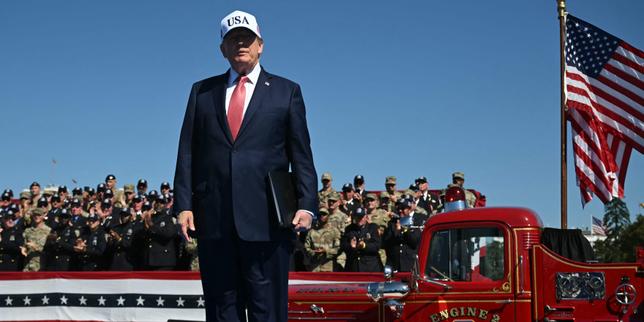
Donald Trump has engineered a complete operational overhaul of the Republican electoral apparatus ahead of the midterm elections, positioning himself not merely as the titular head of the party, but as its chief underwriter, strategist, and gatekeeper. This strategy bypasses traditional party infrastructure entirely, concentrating executive command within his immediate political orbit.
Look past the public rallies and the standard cable news posturing. The real story of modern conservative politics is structural. For months, political analysts obsessed over whether the former president would detach himself from congressional races or use his influence to settle old primary grievances. Instead, he executed a much more disciplined maneuver: a hostile takeover of the institutional machinery itself. By installing loyalists at the apex of campaign finance committees and leveraging his massive donor network as a parallel treasury, Trump transformed the party apparatus into an instrument designed to protect his own future trajectory while dictating the terms of engagement for every incumbent and challenger running down-ballot.
Campaign strategy in Washington has always been a game of leverage, but the current configuration operates under entirely new rules. Old-school strategists believed in distributed power centers. They favored the National Republican Congressional Committee and the National Republican Senatorial Committee serving as independent clearinghouses, vetting candidates through a traditional lens of electability and fundraising prowess in suburban districts. That model is dead.
The new framework relies on ideological purity tested through absolute personal alignment. If a candidate wants access to the high-dollar donor rolls or a coveted endorsement that moves needle points in a competitive primary, they must demonstrate complete fealty. This creates an echo chamber of compliance, but it also alters the math of the midterms in ways both advantageous and perilous for the broader conservative coalition.
The Financial Architecture of Control
Money remains the lifeblood of American campaigns, but the plumbing has been entirely re-routed. Traditional party committees are no longer the primary arbiters of resources. Instead, leadership PACs and joint fundraising committees controlled by Trump's inner circle dictate where the capital flows.
This centralization serves a dual purpose. First, it starves primary opponents of oxygen before they can even launch a viable media buy. Second, it binds congressional candidates to a centralized messaging apparatus that responds in real-time to shifting national narratives rather than local constituency concerns.
Consider how this plays out in a swing district where a moderate Republican might prefer to run on local economic conditions, tax policy, or infrastructure investments. Under the centralized model, candidates find themselves tethered to national flashpoints. The party's nationalized messaging machine drowns out local nuance. For decades, conventional political wisdom dictated that all politics is local. The current iteration of the Republican machine proves the exact opposite: all politics is national, tribal, and dictated from the top down.
Critics within the party whisper about the long-term sustainability of this approach. They point out that hyper-focusing resources on primary battles often leaves general election war chests depleted, forcing outside groups to spend millions cleaning up messy primaries in purple districts where independent voters hold the balance of power. Yet these warnings miss the fundamental incentive structure. For the architects of this strategy, maintaining absolute control over the caucus is more valuable than winning a wider, but potentially rebellious, majority.
Primaries as Loyalty Tests
The transformation of the primary process from a meritocracy of ideas into a loyalty test has fundamentally altered the type of candidate emerging from Republican nominating contests. Seasoned operatives who understand the granular mechanics of legislative drafting and committee maneuvering are frequently sidelined in favor of figures who excel at generating digital outrage and national media attention.
This dynamic changes the internal chemistry of Congress. When members arrive in Washington owing their seats entirely to a national executive endorsement rather than local coalition-building, their primary accountability lies with that external power center, not with their local constituents or House leadership. Legislative negotiations become far more volatile. Compromise is treated as betrayal. Passing a routine budget or raising the debt ceiling transforms into an existential crisis because individual members fear being branded as apostates by the digital ecosystem that birthed their political viability.
We watched this play out in previous legislative showdowns, but the midterm cycle accelerates the trend. The bench of experienced legislators is shrinking, replaced by a class of performative politicians whose primary skill set is media combat. For the party's leadership, this guarantees disciplined foot soldiers for culture-war battles. For the institution of Congress itself, it represents a further erosion of internal governance and institutional memory.
The Demographic Gamble
Electoral math cares little for internal party politics. Winning a midterm election requires addition, not subtraction. By doubling down on a base-turnout strategy that prioritizes high-propensity rural voters and disaffected working-class constituencies, the Republican machine is making a calculated bet on demographic shifts.
Traditional analysts look at suburban battlegrounds—places like Maricopa County, the collar counties around Chicago, or the northern suburbs of Atlanta—and sound alarms. They argue that alienation among college-educated suburbanites, particularly women, creates a ceiling for Republican candidates in competitive House districts. The counter-argument from the Trump camp is equally data-driven, even if it relies on a different set of assumptions. They argue that chasing the mythical median suburban voter is a fool's errand that demobilizes the very voters who fueled the 2016 and 2020 coalitions.
Instead of moderating to capture the center, the strategy seeks to expand the map by turning out non-traditional voters in rural and exurban areas who previously sat out midterm elections. It is a high-risk, high-reward wager. If the economy stumbles or inflation bites deeply into household budgets, the nationalized referendum model works brilliantly, sweeping wave after wave of populist candidates into office regardless of local candidate quality. If, however, economic indicators stabilize and abortion access or institutional stability remains front-of-mind for independent voters, the base-only strategy risks hitting a hard electoral wall in closely divided states.
The Shadow Transition
Beyond the immediate mechanics of the midterms, this level of control serves a longer-term objective. By placing himself squarely at the center of the campaign apparatus, Trump is effectively running a shadow transition operation years ahead of schedule.
Every candidate who signs on, every operative who takes a contract, and every dollar that moves through the aligned committees reinforces a parallel infrastructure. This apparatus operates independently of the Republican National Committee's historical institutional memory, creating a permanent structural footprint that will outlast any single election cycle.
Establishment figures who hoped to reclaim the party machinery after the smoke cleared have found themselves outmaneuvered not by superior ideology, but by superior operational execution. The party is no longer an association of state-level federations and independent county committees. It is a centralized corporate franchise, with quality control, brand management, and strategic direction flowing directly from Mar-a-Lago.
The midterms will test whether this centralized franchise can conquer the structural headwinds traditionally faced by the party in power or the party out of power, depending on the exact electoral calendar. But regardless of the numerical outcome on election night, one reality is already immutable. The old Republican party—the party of chambers of commerce, country club pragmatism, and traditional conservative orthodoxy—is gone. In its place stands a personalized political instrument, operating with a level of discipline and centralized control that American politics has not witnessed in a century.
The consequences of this transformation will reverberate long after the final ballots are tallied, reshaping not just the conservative movement, but the entire architecture of American governance.