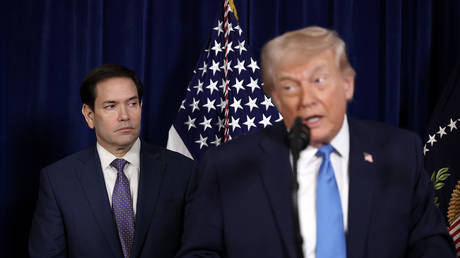
The chattering class is obsessed with a binary that doesn't exist. They want to tell you that Donald Trump is the "isolationist" dove and Marco Rubio is the "neoconservative" hawk, and that their friction over Iran is a fundamental breakdown in foreign policy logic. This narrative is a comfortable lie. It’s a lazy consensus built by pundits who prefer tribal labels over the cold, hard mechanics of geopolitical leverage.
If you believe the mainstream take, Trump and Rubio are "out of step" because they disagree on the why of a potential conflict. One supposedly wants to protect American wallets; the other wants to project American values. This is a surface-level reading of a high-stakes poker game. In reality, both men are operating within the same framework of maximum pressure, just utilizing different marketing departments. The disagreement isn't over the destination; it’s over the speed of the car and who gets to hold the map.
The Myth of the Isolationist Businessman
Let's dismantle the first pillar of the "out of step" argument: the idea that Donald Trump is inherently anti-war.
Trump is not a pacifist. He is a transactional realist. To a transactionalist, war is a bad investment with a terrible ROI, but the threat of war is a valuable asset. When the media claims Trump is "out of step" with Rubio’s hawkishness, they ignore the fact that Trump’s administration assassinated Qasem Soleimani—a move more aggressive than anything the "hawks" of the previous two decades managed to pull off.
The "lazy consensus" says Trump wants to exit the Middle East to save money. The nuance? Trump wants to privatize the security risk. He isn't looking for peace; he’s looking for a subscription model where regional players pay for the umbrella of American power. Rubio isn't arguing against this; he’s simply arguing that the umbrella needs to be permanently deployed to remain credible.
Rubio’s Doctrine is Not Your Father’s Neoconservatism
The second misconception is that Marco Rubio is a 2003-era neocon itching for "regime change" and "nation-building." That’s a fossilized view of foreign policy.
Modern hawks like Rubio have watched the failures of Iraq and Afghanistan. They aren't looking to build a Jeffersonian democracy in Tehran. Their goal is containment through kinetic deterrence. When Rubio talks about the moral imperative or the threat to Israel, he isn't being a starry-eyed idealist. He is using ideological language to justify a structural necessity: preventing a regional hegemon from controlling the Strait of Hormuz.
- The Competitor's Error: They claim Rubio wants war for "reasons of state" while Trump wants to avoid it for "reasons of the pocketbook."
- The Reality: Both realize that an Iran with a nuclear breakout capacity destroys the global oil markets. A $150 barrel of oil is the ultimate "pocketbook" issue.
Rubio’s hawkishness is the "bad cop" to Trump’s "unpredictable cop." If you don't have a Rubio threatening fire and brimstone, Trump’s "let’s make a deal" rhetoric has zero teeth. They aren't out of step; they are a synchronized pincer movement.
The Economics of the "Eternal War" Narrative
I have seen political consultants and defense contractors bank millions by selling the idea of a "split" in the GOP on Iran. It’s a fundraising goldmine. If you can convince the base that there is a "peace wing" and a "war wing," you can keep both sides agitated and opening their wallets.
But look at the actual policy outputs.
Whether it’s the Abraham Accords or the expansion of sanctions, the trajectory remains the same. The U.S. is pivoting toward a "Proxy-First" strategy. We provide the intelligence, the hardware, and the satellite coverage; our regional partners provide the boots. The debate between Trump and Rubio is merely about how much credit the U.S. should take for the results.
Dismantling the "People Also Ask" Fallacy
People often ask: "Will Trump stop a war with Iran?"
This is the wrong question. The right question is: "Can the U.S. economy survive the absence of the threat of war?"
The American dollar’s status as the global reserve currency is tied inextricably to the petrodollar system. If Iran manages to flip the regional script and trade oil in a basket of currencies that excludes the dollar, every American—from the MAGA voter to the Miami Rubio supporter—sees their purchasing power evaporate.
When Trump grumbles about "endless wars," he’s signaling to his base that he’s on their side. When Rubio calls for "decisive action," he’s signaling to the markets that the U.S. will not allow the energy status quo to be upended.
The Strategic Value of Friction
We need to stop viewing political disagreement as a "glitch." In the context of Iran, the friction between the Trump camp and the Rubio camp is a feature, not a bug.
Imagine a scenario where the U.S. executive branch is a monolith. If the U.S. is 100% "peace," Iran has no reason to negotiate. If the U.S. is 100% "war," Iran has no reason not to build a bomb as fast as humanly possible, because they know the strike is coming anyway.
The "out of step" narrative creates a zone of uncertainty. It makes the Iranian leadership wonder: Is the crazy guy in charge going to bomb us today, or is the guy who talks about human rights going to convince him to wait until tomorrow? This uncertainty is the only thing currently keeping a lid on the powder keg.
The Truth About the "Reasons" for War
The competitor article gets bogged down in the "reasons" for war—democracy, security, economy.
These are labels on a suitcase. The suitcase is the same. The contents are the same.
- Nuclear Non-Proliferation: Non-negotiable for both.
- Maritime Hegemony: Non-negotiable for both.
- Israel’s Survival: Non-negotiable for both.
The only real "split" is in the aesthetic. Trump prefers the aesthetic of the "tough dealmaker" who walked away from the table. Rubio prefers the aesthetic of the "principled leader" who never left the garrison.
If you’re waiting for a civil war within the Republican party over Iran policy, you’re going to be waiting a long time. You’re watching a choreographed dance and calling it a fight because the dancers are scowling at each other.
Stop looking at the tweets and start looking at the budget lines. The funding for CentCom isn't shrinking. The sales of F-15s to regional allies aren't stopping. The intelligence sharing is accelerating.
The media wants a "split" because a split is a story. Unity is boring. But the unity of purpose regarding Iran is the most ignored reality in Washington. Trump and Rubio aren't "out of step." They are walking a tightrope together, and they are both terrified of falling.
The next time you read a piece about the "deep divisions" in foreign policy, ask yourself who benefits from you believing the U.S. doesn't have a plan. The plan is exactly what it has been since 1979: keep Iran in a box, by any means necessary, while arguing about which color the box should be painted.
Turn off the news. Watch the tankers in the Persian Gulf. That’s where the real policy is written.