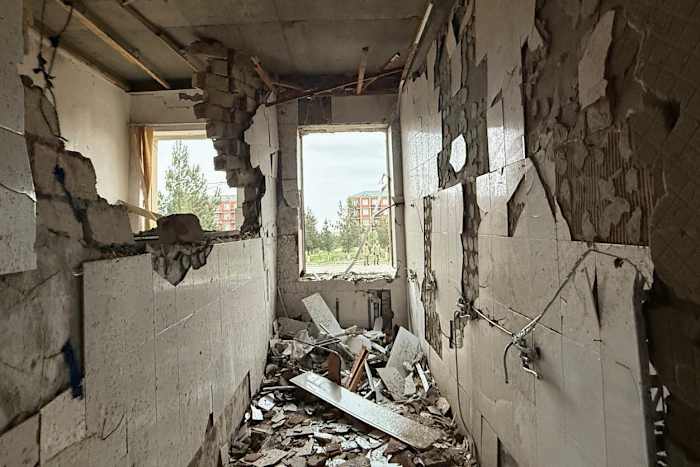
The wind across the Araxes River doesn’t carry news. It carries dust, the scent of parched earth, and the low hum of irrigation pumps that have kept the borderlands breathing for generations. But lately, the air feels different. It feels heavy. In the tea houses of Baku and the quiet corridors of power, the talk isn't about the harvest or the price of crude. It is about the mechanical buzz of a visitor that wasn't invited.
A drone is a small thing in a vast sky. To a farmer tending to his crops near the southern frontier, it might look like a large bird or a trick of the light. But to the military radars of Azerbaijan, it is a signature of intent. When Baku recently announced that an Iranian drone had violated its airspace, the declaration wasn't just a technical report. It was a scream across a canyon that has been widening for years. For a different view, see: this related article.
The Invisible Tripwire
Imagine standing in a room where the floor is covered in glass shards. Every step you take is calculated, quiet, and fraught with the risk of a sudden, sharp sound. This is the current state of the Caucasus.
Azerbaijan and Iran share more than a border. They share a history, a religion, and a complex web of ethnic ties. Millions of ethnic Azeris live within Iran’s borders, creating a human bridge that should, in theory, foster peace. Instead, that bridge has become a source of profound anxiety for Tehran. The Iranian government looks north and sees a secular, oil-rich neighbor that has grown increasingly bold, increasingly well-armed, and—most troubling to the clerics—increasingly close to Israel. Related analysis regarding this has been shared by The Washington Post.
The "drone attack" reported by Baku is the latest spark in a powder keg. While the physical damage of such an incursion might be minimal, the symbolic wreckage is total. By sending a remote-controlled eyesore into Azerbaijani territory, Iran is sending a message: We are watching, and your sovereignty is a thin curtain.
The Israeli Ghost in the Room
To understand why a single drone causes a diplomatic earthquake, we have to look at the shadow players. Azerbaijan doesn't just buy weapons; it buys a specific kind of security. During the 44-day war in Nagorno-Karabakh, Israeli-made drones were the undisputed stars of the show. They turned the tide, dismantled traditional defenses, and changed the geometry of modern warfare.
For Iran, this is a nightmare realized. They see Azerbaijan as a potential "launchpad" for Israeli intelligence or even military action. Every time an Azerbaijani official shakes hands with a representative from Tel Aviv, the temperature in Tehran rises by ten degrees.
The retaliation Baku has promised isn't necessarily a rain of missiles. Retaliation in this theater is often subtle. It looks like "military exercises" conducted right on the fence line. It looks like the tightening of transit routes that Iran uses to reach Russia and Europe. It looks like a slow, deliberate strangulation of diplomatic goodwill.
A Tale of Two Brothers
Consider a hypothetical citizen of the border region—let’s call him Elman. Elman’s grandfather was born when the border was a mere suggestion, a place where families crossed to attend weddings or trade sheep. Today, Elman watches the horizon. He sees the heavy trucks carrying equipment toward the front. He hears the jets. He knows that if a "retaliation" goes wrong, his fields are the ones that will burn.
The tragedy of the Azerbaijan-Iran spat is that it is a conflict of brothers who have forgotten how to speak the same language. Tehran fears encirclement and internal dissent. Baku fears a neighbor that cannot accept its rise as a regional power. When Azerbaijan vows to retaliate, they are asserting a right to exist without the constant shadow of a "Big Brother" looming over them.
The Mechanics of a Grudge
The facts are often obscured by the fog of propaganda. Iran denies the incursion, or perhaps attributes it to a "technical error." Azerbaijan produces radar tracks and debris. But the truth isn't found in the metal fragments or the black boxes of a downed drone. The truth is in the tone of the press releases.
The words "sovereignty" and "retaliation" are heavy-duty tools. They are the scaffolding for a conflict that isn't about one drone, but about a thousand. It is about a gas pipeline. It is about an Armenian road. It is about the soul of the South Caucasus.
When we talk about Azerbaijan’s promise to retaliate, we are talking about a nation that has spent billions of dollars on a military it once only dreamed of. Baku is no longer the underdog. It is a regional power with allies that reach from Ankara to Tel Aviv and Washington. For Iran, this is a bitter pill to swallow. Their neighbor has outgrown them in some ways, and in the world of geopolitical pride, that is an unforgivable sin.
A Silence That Echoes
There is a particular kind of silence that follows a border incident. It’s not the silence of peace; it’s the silence of a deep breath before a plunge. In the villages along the Araxes, the sunset used to be a time for tea and quiet reflection. Now, it is a time to watch for the blinking lights of a surveillance craft. It is a time to wonder if the night will be broken by the sound of sirens or the rumble of tanks.
The "drone attack" is a symptom of a deeper fever. It is a sign that the old rules of the Caucasus—where Moscow called the shots and everyone else fell in line—are dead. Azerbaijan is carving out its own destiny, and Iran is terrified of being left behind or, worse, being surrounded.
The dust on the Araxes River doesn't just settle. It waits for the next wind to kick it up again. The retaliation promised by Baku isn't just about a drone. It’s about a nation that has decided it will never again be a pawn in someone else’s game. The invisible stakes are nothing less than the future of the Middle East’s northern gate, and the cost of a single miscalculation could be a fire that nobody knows how to put out.
The sun sets behind the hills of Zangilan, casting a long, jagged shadow across the water. On one side, the lights of a new Azerbaijan flicker to life—bright, defiant, and modern. On the other, the dark, ancient mountains of Iran stand in silent, watchful judgment. Between them, the river flows on, indifferent to the machines that buzz above it and the men who promise to break them.