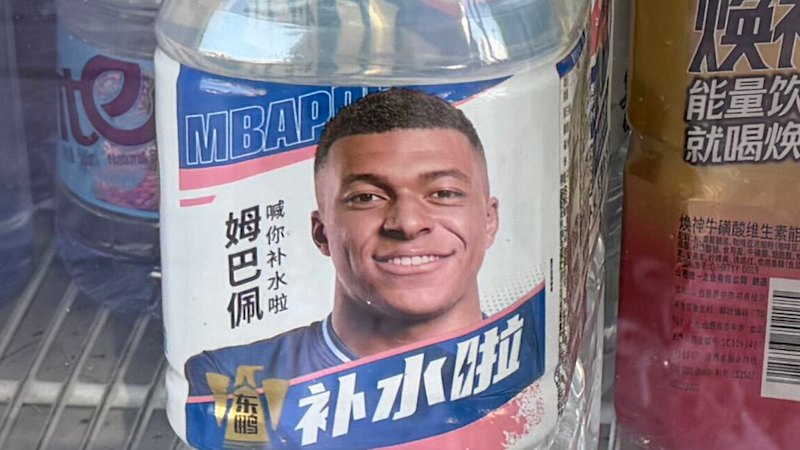
Kylian Mbappé cannot be watched live on mainstream Chinese television, yet his face remains plastered across convenience store coolers, subway billboards, and e-commerce banners from Beijing to Shenzhen. This apparent contradiction is not a bureaucratic oversight. It is the result of a cold, calculated split in how China’s sports economy operates: state broadcasters and domestic streaming giants have walked away from overpriced European football rights, while global consumer brands continue to pay tens of millions of dollars for the image rights of individual superstars who transcend the leagues they play in.
For decades, the business model of international sports marketing rested on a simple premise. Broadcast exposure drove fan engagement, and fan engagement justified corporate sponsorship. Without live matches airing in prime time, a player’s commercial value was supposed to wither. That rule book no longer applies in mainland China. Walk into a convenience store in Beijing’s Chaoyang District, and you will still see Mbappé’s likeness staring back from bottle labels and point-of-sale displays. Meanwhile, finding a legal, free-to-air broadcast of his club matches on a Saturday night requires navigating a fractured, paywalled, and largely abandoned media market.
The Anatomy of a Broadcast Blackout
To understand why Mbappé the pitchman outlasted Mbappé the footballer on Chinese screens, you have to look at the wreckage of China’s sports media bubble. Between 2015 and 2019, tech conglomerates and state-backed media groups spent billions of dollars acquiring the exclusive Chinese broadcasting rights to Europe’s top football leagues. Companies like Suning’s PPTV, iQIYI, and Tencent bid against one another with reckless abandon, driving rights fees into the hundreds of millions of dollars per cycle.
The math never worked. Chinese consumers, accustomed to free sports broadcasts on state television giant CCTV-5 or easily accessible pirated streams, refused to pay Western-style subscription fees in numbers large enough to cover the licensing costs. When the pandemic hit in 2020 and consumer spending tightened, the bubble burst. PPTV defaulted on massive payments to the Premier League and Serie A. Other platforms quietly let their contracts expire or renegotiated at steep discounts.
State broadcaster CCTV-5, constrained by tighter budgets, shifting political priorities toward domestic athletics, and unfavorable time zones that put European kickoffs at 3:00 AM or 4:00 AM Beijing time, drastically scaled back its European club football coverage. Even when matches are available on niche digital platforms like Migu—backed by state telecom giant China Mobile—they are often locked behind multi-tiered VIP paywalls that casual fans ignore. For the average viewer in Beijing, top-flight European club football effectively vanished from the cultural mainstream.
Why Brands Separated the Player from the Pitch
Global marketers noticed this shift long before sports executives admitted it. Companies selling fast-moving consumer goods—bottled beverages, sportswear, luxury watches, and electronics—do not buy media rights. They buy attention and cultural cachet. And in China’s hyper-fragmented digital ecosystem, individual athletes generate far more engagement than the competitions they play in.
Consider how a multinational beverage company or sportswear giant evaluates a return on investment in China. If a brand sponsors a European football league, its logo appears on LED perimeter boards during matches that kick off while Beijing is asleep, broadcast on a platform with limited reach. If that same brand signs Kylian Mbappé directly, it acquires the right to put his face on physical packaging in millions of retail outlets, run targeted short-video campaigns on Douyin, and associate its product with a globally recognized symbol of speed, youth, and excellence.
Athlete-centric marketing has completely decoupled from live broadcast distribution. In China, fans consume football through fifteen-second highlight clips on Douyin, viral memes on Weibo, and video games like EA Sports FC. A teenager in Shanghai does not need to watch ninety minutes of a domestic European league match to know who Kylian Mbappé is. They know him from his World Cup heroics—an event that CCTV-5 still broadcasts nationwide to hundreds of millions of viewers—and from his constant presence in digital culture.
The Economics of Physical Retail Visibility
There is a hard, logistical reason why Mbappé’s image remains ubiquitous in Beijing’s retail corridors even during a broadcast drought. Major consumer brands operate on multi-year licensing and production cycles. When a global beverage conglomerate signs a tier-one ambassador like Mbappé, the contract covers global or regional image rights across physical packaging, point-of-sale displays, and digital activations.
Once a brand commits to printing tens of millions of labels featuring an athlete’s likeness, that inventory moves through supply chains regardless of who holds the local television rights for his club team. In high-density urban markets like Beijing, physical retail shelf space is the most valuable advertising real estate on earth. Convenience store chains such as 7-Eleven, Lawson, and Bianlifeng act as 24-hour billboards on every city block.
For a consumer grabbing a cold drink on a humid afternoon or during a morning commute, the decision happens in less than three seconds. Packaging needs an immediate visual anchor. Mbappé provides instant recognition without requiring a single word of Mandarin translation. To a marketing director in Shanghai, paying a premium for Mbappé’s face on a bottle is a proven volume driver at the cash register, completely insulated from the financial headaches of sports broadcasters.
The Ghost of 2019 and Geopolitical Risk
There is another layer to this divergence that corporate executives rarely discuss in public: political risk management. Chinese state media has demonstrated repeatedly that it will pull international sports broadcasts off the air overnight if a league, team, or executive crosses a political red line.
The most famous precedent remains the 2019 fallout between the NBA and CCTV after a Houston Rockets executive posted a tweet supporting protests in Hong Kong. CCTV immediately blacked out NBA games for over a year, costing the league hundreds of millions of dollars in lost revenue. Similar sudden blackouts have hit individual Premier League matches when players or clubs made political gestures that clashed with Beijing’s official stances.
Because live sports broadcasts in China are subject to sudden censorship or geopolitical retaliation, brands have grown wary of tying their marketing budgets exclusively to broadcast integrations. Sponsoring an individual athlete like Mbappé carries a different risk profile. While individual athletes are certainly scrutinized by Chinese netizens—and any misstep can trigger a swift consumer boycott—superstars managed by sophisticated global agencies tend to stay strictly apolitical. They stick to safe, universal themes: hard work, victory, style, and athleticism.
For brands operating in China, an apolitical global icon is a far safer bet than a sprawling sports league whose owners, players, or broadcasters might inadvertently spark a diplomatic incident.
How Chinese Fans Actually Follow Mbappé Today
If you ask a sports executive in London or Madrid whether a broadcast blackout kills a player’s popularity in Asia, they will usually say yes. If you ask a twenty-two-year-old football fan in Beijing, they will laugh. The idea that television broadcasts are the primary gateway to sports fandom is an outdated Western assumption.
In China, the consumption of European football has migrated almost entirely to second-screen ecosystems. While live matches are dark on mainstream television, every goal, dribble, and post-match interview involving Mbappé is uploaded to Douyin, Bilibili, and Kuaishou within minutes of the final whistle—often via gray-market clip accounts or official league social media channels that give away highlights for free to keep their brands alive.
Let us look at a hypothetical example to see how this plays out in practice. Imagine a university student in Beijing who follows Mbappé. He does not pay for a monthly streaming subscription to watch a match at 3:30 AM on a Monday morning before classes. Instead, he wakes up at 7:30 AM, opens Douyin while riding the subway, watches a sixty-second compilation of Mbappé’s touches set to trending electronic music, reads five hundred comments debating Mbappé’s tactical positioning, and then stops at a convenience store outside his campus gate to buy a drink featuring Mbappé on the bottle.
From the perspective of the beverage company, the marketing funnel worked flawlessly. The student engaged with the athlete, felt a connection to global pop culture, and made a purchase. The fact that no broadcaster paid millions of dollars to air the live ninety-minute match is completely irrelevant to the transaction.
The Hidden Vulnerability for European Leagues
This dynamic represents an existential threat to the long-term financial projections of European football clubs and leagues. For years, clubs justified escalating player wages and transfer fees by pointing to untapped growth in Asian media rights. The theory was that as China’s middle class expanded, broadcast revenues from Beijing and Shanghai would eventually rival those from London and New York.
Instead, the exact opposite happened. The value of live club broadcast rights in China stagnated and retreated, while the value of top-tier individual player brands kept climbing. Players like Mbappé, Erling Haaland, and Jude Bellingham capture the lion’s share of commercial attention, leaving the leagues themselves struggling to monetize their core product in the world’s second-largest economy.
When a superstar can generate massive commercial royalties in China without his club’s matches ever appearing on prime-time television, the leverage shifts decisively away from the leagues and toward the players. Agents and commercial managers understand this asymmetry. During contract negotiations, players demand higher percentages of their own image rights precisely because they know their global commercial value is no longer dependent on the league’s broadcast distribution deals.
The Limits of the Billboard Strategy
Of course, relying on retail visibility and short-form video clips without live broadcast backing is not a perpetual motion machine. Brand equity built on past World Cup glory and highlight reels has a shelf life. Without regular, accessible live storytelling—the week-in, week-out drama of title races and Champions League knockout nights—casual fans eventually drift toward domestic entertainment, e-sports, or local athletes who are visible every day on state media.
Chinese domestic sports stars, such as Olympic swimmers, table tennis champions, and tennis players like Zheng Qinwen, enjoy massive state-backed promotional campaigns and prime-time broadcast slots that foreign footballers can no longer match. Local brands increasingly favor domestic heroes who carry zero geopolitical baggage and command fierce national pride.
Yet as long as multinational corporations need a universally recognizable face to move inventory across millions of retail shelves, Kylian Mbappé will remain a fixture of Beijing’s commercial streetscape—a ghost on the television dial, but an undisputed heavyweight at the checkout counter.