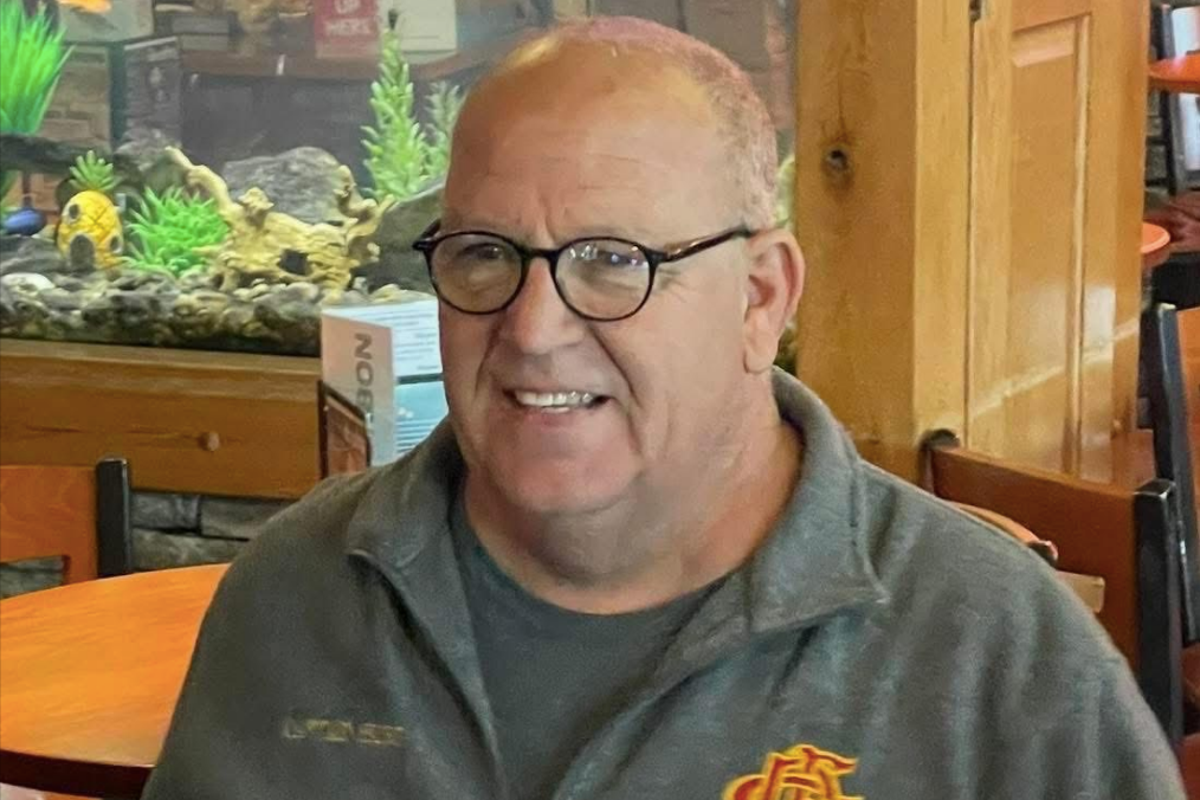
The sound of shearing metal is something you never forget. It isn’t a clean snap. It’s a rhythmic, agonizing groan of steel resisting the inevitable, a high-pitched protest that vibrates in your molars. For thirty years, Tim Tyson was the man who spoke back to that sound.
He didn't just carry a badge; he carried the heavy, hydraulic weight of the "Jaws of Life." When a chassis crumpled like a discarded soda can, pinning a human life inside a tomb of jagged glass and hot oil, Tim was the one who knew exactly where the structural integrity of a vehicle failed and where his expertise had to begin. He was a retired fire captain and a legend in the specialized world of vehicle extrication. He spent his life pulling people out of the dark.
Then came the afternoon at New Smyrna Speedway.
The air at a racetrack has a specific thickness. It smells of burnt rubber, high-octane fuel, and the electric tension of speed. On this particular Saturday, the sun was beating down on the asphalt, and the roar of the engines provided the heartbeat of the venue. Tim wasn't there as a spectator. Even in retirement, the instinct to protect doesn't just evaporate. He was part of the safety crew, the invisible net that waits beneath the tightrope of professional racing.
When the call went out over the radio—a crash on the track—the reaction was visceral. It was muscle memory. Tim and his partner, 64-year-old Peter Manser, didn't hesitate. They climbed into their support vehicle, a GMC Sierra, lights flashing, and began the sprint across the infield.
They were responding to a crisis. They were the help.
But the geometry of a tragedy is often dictated by seconds and inches. As they crossed the pit road exit, heading toward the wreckage of the race car, a support truck was screaming down the same stretch of pavement.
Physics is indifferent to a man’s resume. It doesn't care that Tim Tyson had saved more lives than most people will ever meet. It doesn't care that he was a mentor, a father, or a friend who could fix anything with a motor. When the support truck struck the passenger side of the Sierra, the impact was catastrophic.
The irony is a jagged pill to swallow. The man who spent decades perfecting the art of cutting people out of wrecked cars was now trapped in one himself.
The Volusia County Sheriff’s Office later pieced together the telemetry of the moment. The support truck, driven by a 62-year-old man from Deland, slammed into the side where Tim sat. The force was enough to send both vehicles spinning into the nightmare that every first responder fears: the transition from rescuer to victim.
In the fire service, there is a concept called the "Golden Hour." It is the window of time between a traumatic injury and the moment a patient reaches the operating table. If you can get them there within sixty minutes, their chances of survival skyrocket. Tim Tyson had spent his entire career fighting for other people’s Golden Hour. He had raced against the clock in the rain, in the middle of the night on lonely Florida highways, and amidst the smoke of burning buildings.
But on that Saturday, the clock ran out.
Tim was pronounced dead at the scene. His partner, Peter, was rushed to the hospital with serious injuries. The driver of the other truck survived, left to grapple with the crushing weight of a split-second intersection.
To understand why this loss echoes so loudly through the halls of Florida’s fire stations, you have to understand the man beyond the uniform. Tim wasn't just a firefighter; he was a teacher. He traveled the country showing others how to use hydraulic spreaders and cutters. He knew the specific tension points of a B-pillar. He understood the hidden dangers of undeployed airbags and high-voltage batteries in modern cars. He was a master of a craft that most people hope they never have to see in person.
Imagine a young recruit, hands shaking, standing over a car that has rolled three times. The victim inside is screaming. The recruit looks at the mangled heap of metal and sees an impossible puzzle. Then, a calm voice enters the fray. That was Tim. He would point to a specific spot on the frame. "Cut here," he’d say. "Watch the glass. Steady now." He turned chaos into a process. He turned terror into a series of manageable steps.
His peers didn't just respect him; they sought him out. He was the guy you wanted in the seat next to you when the world went sideways.
The tragedy at New Smyrna Speedway highlights a reality that we often choose to ignore: the men and women who run toward the fire are never truly safe, even when they aren't the ones in the flames. There is a specific kind of bravery required to work in the "hot zone" of a racetrack or a highway. You are operating in a world of high velocity and unpredictable variables. You are trusting that everyone else is paying as much attention as you are.
Sometimes, they aren't.
The investigation into the crash will likely yield a report full of dry, technical language. It will speak of right-of-way, speeds, and sightlines. It will be filed in a cabinet and referenced in safety briefings. But the report won't capture the silence that fell over the fire house when the news broke. It won't describe the way his family feels looking at an empty chair at the dinner table.
It won't explain the hollowness of a community losing a man who was, quite literally, its safety net.
We live in a culture that idolizes the people behind the wheel of the race cars—the ones chasing the checkered flag. We forget about the people standing in the wings, the ones whose entire job is to ensure that if the worst happens, it isn't the end. Tim Tyson lived in those wings. He was comfortable there. He didn't need the trophy or the podium. He just needed to know that when he used his tools, a life was preserved.
The loss of an expert is a loss of institutional memory. When someone like Tim passes, they take with them decades of "feel"—that intuitive understanding of how metal bends and how a life is held in the balance. You can't learn that from a manual. You learn it by doing it a thousand times in the mud and the dark.
There is a haunting symmetry to his departure. He died in the service of others, responding to a call for help, surrounded by the machinery he spent a lifetime mastering.
As the sun set over the speedway that evening, the track finally went quiet. The engines were silenced, and the crowd had thinned out, leaving only the long shadows of the grandstands stretching across the pavement. The stain of the fluid on the ground and the debris of the collision were the only physical markers of what had happened.
But for those who knew Captain Tim Tyson, the mark he left was much deeper than a scar on the asphalt. He was a man who understood that life is fragile, held together by the thin margins of luck and the skill of those who watch over us. He died while standing in that margin.
He was the man who cut us free from our worst moments, only to be caught in a moment he couldn't escape.
The next time you hear the siren of a fire truck or the distant whir of a hydraulic pump, remember that there is a human being behind that noise. They are fathers, they are experts, and they are taking a risk that most of us wouldn't dare. They are people like Tim, who show up when the world breaks, ready to put it back together one piece of steel at a time.
The "Jaws of Life" are heavy. They require a strong back and a steady heart. Tim Tyson had both, until the very end.