The ocean has a way of masking lethal danger with breathtaking beauty. In the Maldives, a place famous for turquoise waters and vibrant marine life, that illusion shattered when five Italian divers vanished inside a deep underwater cave at Vaavu Atoll.
Rescuers just recovered the bodies of two of the four remaining divers from the innermost chamber of the cave system, located roughly 200 feet (60 meters) below the surface. This operation has already cost the life of a local military diver, turning a terrible accident into an international tragedy. It is the worst diving disaster in the history of the island nation, and it exposes the brutal reality of what happens when recreational limits collide with overhead environments.
The Fatal Pull of the Alimathaa Cave
The victims weren't casual tourists. The group included highly respected marine researchers and academics from the University of Genoa. Monica Montefalcone, an associate professor of ecology and director of a Maldives reef monitoring campaign, died alongside her daughter, Giorgia Sommacal. Marine biologist Federico Gualtieri and researcher Muriel Oddenino also perished inside, while diving instructor and boat operations manager Gianluca Benedetti was found dead near the cave entrance shortly after the incident.
They were stationed on the luxury liveaboard Duke of York. While Montefalcone and Oddenino were in the country for an official scientific mission studying how climate change impacts tropical biodiversity, the University of Genoa confirmed this specific excursion was a private, recreational dive.
They targeted a notorious cave system near Alimathaa Island, a spot famous for channel diving. Here, massive tidal currents squeeze between islands, attracting schools of reef sharks and pelagic fish. The terrain is spectacular, but the underwater topography is unforgiving. Unlike inland freshwater caves, these reef structures are complex tunnels that can rapidly trap sediment, instantly wiping out visibility.
When a Recreational Profile Turns Technical
The first major red flag in this incident is depth. The dive took place at approximately 50 to 60 meters (164 to 200 feet).
The legal limit for recreational diving in the Maldives is 30 meters (98 feet). Major international training agencies like PADI and SSI draw a hard line at 40 meters for deep recreational diving. Anything beyond that requires technical decompression training, specialized gas mixes, and equipment redundancy.
Diving Depth Limits & Incident Context:
30 Meters: Legal maximum for recreational diving in the Maldives
40 Meters: Absolute limit for standard recreational scuba training
50-60 Meters: Actual depth where the Italian divers were found
At 50 meters, a diver using standard atmospheric air faces massive physiological hurdles. The most immediate is nitrogen narcosis, often described as a feeling of drunkenness. It slows your reaction times, impairs judgment, and sparks irrational panic.
Worse, breathing standard air at that depth causes oxygen to become toxic to the human body, which can trigger sudden, uncontrollable seizures. If you seize underwater with a standard regulator in your mouth, you drown.
The Trap of the Overhead Environment
Depth was only half the problem. The real trap was the cave itself. The Italian Foreign Ministry noted the cave system is carved into three large chambers linked by tight, narrow passages. The Finnish recovery team eventually located the four bodies clustered together in the third, innermost chamber—the deepest part of the labyrinth.
In open water, if something goes wrong, you can make a controlled emergency ascent to the surface. In a cave, you have a solid ceiling of rock above you. The only way out is back the way you came.
Recreational scuba gear is built for open water. You have one tank and a backup second-stage regulator meant for a buddy. Technical cave divers use independent double tanks or sidemount configurations, ensuring that if a piece of gear fails or a valve rolls shut against the ceiling, they have an entirely separate life support system.
They also run a continuous physical guideline from the open ocean into the cave. Without a line, it takes just one kick of a fin to stir up silt from the floor. When that fine sediment hits the water column, visibility drops from perfect to absolute pitch-black in seconds. Your flashlight becomes useless, reflecting off the suspended particles like high beams in a blizzard. You lose all sense of up and down.
A Recovery Operation with a Heavy Cost
The extreme nature of the site made recovery efforts exceptionally dangerous. The Maldivian National Defense Force launched an immediate search, but the mission took a dark turn when local military diver Mohamed Mahudhee died from severe decompression sickness after a grueling shift at depth.
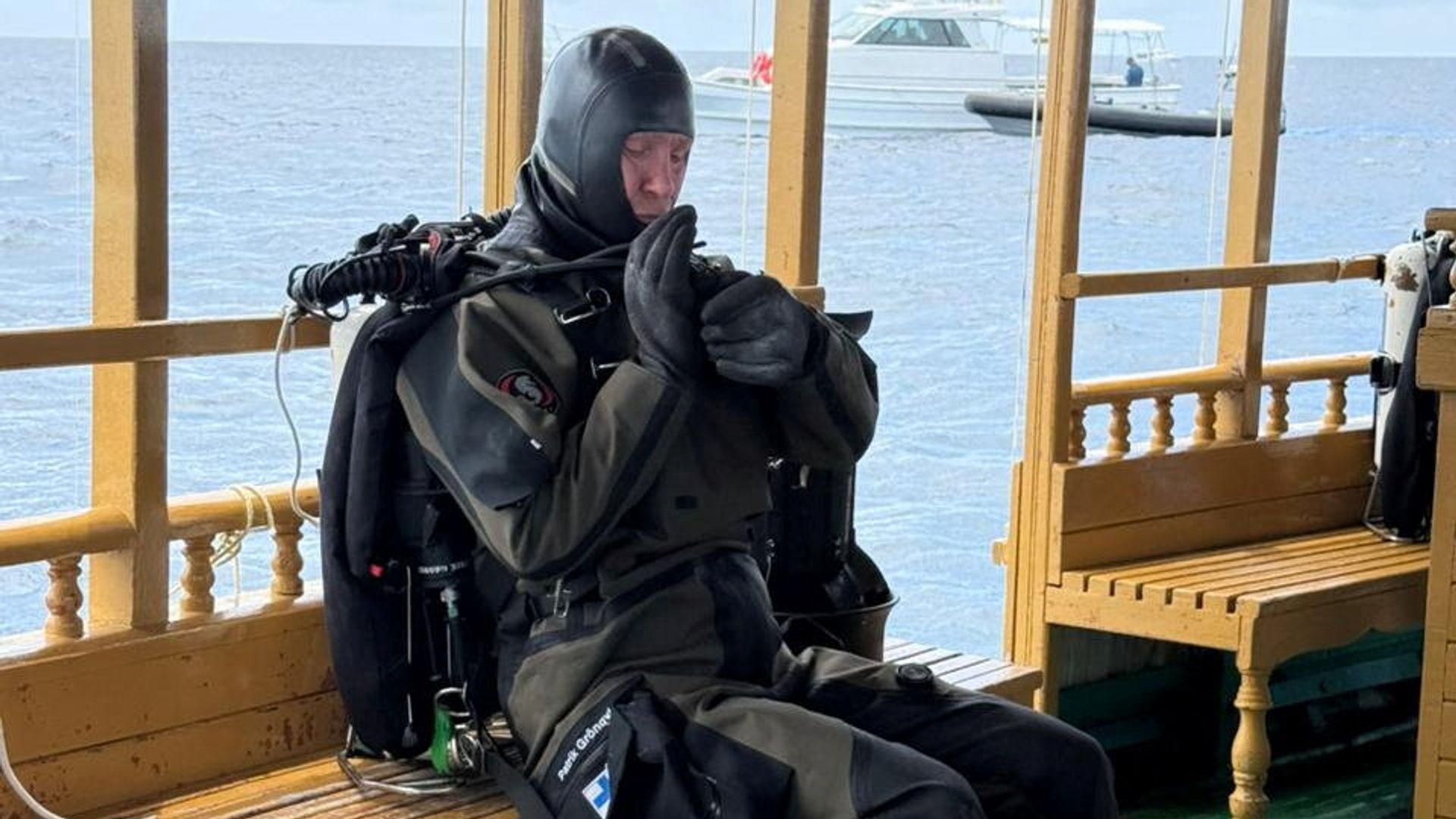
The complexity forced the Maldives government to halt the search until elite international help arrived. Three technical diving experts from the Divers Alert Network (DAN) Europe arrived from Finland to remap the strategy.
These specialists rely on closed-circuit rebreathers (CCRs). Unlike traditional scuba that vents bubbles into the water, a rebreather recycles exhaled gas, scrubs out the carbon dioxide chemically, and injects precise amounts of oxygen. This system minimizes gas consumption and allows divers to stay at 200 feet for hours without running out of air, giving them the time required to navigate zero-visibility spaces safely.
Even with world-class gear, the environment tested the team. Strong tidal currents and sudden downward drafts in the channel threatened to pull rescuers deeper into the abyss. Poor weather on the surface compounded the danger, triggering yellow alerts for local maritime traffic. The Finnish team successfully brought up two of the bodies, with operations scheduled to retrieve the final two victims.
The Lessons the Diving Community Cannot Ignore
The Maldivian Tourism Ministry suspended the operating license of the Duke of York liveaboard vessel while an official investigation checks how a group was allowed to execute a deep cave dive using standard recreational infrastructure. The local tour operator has publicly denied authorizing or knowing about the deep profile.
This tragedy isn't a failure of modern scuba gear. It is a stark reminder of what happens when you treat a technical overhead environment with a recreational mindset. Complacency kills underwater. When you mix extreme depth, heavy currents, and an overhead environment without the proper training, redundant life support systems, and physical guidelines, the margin for error drops to absolute zero.
If you are a certified diver or planning a trip to a world-class destination like the Maldives, let this be a sobering baseline. Never let the sheer beauty of an exotic site override the hard discipline of your training. Stick strictly to your certification limits, respect local depth regulations, and never cross the threshold of a cavern or cave unless you have the specific technical ratings and equipment to get back out.