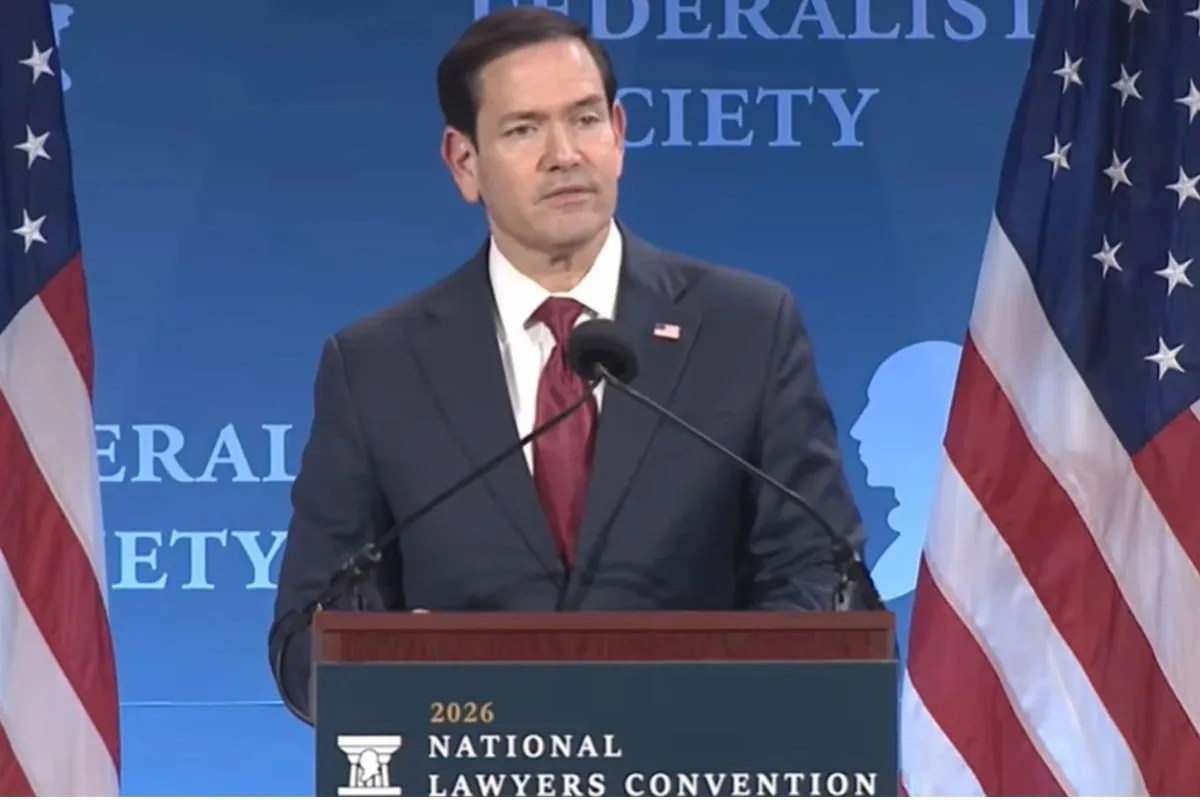
Secretary of State Marco Rubio stepped up to the podium at the Federalist Society convention and delivered a line designed to rattle the chandeliers in Geneva and Brussels. He called international law "an instrument to advance their interests"—a weapon wielded by a "global elite" to constrain American sovereignty.
The conservative applause was thunderous. The progressive backlash was instant and predictable. Mainstream coverage framed it as a binary cage match: populist nationalism versus the sacred, rules-based international order.
Both sides are peddling a comforting fiction.
Rubio is right that international law is an instrument of power. Where his analysis collapses—and where his critics completely miss the plot—is in pretending that the United States is the victim of this system rather than its primary architect and chief beneficiary. To treat international treaties, maritime conventions, and trade tribunals as a foreign trap is like a casino owner complaining that the house rules are rigged against him.
The Myth of the Neutral Referee
The lazy consensus in foreign policy commentary treats international law like gravity—an objective, moral force that exists above politics. When commentators clutch their pearls over Rubio’s remarks, they operate under the delusion that institutions like the United Nations, the World Trade Organization, and the International Court of Justice function like domestic courts with a sheriff waiting outside the door.
They do not. International relations operates in a state of structural anarchy. There is no global police force. As political scientist Hans Morgenthau argued decades ago in Politics Among Nations, international law is a primitive legal system precisely because enforcement relies entirely on decentralized self-help by sovereign states.
Rubio’s speech tapped into a real friction: transnational bureaucrats and non-governmental organizations frequently attempt to use customary international law to bypass domestic democratic legislatures. When unelected panels dictate immigration policy, environmental targets, or military rules of engagement, voters in Ohio or Florida rightly ask who elected these judges.
Yet stopping the analysis there is intellectual malpractice. Every major pillar of modern international law—from the Bretton Woods financial architecture to the Geneva Conventions—was drafted with American pens, backed by American capital, and enforced by American aircraft carriers.
Who Actually Wrote the Rules?
If international law is a weapon used by elites to advance their interests, look at who holds the handle.
Consider the United Nations Convention on the Law of the Sea (UNCLOS). The United States has never formally ratified it, largely due to Senate resistance over deep-seabed mining provisions. Yet the U.S. Navy relies on UNCLOS every single day to justify Freedom of Navigation Operations in the South China Sea. When Washington challenges Beijing’s artificial islands, it does not cite the Second Amendment or the Monroe Doctrine. It cites international maritime law.
Why? Because codified rules lower the cost of hegemony.
Imagine a scenario where the United States abandons the pretense of international legal norms entirely and relies purely on bilateral muscle. Every single transit of a commercial container ship through the Strait of Malacca, every airspace clearance for a diplomatic flight, and every cross-border banking transaction would require continuous, exhausting negotiation backed by explicit threats of force.
Power without legitimacy is astronomically expensive. As political scientist John Ikenberry demonstrated in After Victory, leading states bind themselves to institutional rules after major wars not out of altruism, but to lock in a favorable distribution of power for decades. By agreeing to play by predictable rules, the dominant power convinces weaker states to accept its leadership voluntarily rather than forming hostile counter-coalitions.
Rubio’s framing ignores this basic return on investment. Framing the rules-based order as a burden imposed on Washington by European elites flips historical reality on its head. The "global elite" Rubio attacks are mostly operating inside a legal operating system built in Washington, D.C. in 1945.
The Realist Blind Spot on Asymmetric Lawfare
While mainstream critics accuse Rubio of reckless isolationism, they refuse to confront the legitimate strategic vulnerability he is pointing toward: asymmetric lawfare.
In legal and military strategy, lawfare is the use of legal systems and principles against an enemy to delegitimize their actions, tie up their resources, or achieve tactical victories without firing a shot. Democracies are uniquely vulnerable to this tactic because their domestic courts, free press, and civil societies take legal obligations seriously. Authoritarian regimes treat those exact same treaties as decorative stationery.
Look at how this plays out in practice:
- Arms Control: During the Cold War and its aftermath, Washington subjected its nuclear and missile programs to exhaustive verification regimes under treaties like the INF Treaty. Russia quietly developed and deployed prohibited ground-launched cruise missiles while American compliance lawyers scrutinized every bolt on U.S. prototypes.
- Humanitarian Law: Western militaries embed judge advocates (JAGs) into targeting cells to ensure every airstrike complies with the Law of Armed Conflict principles of proportionality and distinction. Insurgent groups and state adversaries intentionally embed command centers beneath hospitals and schools, weaponizing Western legal compliance as a human shield.
- Trade Disputes: For two decades, the United States accepted adverse rulings from the World Trade Organization’s Appellate Body while state-capitalist economies used opaque subsidies and forced technology transfers that the WTO’s legal framework was never designed to catch.
When Rubio tells the Federalist Society that international law is used to advance specific interests, he is describing this exact asymmetry. Pretending that autocracies and democracies view international treaties through the same lens is not idealism; it is strategic negligence.
Why the Federalist Society Applause Misses the Trap
The danger of Rubio’s rhetoric lies in the cure he implies. If you convince the American public that international law is inherently a scam designed to weaken the nation, you dismantle the very tools required to contain rising rivals.
Take the dollar’s status as the world's reserve currency and the reach of U.S. secondary sanctions. When the Treasury Department cuts a foreign bank off from the SWIFT messaging system or freezes sovereign central bank assets, that power rests on an intricate web of international banking agreements, bilateral investment treaties, and extraterritorial legal jurisdictions.
If Washington openly declares that international legal norms are merely instruments of raw self-interest, other nations will accelerate their efforts to build parallel financial, technological, and legal architectures outside American reach. We are already seeing the early tremors of this shift in BRICS payment alternatives and competing arbitration centers in Singapore and Dubai.
I have watched corporate executives and policy strategists make this exact mistake in boardrooms and diplomatic backchannels: they confuse leverage with autonomy. They assume that because they hold the biggest balance sheet or the strongest military, tearing up the contract gives them more freedom. In reality, tearing up the contract forces everyone else to hedge against you.
The Nuance Neither Side Wants to Touch
The debate over international law is broken because both camps treat sovereignty and international institutions as a zero-sum tug-of-war.
| Dimension | The Populist Nationalist View | The Liberal Institutionalist View | The Strategic Reality |
|---|---|---|---|
| Nature of International Law | A tool used by global elites to restrict national sovereignty. | A neutral, evolving moral framework that replaces power politics. | A codified reflection of power balances that lowers enforcement costs. |
| Primary Threat | Loss of domestic democratic control to foreign tribunals. | Unilateralism triggering a collapse into global chaos. | Asymmetric compliance where democracies bind themselves while rivals cheat. |
| Role of the U.S. | A constrained giant being bled dry by ungrateful allies. | The indispensable guardian of universal norms. | The system's architect whose legitimacy depends on selective, strategic restraint. |
| Optimal Strategy | Withdraw from treaties and assert pure bilateral power. | Ratify everything and defer to multilateral rulings. | Weaponize rules selectively while rejecting binding jurisdiction over core security. |
To navigate a multipolar world without getting played for a sucker or isolating the country, foreign policy makers need to abandon both dogma and naivety.
First, separate coordination rules from ideological mandates. Technical treaties governing aviation safety, radio spectrum allocation, maritime transit, and cross-border commerce are force multipliers for American power. Attacking "international law" as a monolith lumps the Federal Aviation Administration's global standards in with activist human rights tribunals. That is sloppy thinking.
Second, enforce strict reciprocity. The era of unilateral compliance must end. If a signatory violates an arms control pact, trade agreement, or maritime boundary, the response cannot be a five-year litigation process in Geneva. Treaties must include automatic snap-back provisions and immediate reciprocal suspension of benefits.
Third, maintain selective institutional distance. The United States has historically refused to submit to the compulsory jurisdiction of the International Court of Justice or ratify the Rome Statute of the International Criminal Court for good reason: global military responsibilities create unique legal exposures that domestic courts alone should adjudicate. Protecting that constitutional boundary does not require burning down the rest of the diplomatic house.
Asking the Wrong Question
Journalists and pundits love to ask: "Should America follow international law or put its own interests first?"
That question is a trap. It assumes the two are opposites.
For eighty years, international law was how America put its own interests first—by persuading the rest of the world that American dominance looked like order rather than conquest.
Dismissing the entire legal architecture as a plot by global elites hands Beijing and Moscow a propaganda victory they could never buy. They do not want to destroy international law; they want to rewrite it with themselves at the center. Vacating the courtroom doesn't make you free. It just lets your rival pick the judge.