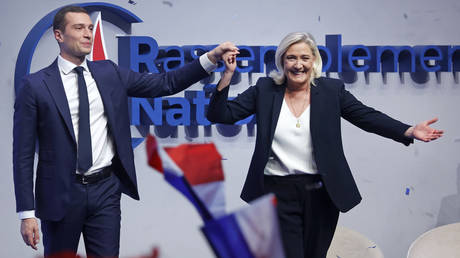
The lazy consensus in European politics right now smells like stale Gauloises and defeatism. Every time Marine Le Pen’s party stands up in the National Assembly or bangs the drum on television to declare that France cannot possibly finance Ukraine forever, the political commentariat nods along like a row of plastic dashboard dogs. They call it fiscal realism. They call it putting French taxpayers first.
It is none of those things. It is an economic delusion wrapped in nationalist theater. Don't miss our earlier post on this related article.
Let us look past the populist panic and examine the actual ledger. The claim that writing checks to Kyiv drains French coffers dry assumes that state budgets are giant piggy banks where every euro sent east is a euro stolen from a Parisian hospital or a rural pension. That is not how sovereign fiat currency works, nor is it how modern defense economics function. France is not mailing pallets of physical cash across Europe. It is procuring equipment, much of it from domestic manufacturers, pumping liquidity straight back into its own industrial base.
I have watched politicians weaponize budget anxiety for decades, convincing the public that national bankruptcy is just one artillery shell away while ignoring the vastly higher cost of regional destabilization. To read more about the history of this, Al Jazeera offers an informative breakdown.
When Le Pen argues France is running out of financial runway, she relies on a static view of wealth. Money spent on French Caesar howitzers or SCALP missiles does not vanish into a black hole in the Donbas. It pays the engineers in Bourges. It keeps assembly lines humming in Tulle. It upgrades the technological capability of a domestic defense sector that has spent thirty years living on the scraps of the post-Cold War peace dividend.
The Real Price of Cheap Security
To understand why the populist argument falls apart, we have to dismantle the core myth of European austerity spending. The narrative treats defense assistance as charity. It frames aid to Ukraine as a philanthropic endeavor we can simply turn off when times get tight, like a gym membership we no longer use.
This is dangerously naive. Geopolitical security is not a subscription service you cancel to save fifty euros a month. It is the foundational infrastructure upon which all domestic economic activity rests. If Russian forces shatter the security architecture of Eastern Europe, the resulting financial contagion—energy shocks, refugee flows, shattered supply chains, and the mandatory re-arming of an entire continent on an emergency footing—will dwarf the cost of current support packages by a factor of ten.
France’s current assistance to Ukraine is an investment in risk mitigation. Imagine a scenario where a corporate CFO decides to stop paying fire insurance on a factory because the building hasn't burned down yet this year. That is the exact logic driving the rhetoric coming out of the National Rally. They want to save the premium today and invite total destruction tomorrow.
Following the Defense Euro
Let us trace where the money actually goes. When the French Ministry of Armed Forces allocates funds for military support, the treasury transfers capital to defense primes like Thales, Dassault, and Nexter. These corporations employ French citizens, pay French corporate taxes, and fund local supply chains spanning hundreds of small and medium enterprises across the Hexagon.
The cash velocity within the domestic economy creates a multiplier effect. A worker in Lyon building components for a radar system spends their salary at local restaurants, buys cars manufactured domestically, and contributes to the social security fund.
When critics complain about the sheer volume of aid, they deliberately obscure this internal feedback loop. They want voters to picture piles of French banknotes burning in a muddy trench outside Kharkiv. The reality is an industrial stimulus package disguised as foreign aid. If France stopped supporting Ukraine tomorrow, the French defense budget would not magically get reallocated to fund daycare centers. It would stagnate, manufacturing capacity would atrophy, and the nation would lose its sovereign edge in military technology.
The Sovereignty Paradox
The great irony of the nationalist stance on Ukraine is that it wraps itself in the flag of French sovereignty while advocating for a policy that would utterly destroy it.
Le Pen’s platform constantly champions la souveraineté nationale. Yet, cutting off aid to a sovereign European nation fighting off an imperial aggressor signals weakness, unreliability, and strategic cowardice. A truly sovereign France is one that projects power, protects its neighborhood, and maintains an independent defense posture capable of deterring aggression before it reaches the Rhine.
By whining that the state budget is too fragile to sustain a multi-year conflict, the populist right is effectively declaring that France is a declining middle power incapable of sustaining its own strategic ambitions. They are selling a narrative of permanent national decline disguised as prudence.
The Uncomfortable Truth About State Debt
Let us address the elephant in the room. France has a massive national debt problem. The deficit hovers well above European Union rules, and the bond markets are perpetually nervous about Parisian fiscal discipline.
Critics love to point at this macro-economic vulnerability and scream, "See? We have no money for Ukraine!"
This is where the economic illiterate meets the political opportunist. National debt is not a household credit card. A sovereign state with a central bank printing the euro—backed by the collective weight of the European Central Bank—does not go bankrupt because it bought artillery shells. It faces inflation risks, currency fluctuations, and bond yield pressures, yes. But those are managed through monetary policy and tax reform, not by abandoning geopolitical responsibilities.
If France wanted to balance its budget, the place to start is not the military aid ledger. It is the labyrinthine domestic subsidy regime, the archaic labor protections that stifle productivity, and the bloated administrative apparatus that drains public coffers daily. Blaming Ukraine for French fiscal bloat is a coward's game. It is much easier to point to a war zone a thousand miles away than to tell domestic interest groups they need to give up their sacred cow tax breaks.
What the Data Actually Shows
Look at the GDP-to-aid ratios across Europe. France is middle-of-the-pack when it comes to total bilateral assistance as a percentage of economic output, lagging far behind the Nordic states, the Baltics, and even Germany. For a nation that fancies itself the intellectual and military leader of the European Union, the current contribution is modest at best.
The idea that France is somehow bleeding itself white for Kyiv is statistical fiction. France can easily finance its portion of European security support for the next decade without touching basic social services, provided it possesses the political courage to restructure its tax base and prioritize national survival over short-term electoral populism.
The Cost of Inaction
We must stop treating support for Ukraine as a discretionary line item that can be negotiated away when polling numbers drop. Every euro withheld from Ukraine today is a down payment on a much larger blood and treasure tax tomorrow.
History does not forgive nations that choose comfort over defense. When the bill for European security finally comes due, whining about the cost won't buy you safety. Stop pretending you can budget your way out of a war you are already in.