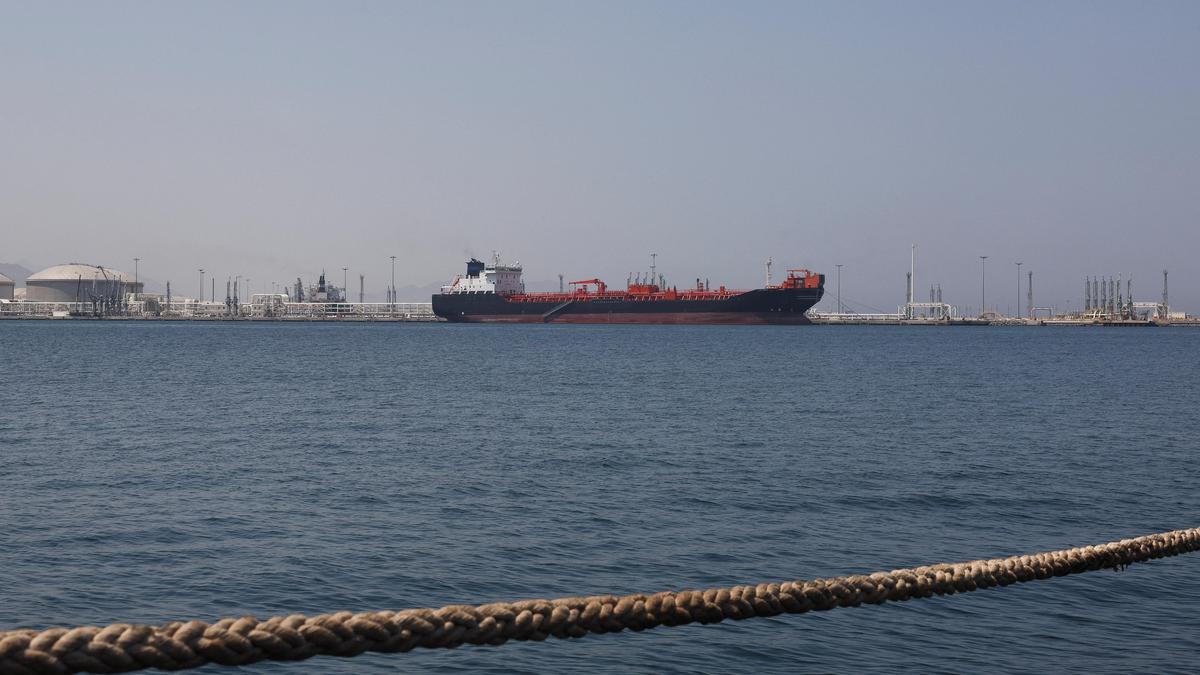
The seizure of a merchant vessel off the coast of the United Arab Emirates by Iranian naval forces represents more than a localized security breach; it is a calculated application of maritime leverage designed to exploit the physical and legal vulnerabilities of global energy supply chains. When a vessel is diverted toward Iranian territorial waters from a position near the Fujairah bunkering hub, the actor is not merely capturing a physical asset. They are stress-testing the international response function and recalibrating the risk premium for every hull operating within the Persian Gulf.
The operational logic of such an intervention rests on three structural pillars: Geographic Chokepoint Dependency, Legal Gray-Zone Maneuvering, and Asymmetric Escalation Dominance.
The Mechanics of Geographic Interdiction
The Strait of Hormuz acts as a singular point of failure for approximately 20% of the world's liquid petroleum consumption. Any kinetic action initiated off the UAE's east coast targets the preamble to this chokepoint.
The logistical reality of the region dictates that vessels must adhere to established Traffic Separation Schemes (TSS). These lanes are narrow, predictable, and geographically constrained. By intercepting a ship in the approach to the Strait, an interdicting force utilizes the "funnel effect."
- Predictability of Pathing: Unlike the open ocean, the Gulf of Oman requires specific headings for safe navigation and depth management. This allows an interceptor to position assets with minimal fuel expenditure and maximum tactical surprise.
- The Proximity of Safe Havens: The distance from the international waters of the Gulf of Oman to the Iranian territorial sea (12 nautical miles) is negligible for high-speed naval craft. Once a vessel is boarded and its bridge controlled, the window for international naval intervention is measured in minutes, not hours.
The cost of defending against this is inherently higher than the cost of execution. A state actor utilizes small, agile Fast Attack Craft (FAC) or Fast Inshore Attack Craft (FIAC). These vessels have a low radar cross-section and can mingle with commercial fishing traffic until the moment of engagement. In contrast, protecting merchant shipping requires sustained destroyer or frigate presence—an expensive, resource-heavy posture that cannot be maintained at a 1:1 ratio for every tanker.
The Legal and Regulatory Kinetic Loop
State-sponsored vessel seizures rarely occur in a vacuum of "piracy." They are almost always framed within a pseudo-legal context to provide diplomatic cover and complicate the decision-making process of Western naval coalitions like IMSC (International Maritime Security Construct).
The legal mechanism usually involves a claimed violation of international maritime law, such as:
- Environmental Non-compliance: Allegations of oil leakage or ballast water discharge.
- Safety of Navigation: Claims that the vessel collided with a local craft or ignored "bridge-to-bridge" radio instructions.
- Debt or Asset Recovery: Framing the seizure as a judicial lien execution related to prior disputes.
By invoking these justifications, the seizing power shifts the burden of proof. The international community is forced to choose between a military counter-escalation—which risks a wider kinetic conflict—or a prolonged legal and diplomatic negotiation. The latter favors the seizing party, as they retain the "physical collateral" (the ship and its cargo) throughout the proceedings.
This creates a Response Bottleneck. If a navy intervenes to stop a "police action" or "regulatory inspection," they risk being labeled the aggressor in international forums. This hesitation is the primary tactical advantage used by Iranian forces during the boarding phase.
Quantifying the Maritime Risk Premium
The immediate impact of a seizure is not found in the loss of the cargo itself, but in the shift of the "War Risk" insurance premiums. Insurance underwriters at Lloyd’s of London and other global hubs calculate premiums based on the frequency and severity of "perils."
When a vessel is seized, the cost function for shipping companies changes instantly:
- Additional Premium (AP): Shipowners must pay a surcharge to enter "listed areas" defined by the Joint War Committee (JWC). A single seizure can lead to a 5% to 15% spike in these costs overnight.
- Hull and Machinery (H&M) Impacts: The risk of permanent asset loss or long-term impoundment increases the "Total Loss" probability in actuarial models.
- Freight Rate Volatility: As shipowners avoid the region or demand higher compensation for the risk, the cost of chartering a vessel rises. This cost is eventually passed to the end consumer, manifesting as energy price inflation.
This is the Macro-Economic Transmission Mechanism. A small-scale naval operation involving twenty personnel and two speedboats can effectively levy a "tax" on global energy markets by manipulating the perceived safety of the Strait of Hormuz.
Technological Asymmetry in Boarding Operations
The physical seizure of a merchant ship involves a specific hierarchy of tactical steps. Modern merchant vessels, despite their size, are remarkably vulnerable to boarding due to their low freeboard (the distance from the waterline to the deck) when fully laden and their limited crew sizes.
The Boarding Vector
Most seizures utilize "Fast Rope" insertions from helicopters or boarding via telescopic ladders from FACs. Merchant crews are trained in "Best Management Practices" (BMP5), which include the use of razor wire, water cannons, and the retreat to a "Citadel" (a hardened, secure room with independent communications).
However, Citadels have a critical flaw: they are designed to outlast pirates who seek a quick ransom, not a state-actor with the time and engineering equipment to breach the door or flood the ventilation system with tear gas. Once the engineering space or the bridge is compromised, the vessel is effectively neutralized.
Signal Interference and AIS Spoofing
Before and during a seizure, the "Electronic Signature" of the event is often manipulated.
- AIS (Automatic Identification System) Manipulation: The seizing party or the vessel itself (under duress) may disable its transponder, making it "dark" to global tracking software.
- GPS Jamming: Localized spoofing can confuse the ship’s navigation, potentially luring it into territorial waters where a seizure is "legally" easier to justify.
The Strategic Recommendation for Maritime Stakeholders
The current security architecture in the Gulf of Oman is reactive. To mitigate the risk of seizure, shipowners and regional security partners must move toward a Distributed Defense Model.
The reliance on large, manned warships is insufficient for the volume of traffic. The second limitation is the lack of "Active Denial" systems on merchant vessels. To alter the cost-benefit analysis of an interdicting force, the following logic must be applied:
- Hardening the Asset: Shipowners should move beyond passive defenses (razor wire) to non-lethal active denial systems, such as Long Range Acoustic Devices (LRAD) and high-intensity strobe systems, to disrupt the boarding phase without escalating to lethal force.
- Redundant Communication Nodes: Vessels must be equipped with burst-transmission satellite systems that are independent of the main bridge power. This ensures that the exact coordinates and video evidence of a boarding are transmitted to international authorities even if the AIS is disabled.
- The Escort-by-Exception Policy: Rather than attempting to escort all vessels, naval forces must use AI-driven anomaly detection to identify "High-Risk Profiles"—ships with specific flags, ownership histories, or cargo types that align with the current geopolitical tension. These vessels should receive priority monitoring via Persistent Organic Surveillance (UAVs).
The shift from merchant vessel to "sovereign hostage" is the defining characteristic of modern maritime friction in the Middle East. Until the international community establishes a credible, automated deterrent that operates below the threshold of full-scale war, the seizure of vessels will remain a low-cost, high-reward tool for regional power projection. Owners must treat maritime security not as a compliance check, but as a dynamic tactical variable that directly dictates the solvency of the voyage.

:max_bytes(150000):strip_icc():focal(819x186:821x188)/Murdaugh-Family-e90854a716884d608fb6fd925e18d840.jpg)
